Astronomers discover ‘Super-Earth’ orbiting Sun’s nearest star

Agencies
November 15, 2018

Paris, Nov 15: A "super-Earth" has been discovered orbiting the closest single star to our Sun, scientists said Wednesday in a breakthrough that could shine a light on Earth's nearest planetary neighbours.

Astronomers studied Barnard's Star, a red dwarf just six light years away -- practically in our back garden, galactically speaking -- and noticed the presence of a "frozen, dimly lit world" at least 3.2 times heavier than Earth.

A handout picture released by the European Southern Observatory (ESO), shows an artist's impression of a 'super-Earth' planet viewed from space.

The planet, known for now as Barnard's Star b, is the second nearest to Earth outside the solar system and orbits its host star once every 233 days.

"It's important because it's really our nextdoor neighbour and we like to meet our neighbours in general," Ignasi Ribas, from the Institute of Space Studies of Cataloniaand Spain's Institute of Space Sciences, told AFP.

Despite being relatively close to its parent star, the planet receives less than two per cent of the energy Earth gets from the Sun, and the team estimates it has a surface temperature of -170 degrees Celsius (-274 Fahrenheit) -- far too cold to support life as we know it.

"It's definitely not in the habitable zone, no liquid water. If it has any water or gas this is probably in solid form so that's why we call it frozen," said Ribas.

In mankind's bid to map the planets in the night sky, most historic research has focused on brighter, newer stars, which produce more light and increase the chances of scientists noticing anything orbiting them.

But since Barnard's Star is a red dwarf, a small and cooling star probably about twice as old as the Sun, it produces relatively little light making it hard to discern any bodies in its orbit.

To find Barnard's Star b, Ribas and the team studied more than 20 years' worth of observations from seven separate instruments.

They then used a phenomenon known as the Doppler effect to track the impact of its gravitational pull on its parent star.

Astronomers can use this technique to measure a planet's velocity and, therefore, mass.

"We have all worked very hard on this breakthrough," said Guillem Anglada Escude, from London's Queen Mary University, who co-authored the study published in the journal Nature.

The team worked with the European Southern Observatory using astronomical instruments so accurate they can detect changes in a star's velocity as small as 3.5 kilometres (2.2 miles) per hour -- a gentle walking pace.

It's thought that Barnard's Star is tearing through space at around 500,000 km/h, making it the fastest-moving known object in the universe.

Ribas said that although stargazers could predict its size and orbit with relative accuracy using the Doppler effect, any attempt at this stage to find out what the new planet looked like would be "guesswork".

"It's sort of in a fuzzy area with respect to its properties. We've seen planets of this mass be rocky, meaning that it could look like Earth with a solid surface with potentially some atmosphere or some frozen layer on top," he said.

"Or it may be what we call a mini-Neptune, like a scaled-down version of the gas giants of our solar system."

It might be cold, inhospitable and all but invisible but the new planet has one thing going for it: it's really close.

The only known exoplanet closer to Earth was discovered in 2016 orbiting one of a cluster of stars in the Alpha Centauri system, just over four light years away.

"There's not so many stars in our immediate neighbourhood. The investment to find them is expensive," said Ribas.

"It's really near and therefore if you have the hope -- like I do -- of eventually seeing these planets to study them in detail we have to start with the immediate ones. It could lead potentially to other discoveries."


Comments

Add new comment

  • Coastaldigest.com reserves the right to delete or block any comments.
  • Coastaldigset.com is not responsible for its readers’ comments.
  • Comments that are abusive, incendiary or irrelevant are strictly prohibited.
  • Please use a genuine email ID and provide your name to avoid reject.
News Network
November 22,2025

gaza.jpg

The Israeli regime’s forces have killed two Palestinian children in the Gaza Strip every day since the ceasefire began in early October, UNICEF has warned.

The UN children’s agency said on Friday that Israeli forces continue to attack Palestinians in Gaza even though the agreement was meant to stop the killing.

“Since 11 October, while the ceasefire has been in effect, at least 67 children have been killed in conflict-related incidents in the Gaza Strip. Dozens more have been injured. That is an average of almost two children killed every day since the ceasefire took effect,” UNICEF spokesperson Ricardo Pires said in Geneva, reminding that each number in the statistics represents a child whose life had ended violently.

“These are not statistics,” he said. “Each child had a story, a family, and a future that was stolen from them.”

Data from Palestinian factions, human rights groups, and government bodies recorded since the US-brokered ceasefire deal went into effect on October 10 show that Israeli forces have carried out numerous attacks, each constituting a separate ceasefire violation.

UNICEF teams say they repeatedly continue to witness heart-wrenching scenes of fearful Palestinian children sleeping outdoors with amputated limbs, while others live as orphans in flooded, makeshift shelters.

“I saw this myself in August. There is no safe place for them. The world cannot normalize their suffering,” Pires said, lamenting that the UN could “do a lot more if the aid that is really needed was entering faster.”

The UNICEF spokesperson warned that with the advent of winter, the risks for hundreds of thousands of displaced children will increase.

He warned, “The stakes are incredibly high” for children as winter acts as a threat multiplier, where children have no heating, no insulation, and few blankets. He said respiratory infections rise.

“Too many children have already paid the highest price,” Pires said. “Too many are still paying it, even under a ceasefire. The world promised them it would stop and that we would protect them.”

“Now we must act like it,” the UNICEF spokesperson added.

Since the Israeli regime launched its genocidal war against Palestinians in Gaza in October 2023, it has killed nearly 70,000 people in the territory, most of them women and children, and injured over 170,000 more, while reducing most of the structures in the enclave to rubble.

Comments

Add new comment

  • Coastaldigest.com reserves the right to delete or block any comments.
  • Coastaldigset.com is not responsible for its readers’ comments.
  • Comments that are abusive, incendiary or irrelevant are strictly prohibited.
  • Please use a genuine email ID and provide your name to avoid reject.
coastaldigest.com news network
December 2,2025

karkala.jpg

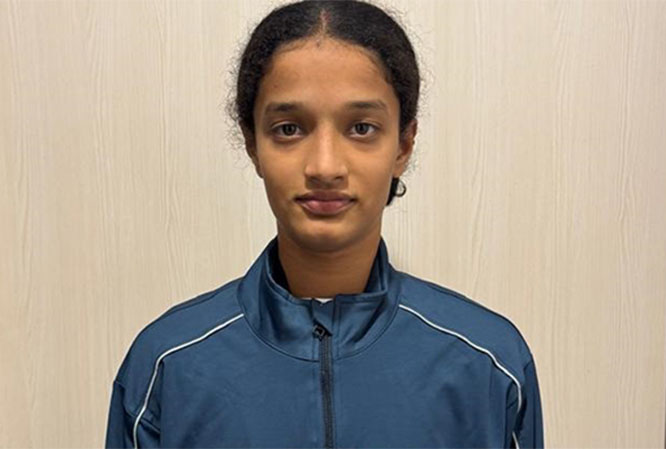
Udupi, Dec 2: A wave of regional pride is sweeping through Udupi district as Shagun S Verma Hegde, a talented Class 9 student from Christ King English Medium High School, Karkala, has been named the captain of the Indian National Team for the Under-15 Girls’ Volleyball Championship.

Shagun holds the unique distinction of being the sole player from Karnataka selected to represent the country in the prestigious international tournament. The championship, organized by the School Games Federation, is scheduled to take place in Shangluo, China, from December 3 to 13, where Shagun will lead the national squad.

A Remarkable Journey to the Top

Shagun’s selection is a testament to her dedication and exceptional skill on the court. Her journey included several rigorous rounds of selection:

•    She was the only player from Udupi district to qualify for the state-level selection camp.

•    Out of eight players from Karnataka who advanced to the national selection camp in Pune, Maharashtra, Shagun was the only one to secure a place in the final national squad.

•    The national camp saw participation from approximately 200 players, which was shortlisted to 23. Shagun not only made the final cut but was also ranked as the second-best player overall, solidifying her leadership role.

Shagun, who is the daughter of Sandesh Verma and Shruthiraj of Kallotte, Karkala, has trained under experienced coaches Santosh D’Souza, Jeevan D’Silva, Jairaj Poojary, and Ramesh. Her selection as the team captain has brought profound honour to her family, school, the Udupi district, and the entire state of Karnataka.

Comments

Add new comment

  • Coastaldigest.com reserves the right to delete or block any comments.
  • Coastaldigset.com is not responsible for its readers’ comments.
  • Comments that are abusive, incendiary or irrelevant are strictly prohibited.
  • Please use a genuine email ID and provide your name to avoid reject.
News Network
December 2,2025

A major upgrade in safety and monitoring is planned for Haj 2026, with every Indian pilgrim set to receive a Haj Suvidha smart wristband linked to the official Haj Suvidha mobile app. The initiative aims to support pilgrims—especially senior citizens—who may struggle with smartphones during the 45-day journey.

What the Smart Wristband Will Do

Officials said the device will come with:
•    Location tracking
•    Pedometer
•    SOS emergency button
•    Qibla compass
•    Prayer timings
•    Basic health monitoring

SP Tiwari, secretary of the UP State Haj Committee, said the goal is to make the pilgrimage safer and more comfortable.

“Most Hajis are elderly and not comfortable with mobile apps,” he said. “The smartwatch will help locate pilgrims who forget their way or cannot communicate their location.”

The wristbands will be monitored by the Consulate General of India in Saudi Arabia, similar to mobile tracking via the Haj Suvidha App.

Free Distribution and Training

•    Smart wristbands will be given free of cost.
•    Training for pilgrims will be conducted between January and February 2026.
•    Sample units will reach state Haj committees soon.
•    Final devices will be distributed as pilgrims begin their journey.

New Rules for Accommodation

Two major decisions have also been finalised for Haj 2026:
1.    Separate rooms for men and women – including married couples. They may stay on the same floor but must occupy different rooms, following stricter Saudi guidelines.
2.    Cooking banned – gas cylinders will not be allowed; all meals will be provided through official catering services arranged by the Haj Committee of India.

These decisions were finalised during a meeting of the Haj Committee of India and state representatives in Mumbai.

Haj Suvidha App Launched Earlier

The government launched the Haj Suvidha App in 2024, offering:

•    Training modules
•    Accommodation and flight details
•    Baggage information
•    SOS and translation tools
•    Grievance redressal

Haj 2026 Quota and Key States

•    India’s total Haj quota for 2026: 1,75,025 pilgrims
•    70% (1,25,000) allotted to the Haj Committee of India
•    30% (around 50,000) reserved for Haj Group Organisers

Uttar Pradesh has the largest allocation (around 30,000 seats), though approximately 18,000 pilgrims are expected to go this year. States with high pilgrim numbers include Kerala, Maharashtra and Gujarat.

Dates of Haj 2026

The pilgrimage is scheduled to take place from 24 May to 29 May, 2026 (tentative).
Haj is one of the five pillars of Islam and is mandatory for Muslims who meet the required conditions.

Comments

Add new comment

  • Coastaldigest.com reserves the right to delete or block any comments.
  • Coastaldigset.com is not responsible for its readers’ comments.
  • Comments that are abusive, incendiary or irrelevant are strictly prohibited.
  • Please use a genuine email ID and provide your name to avoid reject.