Babri mosque dispute: Key litigants not part of final hearing

Agencies
December 5, 2017

Ayodhya, Dec 5: The key litigants in the 25-year-old Ram Janmabhoomi-Babri Masjid dispute will not be part of the final proceedings in the Supreme Court.

The reached the local court in 1949 when Mahant Ramchandradas Paramhans approached it for allowing 'darshan and pujan' (worshipping and paying obeisance) to Ram Lalla.

In the same city, Hashim Ansari also approached the court for removing Lord Rama's statue from the Babri mosque.

While Mahant Paramhans died on July 20, 2003, Ansari died in July 2016.

As the Supreme Court takes up the final hearing, both of them will be missed, said local resident Mohammad Idris.

Ansari was a witness when idols of Ram Lalla appeared at the Babri Masjid site on the night of December 22, 1949.

He was the first to file the suit in the court of civil judge of Faizabad against the "illegal encroachment of Masjid by the Hindu Mahasabha".

With Ansari's death, an era in the Ayodhya dispute ended as he was a witness to "placing of Idols in Babri Masjid in 1949", unlocking of the disputed structure for the worship of Ram Lalla as per a court's order in 1987, demolition of the mosque in 1992 and division of the disputed land into three parts by the Lucknow High Court in 2010.

He also became the first plaintiff in the Supreme Court in 2011.

Another known figure in courts was Mahant Bhaskar Das, the chief litigant in the case and the chief priest of the Nirmohi Akhada in Ayodhya.

The Nirmohi Akhada priest had filed a claim for the ownership of Ram Janmaboomi in 1959.

Apart from being the Nirmohi Akhada sarpanch, he was the mahant of the Naka Hanuman Garhi in the temple town.

In 1959, Nirmohi Akhada's mahant Raghunath Das filed a case laying claims over Ram Janmabhoomi.

At that time, Bhaskar Das, who was in charge of rituals at Ram Chabutra on the premises, too, joined the case and filed the claim.

After the Lucknow bench of the Allahabad High Court gave a verdict in the case on September 30, 2010, Bhaskar Das filed a petition in the Supreme Court for ownership of the entire premises. Bhaskar died in September.

Vishwa Hindu Parishad (VHP) leader Ashok Singhal, who died in 2015, was considered architect of the Ram temple movement. In the 1980s Singhal became a symbol of the Ayodhya movement.

Singhal was sent to the VHP by the then RSS chief Bala Saheb Deoras in 1981.

He had launched the Ram Janki Rath Yatra in 1985 and had demanded the opening of the locks at Ram Janmabhoomi.

While the opening of the locks was ordered by the local Faizabad court, Singhal launched a movement to build a temple.

Though the matter is sub judice, these key figures and their roles will always be noted in their respective camps.


Comments

Add new comment

  • Coastaldigest.com reserves the right to delete or block any comments.
  • Coastaldigset.com is not responsible for its readers’ comments.
  • Comments that are abusive, incendiary or irrelevant are strictly prohibited.
  • Please use a genuine email ID and provide your name to avoid reject.
News Network
December 6,2025

pilot.jpg

New Delhi: IndiGo, India’s largest airline, faced major operational turbulence this week after failing to prepare for new pilot-fatigue regulations issued by the Directorate General of Civil Aviation (DGCA). The stricter rules—designed to improve flight safety—took effect in phases through 2024, with the latest implementation on November 1. IndiGo has acknowledged that inadequate roster planning led to widespread cancellations and delays.

Below are the key DGCA rules that affected IndiGo’s operations:

1. Longer Mandatory Weekly Rest

Weekly rest for pilots has been increased from 36 hours to 48 hours.

The government says the extended break is essential to curb cumulative fatigue. This rule remains in force despite the current crisis.

2. Cap on Night Landings

Pilots can now perform only two night landings per week—a steep reduction from the earlier limit of six.

Night hours, defined as midnight to early morning, are considered the least alert period for pilots.

Given the disruptions, this rule has been temporarily relaxed for IndiGo until February 10.

3. Reduced Maximum Night Flight Duty

Flight duty that stretches into the night is now capped at 10 hours.

This measure has also been kept on hold for IndiGo until February 10 to stabilize operations.

4. Weekly Rest Cannot Be Replaced With Personal Leave

Airlines can no longer count a pilot’s personal leave as part of the mandatory 48-hour rest.

Pilots say this closes a loophole that previously reduced actual rest time.

Currently, all airlines are exempt from this rule to normalise travel.

5. Mandatory Fatigue Monitoring

Airlines must submit quarterly fatigue reports along with corrective actions to DGCA.

This system aims to create a transparent fatigue-tracking framework across the industry.

The DGCA has stressed that these rules were crafted to strengthen flight safety and align India with global fatigue-management standards. The temporary relaxations are expected to remain until February 2025, giving IndiGo time to stabilise its schedules and restore normal air travel.

Comments

Add new comment

  • Coastaldigest.com reserves the right to delete or block any comments.
  • Coastaldigset.com is not responsible for its readers’ comments.
  • Comments that are abusive, incendiary or irrelevant are strictly prohibited.
  • Please use a genuine email ID and provide your name to avoid reject.
News Network
December 7,2025

envoy.jpg

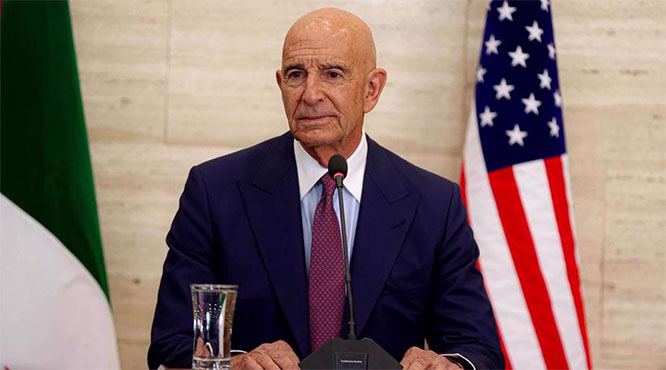
Since 1946, the United States has attempted 93 coups or “regime change” operations across the world — including two in Iran, US Special Envoy for Syria Tom Barrack has admitted.

Speaking to the UAE-based IMI Media Group, in remarks published by The National, Barrack said Washington tried twice to overthrow the Iranian government but failed both times. 

“For (Trump) then to be imputed with regime change — we had two regime changes in Iran already. Neither one worked. So I think wisely leave it to the region to solve,” said Barrack, who also serves as the US ambassador to Turkey.

His comments come six months after the US joined Israel in airstrikes against Iran during ongoing indirect nuclear negotiations between Tehran and Washington.

On June 13, Israel launched an attack on Iran that killed at least 1,064 people and hit civilian infrastructure. Days later, the United States targeted three nuclear facilities — Fordow, Natanz and Isfahan — in what Iran called a clear violation of international law. Iranian retaliation eventually forced a halt to the assault on June 24.

Barrack further claimed that US President Donald Trump and Foreign Secretary Marco Rubio are “not into regime change” and prefer a regional approach driven by Middle Eastern countries themselves. According to him, regional dialogue and non-interference by outside powers offer a more durable path forward.

He added that Washington is still open to an agreement with Tehran if Iranian authorities show “seriousness” and willingness to engage constructively.

However, Iran maintains the US has not shown readiness for meaningful talks. In an interview with Japan’s Kyodo News, Iranian Foreign Minister Abbas Araghchi said negotiations could advance only if Washington acknowledges Iran’s right to peaceful nuclear energy and lifts unilateral sanctions.

Comments

Add new comment

  • Coastaldigest.com reserves the right to delete or block any comments.
  • Coastaldigset.com is not responsible for its readers’ comments.
  • Comments that are abusive, incendiary or irrelevant are strictly prohibited.
  • Please use a genuine email ID and provide your name to avoid reject.
News Network
December 2,2025

Puttur: The long-cherished dream of a government medical college in Puttur has moved a decisive step closer to reality, with the Karnataka State Finance Department granting its official approval for the construction of a new 300-bed hospital.

Puttur MLA Ashok Kumar Rai announced the crucial development to reporters on Monday, confirming that the official communication from the finance department was issued on November 27. This 300-bed facility is intended to be the cornerstone for the establishment of the government medical college, a project announced in the state budget.

Fast-Track Implementation

The MLA outlined an aggressive timeline for the project:

•    A Detailed Project Report (DPR) for the hospital is expected to be ready within 45 days.

•    The tender process for the construction will be completed within two months.

Following the completion of the tender process, Chief Minister Siddaramaiah is scheduled to lay the foundation stone for the project.

"Setting up a medical college in Puttur is a historical decision by the Congress government in Karnataka," Rai stated. The project has an estimated budget allocation of Rs 1,000 crore for the medical college.

Focus on Medical Education Department

The MLA highlighted a key strategic move: requesting the government to implement the hospital construction through the Medical Education Department instead of the Health and Family Welfare Department. This is intended to streamline the entire process of establishing the full medical college, ensuring the facilities—including labs, operation theatres, and other necessary infrastructure—adhere to the strict guidelines set by the Medical Council of India (MCI). The proposed site for the project is in Bannur.

Rai also took the opportunity to address political criticism, stating that the government has fulfilled its promise despite "apprehensions" and "mocking and criticising" from opposition parties who had failed to take similar initiatives when they were in power. "Chief Minister Siddaramaiah has kept his word," he added.

Comments

Add new comment

  • Coastaldigest.com reserves the right to delete or block any comments.
  • Coastaldigset.com is not responsible for its readers’ comments.
  • Comments that are abusive, incendiary or irrelevant are strictly prohibited.
  • Please use a genuine email ID and provide your name to avoid reject.