



Cash crunch: ATMs are running dry across India; government says needs three days to fix problem

Agencies
April 17, 2018

New Delhi, Apr 17: ATMs in several cities across the country, operated by both state-run and private banks, are reportedly running dry. The problem seems to have affected ATMs in cities and towns across Andhra Pradesh, Telangana, Karnataka, Madhya Pradesh, Maharashtra, Rajasthan and Uttar Pradesh, according to media reports.

One reason for this could be that cash withdrawals at some bank branches and their ATMs are much higher than deposits made at those branches.

An email sent to the Reserve Bank of India (RBI), on Tuesday, seeking response on the reported cash shortage, remained unanswered when this report was published.

Commenting on the cash crunch, Finance Minister Arun Jaitley assured hassled customers that the government will resolve the problem 'quickly'. Minister of State (MoS) for Finance SP Shukla said the Centre needs three days to fix the problem. Separately, State Bank of India (SBI) Chairman Rajnish Kumar told CNBC-TV18 that there is sufficient cash in the system.

Troubled customers tweeted about the non availability of cash at ATMs.

West Bengal Chief Minister Mamata Banerjee, on Tuesday, said the situation reminded her of the demonetisation days.

Communist Party of India member Sitaram Yechury too took to twitter to express his angst.

MoS for Finance Shiv Pratap Shukla said: "We've cash currency of Rs 1,25,000 crore right now. There is one problem that some states have less currency and others have more. Government has formed state-wise committee and RBI also formed committee to transfer currency from one state to other. It will be done in three days."

Earlier, referring to reports of ATMs running out of cash at some places in his state, Madhya Pradesh Chief Minister Shivraj Singh Chouhan claimed that Rs 2,000 notes were vanishing from the market, and alleged that there is a 'conspiracy' behind their disappearance. Addressing a farmers' convention, Chouhan said: "The currency worth Rs 15,00,000 crore was in circulation before demonetisation. After this exercise [demonetisation], the currency in circulation increased to Rs 16,50,000 crore. But notes of Rs 2,000 are missing from the market."

Several states have faced cash shortages despite the fact that currency flows are now at the pre-demonetisation level. A recent analysis by the RBI has found that the rate of cash withdrawals were far more than cash deposits at banks in states like Andhra Pradesh, Bihar, Karnataka, Maharashtra, Rajasthan, Uttar Pradesh, Madhya Pradesh, and Telangana, according to a report.

According to RBI data, currency in circulation as on 6 April was Rs 18.17 lakh crore.

Bank run

In March, the government's Financial Resolution and Deposit Insurance (FRDI) bill triggered a bank run in two southern states. Thanks to a fear of losing their hard earned money, because of a bail-in clause in the FRDI Bill, people in Andhra Pradesh and Telangana queued up to withdraw fairly large amounts from their bank accounts. The salaried, who typically withdraw only Rs 5,000 to Rs 10,000 in the first few weeks of any month, were seen queuing up to draw the entire amount from ATMs immediately after their salary was credited.

ATMs ran dry immediately after the demonetisation drive was announced, on 8 November, 2016, as people rushed to pull out as much cash as possible.

Comments

Add new comment

  • Coastaldigest.com reserves the right to delete or block any comments.
  • Coastaldigset.com is not responsible for its readers’ comments.
  • Comments that are abusive, incendiary or irrelevant are strictly prohibited.
  • Please use a genuine email ID and provide your name to avoid reject.
News Network
December 4,2025

Mangaluru: Chaos erupted at Mangaluru International Airport (MIA) after IndiGo flight 6E 5150, bound for Mumbai, was repeatedly delayed and ultimately cancelled, leaving around 100 passengers stranded overnight. The incident highlights the ongoing country-wide operational disruptions affecting the airline, largely due to the implementation of new Flight Duty Time Limitations (FDTL) norms for crew.

The flight was initially scheduled for 9:25 PM on Tuesday but was first postponed to 11:40 PM, then midnight, before being cancelled around 3:00 AM. Passengers expressed frustration over last-minute communication and the lack of clarity, with elderly and ailing travellers particularly affected. “Though the airline arranged food, there was no proper communication, leaving us confused,” said one family member.

An IndiGo executive at MIA cited the FDTL rules, designed to prevent pilot fatigue by limiting crew working hours, as the cause of the cancellation. While alternative arrangements, including hotel stays, were offered, about 100 passengers chose to remain at the airport, creating tension. A replacement flight was arranged but also faced delays due to the same constraints, finally departing for Mumbai around 1:45 PM on Wednesday. Passengers either flew, requested refunds, or postponed their travel.

The Mangaluru delay is part of a broader crisis for IndiGo. The airline has been forced to make “calibrated schedule adjustments”—a euphemism for widespread cancellations and delays—after stricter FDTL norms came into effect on November 1.

While an IndiGo spokesperson acknowledged unavoidable flight disruptions due to technology issues, operational requirements, and the updated crew rostering rules, the DGCA has intervened, summoning senior airline officials to explain the chaos and outline corrective measures.

The ripple effect has been felt across the country, with major hubs like Bengaluru and Mumbai reporting numerous cancellations. The Mangaluru incident underscores the systemic operational strain currently confronting India’s largest carrier, leaving passengers nationwide grappling with uncertainty and delays.

Comments

Add new comment

  • Coastaldigest.com reserves the right to delete or block any comments.
  • Coastaldigset.com is not responsible for its readers’ comments.
  • Comments that are abusive, incendiary or irrelevant are strictly prohibited.
  • Please use a genuine email ID and provide your name to avoid reject.
News Network
December 2,2025

A major upgrade in safety and monitoring is planned for Haj 2026, with every Indian pilgrim set to receive a Haj Suvidha smart wristband linked to the official Haj Suvidha mobile app. The initiative aims to support pilgrims—especially senior citizens—who may struggle with smartphones during the 45-day journey.

What the Smart Wristband Will Do

Officials said the device will come with:
•    Location tracking
•    Pedometer
•    SOS emergency button
•    Qibla compass
•    Prayer timings
•    Basic health monitoring

SP Tiwari, secretary of the UP State Haj Committee, said the goal is to make the pilgrimage safer and more comfortable.

“Most Hajis are elderly and not comfortable with mobile apps,” he said. “The smartwatch will help locate pilgrims who forget their way or cannot communicate their location.”

The wristbands will be monitored by the Consulate General of India in Saudi Arabia, similar to mobile tracking via the Haj Suvidha App.

Free Distribution and Training

•    Smart wristbands will be given free of cost.
•    Training for pilgrims will be conducted between January and February 2026.
•    Sample units will reach state Haj committees soon.
•    Final devices will be distributed as pilgrims begin their journey.

New Rules for Accommodation

Two major decisions have also been finalised for Haj 2026:
1.    Separate rooms for men and women – including married couples. They may stay on the same floor but must occupy different rooms, following stricter Saudi guidelines.
2.    Cooking banned – gas cylinders will not be allowed; all meals will be provided through official catering services arranged by the Haj Committee of India.

These decisions were finalised during a meeting of the Haj Committee of India and state representatives in Mumbai.

Haj Suvidha App Launched Earlier

The government launched the Haj Suvidha App in 2024, offering:

•    Training modules
•    Accommodation and flight details
•    Baggage information
•    SOS and translation tools
•    Grievance redressal

Haj 2026 Quota and Key States

•    India’s total Haj quota for 2026: 1,75,025 pilgrims
•    70% (1,25,000) allotted to the Haj Committee of India
•    30% (around 50,000) reserved for Haj Group Organisers

Uttar Pradesh has the largest allocation (around 30,000 seats), though approximately 18,000 pilgrims are expected to go this year. States with high pilgrim numbers include Kerala, Maharashtra and Gujarat.

Dates of Haj 2026

The pilgrimage is scheduled to take place from 24 May to 29 May, 2026 (tentative).
Haj is one of the five pillars of Islam and is mandatory for Muslims who meet the required conditions.

Comments

Add new comment

  • Coastaldigest.com reserves the right to delete or block any comments.
  • Coastaldigset.com is not responsible for its readers’ comments.
  • Comments that are abusive, incendiary or irrelevant are strictly prohibited.
  • Please use a genuine email ID and provide your name to avoid reject.
News Network
December 7,2025

envoy.jpg

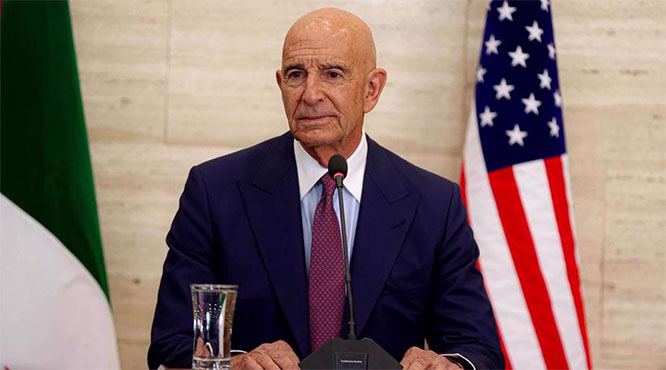
Since 1946, the United States has attempted 93 coups or “regime change” operations across the world — including two in Iran, US Special Envoy for Syria Tom Barrack has admitted.

Speaking to the UAE-based IMI Media Group, in remarks published by The National, Barrack said Washington tried twice to overthrow the Iranian government but failed both times. 

“For (Trump) then to be imputed with regime change — we had two regime changes in Iran already. Neither one worked. So I think wisely leave it to the region to solve,” said Barrack, who also serves as the US ambassador to Turkey.

His comments come six months after the US joined Israel in airstrikes against Iran during ongoing indirect nuclear negotiations between Tehran and Washington.

On June 13, Israel launched an attack on Iran that killed at least 1,064 people and hit civilian infrastructure. Days later, the United States targeted three nuclear facilities — Fordow, Natanz and Isfahan — in what Iran called a clear violation of international law. Iranian retaliation eventually forced a halt to the assault on June 24.

Barrack further claimed that US President Donald Trump and Foreign Secretary Marco Rubio are “not into regime change” and prefer a regional approach driven by Middle Eastern countries themselves. According to him, regional dialogue and non-interference by outside powers offer a more durable path forward.

He added that Washington is still open to an agreement with Tehran if Iranian authorities show “seriousness” and willingness to engage constructively.

However, Iran maintains the US has not shown readiness for meaningful talks. In an interview with Japan’s Kyodo News, Iranian Foreign Minister Abbas Araghchi said negotiations could advance only if Washington acknowledges Iran’s right to peaceful nuclear energy and lifts unilateral sanctions.

Comments

Add new comment

  • Coastaldigest.com reserves the right to delete or block any comments.
  • Coastaldigset.com is not responsible for its readers’ comments.
  • Comments that are abusive, incendiary or irrelevant are strictly prohibited.
  • Please use a genuine email ID and provide your name to avoid reject.