
The Idea of Students' Development

Muhammad Abdullah Javed
September 14, 2023

sudents.jpg

The true essence of educational process is that it continues with sustained progress and ends up with holistic development. In the pursuit of students’ progress, we often evaluate their performance with emphasis on improved test and exam results. However, in reality, the educational journey that students embark ultimately demands their comprehensive development, of which performance in exams is just one aspect. If one fails to recognise the other aspects of this process, students may in the long-run appear to be ill-equipped to solve their own problems. The proper utilization of their inbuilt soft skills may not always be possible to them. Therefore, focussing on the overall development of students becomes essential. This involves nurturing students, by cementing their growing age at the school premises, to emerge with abundant energy and enthusiasm to face the world. Students' comprehensive development can be of three dimensions: academic, moral, and social.

1) Academic Development

By academic development we mean (a) knowledge-enhancement (b) excellence and (c) knowledge-application.

(a) Knowledge: With the gradual advancement of the classes, students must expand their knowledge base. Students should not be seen as vessels for storing information; instead, they should embody the true essence of education. Else, there remain no distinction between a machine and a human being. The topics taught in any subject are brimming with information. When a teacher succeeds in transforming this information into understanding through effective teaching methods, it becomes knowledge that retains in students' memories for longer periods. Therefore, classroom lectures should not be restricted to the mere transmission of information; rather, they should be imbued with the art of transforming information into knowledge. As a result, students will grasp the essence of conceptual understanding, cultivate a culture of healthy argument and develop critical thinking skills.

(b) Excellence: The knowledge acquired through gradual process exerts a vigorous impact and enables students to excel in whatever they do. Therefore, focusing solely on scoring marks can impede their pursuit of excellence. This needs to be taught and should be considered as a parameter to gauge students' performance. From maintaining a decent physical appearance to excelling in both academic and non-academic activities, all aspects need to be in view to make excellence a synonymous with their persona.

(c) Application: The pragmatic approach towards acquired knowledge is pivotal when considering its beneficial aspects. Often, this aspect remains veiled from students, as at times they encounter difficulties in applying the knowledge they have acquired over the years. The knowledge-application aspect serves to identify the authenticity of education and paves the way for improvisation of teaching and learning methodologies. Knowledge acquired with excellence must be synchronized with its practical application. This enables students to know various answers to the question: What can students actually do with the knowledge they gain in every class?

2) Moral Development

The process of moral development for students is like teaching them how the wings of birds enable them to fly and soar high in the skies. The flip side of excellent performance is high moral standards. This implies that students have two sides: one sports their academic performance, and the other reflects their high moral standards. The moral development also has three prong prerequisites: 

(a) Self-awareness: The process of moral development begins with self-awareness. When students know who they are, the rest follows in accordance with their understanding. It sets them on untiring and exemplary journey towards excellence. By self-awareness we mean enabling students recognize their strengths and weaknesses and empowering them with the ability to enhance their strengths and overcome their weaknesses.

(b) Righteous deeds: It can serve as a parameter of one's moral character. The extension of being in good conduct involves performing good deeds. It's about benefiting others, lending a helping hand, speaking the truth, and even a simple smiling gesture….all have the power to exert a positive impact on others.

(c) Duty towards fellow being: It is the natural extension of moral deeds; it involves recognizing one’s obligation to others. The pinnacle of morality is when the people in one's vicinity benefit from either words or deeds. Morality can be summarized as 'loving for others what one loves for oneself. These shades of morality can be summarized as spirituality with the aid of which a person finds proximity with the God.

3) Social Development

Socializing students means synchronizing them with their surroundings. Every aspect, whether related to themselves, their homes, or society, has enormous potential for their educational and moral development. Socially aware students always fall under our jurisdiction. This jurisdiction doesn't rely solely on the four walls of an institution; rather, the entire city where students live becomes a kind of virtual school. Students perceive their surroundings in the way we guide them. When they leave their homes, they view every nook and corner and the surroundings through our perspectives. The influence of the school extends far beyond its physical walls, and the teaching and training process begins the moment students leave their homes.

This socialization requires a mentality of owning everything. Every person is connected to them. From the executives living in high-rise buildings to the individuals residing in small localities, to the beggars who extend their hands to earn a livelihood, all are interconnected with them in one way or another. This owning mentality helps students adopt realistic perspective. The high-rise executives can inspire them to dream big, while the beggars can motivate them to step forward and address this social evil. Their vision will be inclusive of a mission of serving people, and their earnings will be dedicated to the well-being of others through selfless service. This way, the dearth of highly qualified and educated individuals in small villages can be mitigated. This approach can encourage students to consider constructing their societies and actively contribute to the progress of the country in all spheres.

This idea of students’ development can help us make our teaching and learning system more efficient and foster a competitive spirit among both students and teachers alike.

The author is the Director of AJ Academy for Research and Development, Raichur. [email protected] 

Comments

Zaheer Ahmed
 - 
Saturday, 16 Sep 2023

Very well written article and very informative. Covered the topics in all the aspects and dimensions...

Add new comment

  • Coastaldigest.com reserves the right to delete or block any comments.
  • Coastaldigset.com is not responsible for its readers’ comments.
  • Comments that are abusive, incendiary or irrelevant are strictly prohibited.
  • Please use a genuine email ID and provide your name to avoid reject.
P A Hameed Padubidri
November 26,2025

CD.jpg

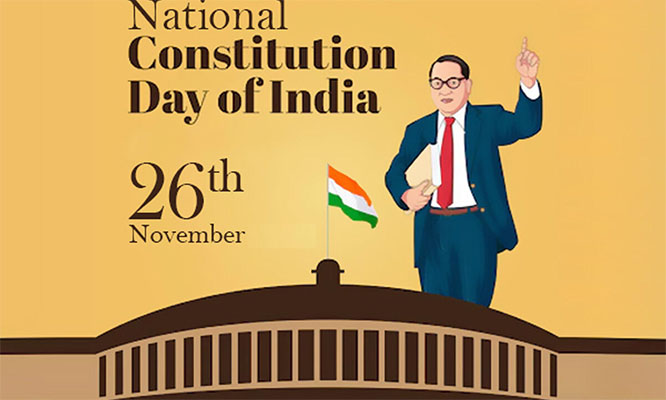
Constitution Day, also known as Samvidhan Divas, is observed every year on November 26 to honor the adoption of the Constitution of India and to recognize the visionary effort that shaped the world’s largest democracy.

Historical Background

It’s on November 26, 1949, the Constituent Assembly of India formally adopted the Constitution.This date is commemorated to acknowledge the completion of nearly three years of drafting, debate, and refinement.

On January 26, 1950, the Constitution came into force, marking India’s transition from a dominion to a sovereign republic.

The date 26 January was chosen to honor the “Purna Swaraj” declaration made in 1930 that marked the relentless efforts & sacrifices of the many. 

Why Constitution Day is Celebrated

* To honor & remember the framers of the Constitution, especially Dr. B. R. Ambedkar, the Chairman of the Drafting Committee, & many others. 

* To remind the citizens of the values, responsibilities, and rights enshrined in the Constitution.

* To promote constitutional values & literacy among students, institutions, and the general public.

* To reaffirm the nation’s commitment to justice, equality, liberty, fraternity and secular values. 

Vision and Significance of the Constitution

It establishes the fundamental political and legal framework for the nation.

Defines the structure, powers and functions of:
    •    The Executive
    •    The Legislature
    •    The Judiciary
    •    Guarantees a comprehensive set of Fundamental Rights, including:

-Equality before law
-Freedom of speech & expression
-Protection of life and personal liberty
-Freedom of religion
-Embeds Directive Principles of State Policy, guiding governance toward social justice and welfare.
-Introduces Fundamental Duties to ensure civic responsibility among citizens.

Key Features Celebrated on Constitution Day

-The Indian constitution is considered one of the longest written constitutions of the world. It’s systematically drafted considering almost all aspects that properly fits to the country. 

-Blend of multiple global constitutional principles while staying rooted in Indian values and realities.

-Framework that balances Federalism, Secularism, Democracy and Rule of Law. This makes everyone-from President to common man-below the law & are equal in the sight of law. 

-Another feature is that it’s based on built-in mechanisms for amendments, ensuring the Constitution grows with changing needs.

Message of the Day

The core ethos of this  Constitution Day is not merely about looking back at history-it’s a reminder of the continuous duty to protect democratic values, respect diversity and uphold the principles that define India as a sovereign, socialist, secular and democratic republic.

Happy Constitution Day to all my compatriots

Comments

Add new comment

  • Coastaldigest.com reserves the right to delete or block any comments.
  • Coastaldigset.com is not responsible for its readers’ comments.
  • Comments that are abusive, incendiary or irrelevant are strictly prohibited.
  • Please use a genuine email ID and provide your name to avoid reject.
News Network
November 29,2025

DKSsiddu.jpg

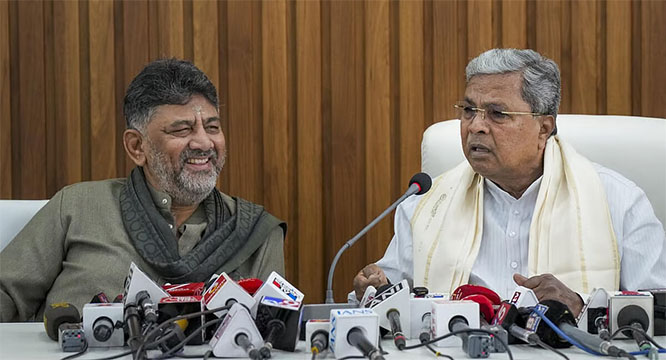
New Delhi: Karnataka chief minister Siddaramaiah and deputy CM DK Shivakumar on Saturday put up a dramatic display of unity at a closely watched joint press briefing, firmly dismissing weeks of speculation about a power-sharing tussle within the Congress. With the high command nudging both leaders to sit together and settle the dust, the meeting became a political spectacle, ending with the duo declaring that there was “no confusion, no differences.”

Calling the reports of a rift “manufactured confusion,” Siddaramaiah said the talks had gone smoothly, even joking about their breakfast. “Breakfast was very good. All three of us enjoyed it,” he said. “We want to end this confusion once and for all. For local elections and for 2028, our mission is clear — Congress must return to power. There is no difference between me and DKS, not now, not before.”

He blamed the media for fuelling rumours and reiterated absolute adherence to the party leadership. “From tomorrow, let there be no confusion. What the high command says, we will follow.”

Siddaramaiah also assured that the Assembly session starting December 8 would run smoothly and vowed that Congress would take on the BJP and JD(S) “together.”

Shivakumar echoed the chief minister word for word, stressing loyalty and discipline. “People have given us a massive mandate. It is our duty to deliver,” he said. “This government was formed under Siddaramaiah’s leadership. We both have complete trust in the high command. If they tell me to wait, I will wait.”

He added that the two leaders had discussed strategy for the 2028 Assembly elections. “Whatever the CM says, I agree. We are loyal soldiers of the party. The party may be facing challenges nationally, but we will keep it strong in Karnataka.”

Shivakumar also said Siddaramaiah would soon visit his home for lunch or dinner — another symbolic gesture meant to underline their unity.

Both leaders later posted on social media describing the breakfast meeting as “productive” and focused on “Karnataka’s priorities.”

The BJP, however, rejected the show of camaraderie as “pure bunkum,” accusing Congress of trying to paper over an internal power struggle. But Siddaramaiah and Shivakumar insisted their united front would continue — and that there was “no confusion” within the state leadership.

Comments

Add new comment

  • Coastaldigest.com reserves the right to delete or block any comments.
  • Coastaldigset.com is not responsible for its readers’ comments.
  • Comments that are abusive, incendiary or irrelevant are strictly prohibited.
  • Please use a genuine email ID and provide your name to avoid reject.
News Network
November 30,2025

The United Nations Committee against Torture (CAT) has condemned the Israeli regime for enforcing a policy of “organized torture” against Palestinians.

In a report published on Friday, CAT stated that the occupying regime enforces a deliberate policy of “organized and widespread torture and ill-treatment” against Palestinian abductees, particularly since October 7, 2023, when Israel launched its genocidal war on Gaza.

The committee expressed “deep concern over repeated severe beatings, dog attacks, electrocution, water-boarding, use of prolonged stress positions [and] sexual violence” inflicted on Palestinians.

Palestinian prisoners were degraded by “being made to act like animals or being urinated on,” systematically denied medical care, and subjected to excessive restraints, “in some cases resulting in amputation,” the report added.

CAT also condemned the routine application of “unlawful combatants law” to justify the prolonged detention without trial of thousands of Palestinian men, women, and children.

More than 10,000 Palestinians, including women and children, are currently held in Israeli prisons, according to Palestinian and international human rights groups, with 3,474 Palestinians in “administrative detention,” meaning they are imprisoned without trial for indefinite periods.

The report highlighted the “high proportion of children who are currently detained without charge or on remand,” noting that while Israel sets the age of criminal responsibility at 12, even younger children have been abducted.

Children designated as security prisoners face severe restrictions on family contact, may be subjected to solitary confinement, and are denied access to education, in clear violation of international law.

The committee further suggested that Israel’s policies across the Occupied Territories constitute collective torture against the Palestinian population.

“A range of policies adopted by Israel in the course of its continued unlawful presence in the Occupied Palestinian Territory amounts to cruel, inhuman or degrading living conditions for the Palestinian population,” the report said.

On Thursday, the Palestinian resistance movement Hamas condemned the systematic killing and torture of Palestinian abductees in Israeli prisons, urging international action to halt these abuses.

Citing human rights data, Hamas stated that 94 Palestinians have been killed in Israeli prisons since the start of Tel Aviv’s genocidal war on Gaza.

“This reflects an organized criminal approach that has turned these prisons into direct killing grounds to eliminate our people,” the resistance movement said.

Hamas called on the international community, the UN, and human rights organizations to immediately pressure Israel to end crimes against prisoners and uphold their rights as guaranteed by all international conventions and norms.

Comments

Add new comment

  • Coastaldigest.com reserves the right to delete or block any comments.
  • Coastaldigset.com is not responsible for its readers’ comments.
  • Comments that are abusive, incendiary or irrelevant are strictly prohibited.
  • Please use a genuine email ID and provide your name to avoid reject.