Lakshadweep – Another Victim of the Hindutva Agenda

Mafazah Sharafuddin
May 28, 2021

lakshadweep.jpg

Several controversial legislative proposals in Lakshadweep have given way to protests by the indigenous population of the island. The legislation are said to attack their livelihood and lifestyle, and the locals of the island are fighting back. 

Praful Patel was appointed administrator of Lakshadweep in December 2020. Unlike what is customary, he is not an IAS officer and was formerly a BJP MP. He served as Home Minister of Gujarat while PM Modi was Chief Minister. He replaced Amit Shah after he resigned following the accusation of Sohrabuddin Sheikh Shah’s alleged extra-judicial killing. 

Prior to this, he was also Administrator in Daman and Diu and Dadra and Nagar Haveli. Like the legislations being protested in in Lakshadweep at the moment, they, too, saw a series of attacks against the livelihood of the indigenous people. 

A few of the legislations being implemented in Lakshadweep are the ban of cow, bull, calf slaughter and the ban of storage and selling of beef, the legalization of alcohol, the inability for anyone with more than two children to contest elections etc. There are also some very contentious policies about land ownership and modification. 

When taken individually, while they are still arbitrary and unnecessary, they seem almost innocuous. The sinister idea is visible only when one looks at them all at once. The big picture, as it has been since 2014 for Indian Muslims, is grim. 

Lakshadweep has an overwhelming majority of Muslims, standing at over 95% of the total populace. In addition to this, over 94% come under Scheduled Tribes. 

Keeping this in mind, it is not surprising that the archipelago does not see the sale of alcohol, and sees no issue with the consumption of beef. With the current push for a Brahmin-centered Hindutva ideology, mainland India’s obsession with homogeneity has not quite reached the island yet. 

Praful Patel’s policies have been called ‘anti-people.’ The people of Lakshadweep have accused him of taking advantage of the fact that people are unable to mobilize at the moment due to COVID to implement policies that hurt the indigenous people of Lakshadweep. They say that it not only destroys their livelihood, but also their culture. The internet has been taken by a storm of activists tweeting #SaveLakshadweep and demanding the recall of Praful Patel. 

The BJP does not keep their biases a secret. From the changing of the name of Allahabad to Prayagraj, the whole fiasco surrounding the destruction of Babri masjid, the various open statements by Pragya Thakur to the CAA-NRC conflict, their stance is clear. It has been clear for decades, now. 

When Article 370 was abrogated and Kashmir was put into lockdown, India expected it to be an exception to the rule. That the same could not occur in the rest of India. After all, Kashmir has been disputed land right from the time of independence. The atrocities committed in Kashmir, internationally acknowledged as human rights violations, seemed disconnected from India to a huge number of Indians. 

The jailing of student activists fighting against the CAA-NRC, the suppression of dissent, the lathi charges during protests, the existence of UAPA are all symptoms of a larger problem. The legislations in Lakshadweep are the latest in a long line of a bigoted pattern falling into place. 

When British colonizers went to America, they had several ways of suppressing the indigenous people, the Native Americans. One of the lesser known of them was bison hunting. Since bison, or buffaloes, were the primary food source for the Native Americans, the colonizers took to large scale hunting of bison. A slogan popularized by the colonizer army was “Kill every buffalo you can. Every buffalo dead is an Indian [Native American] gone.”

The act of genocide does not only involve brutal massacre. It is larger than that. It a systemic thing. It is an attempt to rewrite history and omit a community’s existence in that land. Erasure of culture is the first step to genocide. 

Comments

Add new comment

  • Coastaldigest.com reserves the right to delete or block any comments.
  • Coastaldigset.com is not responsible for its readers’ comments.
  • Comments that are abusive, incendiary or irrelevant are strictly prohibited.
  • Please use a genuine email ID and provide your name to avoid reject.
News Network
December 4,2025

Udupi: A 40-year-old NRI from Udupi has reportedly lost more than Rs 12.25 lakh in an online investment scam operated through Telegram.

According to a complaint filed at the CEN police station, Leo Jerome Mendonsa, who has been working in Dubai for the past 15 years in computer accessories sales, maintains NRI accounts in Karkala and Nitte.

On November 12, 2025, Mendonsa was added to a Telegram group called Instaflow Earnings by unknown individuals. Users identified as Priya and Dipannita persuaded him to invest in “Revenue Tasks.” Initially, Mendonsa transferred Rs 1,100 multiple times and received the promised returns, encouraging him to continue.

On November 14, another user, Nishmitha Shetty, directed him to register on a website, digitvisionuoce.cc, and invest Rs 4 lakh in various shares. Over the next few days, he made multiple transfers totaling Rs 12,25,000, including Rs 50,000 via Google Pay, believing the scheme was legitimate.

After receiving the money, the alleged handlers stopped responding, and neither the invested amount nor the promised profits were returned.

The CEN police have registered a case under Sections 66(C) and 66(D) of the IT Act and Section 318(4) of the Bharatiya Nyaya Sanhita (BNS), and investigations are ongoing.

Comments

Add new comment

  • Coastaldigest.com reserves the right to delete or block any comments.
  • Coastaldigset.com is not responsible for its readers’ comments.
  • Comments that are abusive, incendiary or irrelevant are strictly prohibited.
  • Please use a genuine email ID and provide your name to avoid reject.
News Network
December 6,2025

indigoticket.jpg

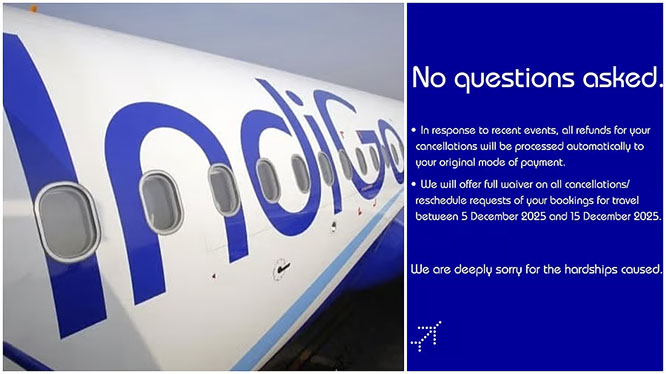
With IndiGo flight disruptions impacting thousands of passengers, the airline on Saturday said that it will offer full waiver on all cancellations/reschedule requests for travel bookings between December 5, 2025 and December 15, 2025.

Earlier in the day, the civil aviation ministry had directed the airline to complete the ticket refund process for the cancelled flights by Sunday evening, as well as ensure baggage separated from the travellers are delivered in the next two days.

In a post on X, titled 'No questions asked', IndiGo wrote, "In response to recent events, all refunds for your cancellations will be processed automatically to your original mode of payment."

"We are deeply sorry for the hardships caused," it further added.

Several passengers, however, complained of not getting full refund as promised by the airline.

Netizens have shared screenchots of getting charged for airline cancellation fee and convenience fee.

"Please tell me why u have did this airline cancellation charges when u say full amount will be refunded (sic)," a user wrote sharing a screenshot of the refund page.

"Well, but you have still debited the convenience charges," wrote another.

Passengers have also raised concerns about the "cancel" option being disabled on the IndiGo app. "First enable the 'Cancel' button on your App & offer full refund on tickets cancelled by customers between the said dates," wrote a user.

A day after the country's largest airline, IndiGo, cancelled more than 1,000 flights and caused disruptions for the fifth day on Saturday, the ministry said that any delay or non-compliance in refund processing will invite immediate regulatory action.

The refund process for all cancelled or disrupted flights must be completed by 8 pm on Sunday, the ministry said in a statement.

"Airlines have also been instructed not to levy any rescheduling charges for passengers whose travel plans were affected by cancellations," it said.

On Saturday, more than 400 flights were cancelled at various airports.

IndiGo has also been instructed to set up dedicated passenger support and refund facilitation cells.

Comments

Add new comment

  • Coastaldigest.com reserves the right to delete or block any comments.
  • Coastaldigset.com is not responsible for its readers’ comments.
  • Comments that are abusive, incendiary or irrelevant are strictly prohibited.
  • Please use a genuine email ID and provide your name to avoid reject.
News Network
December 6,2025

pilot.jpg

New Delhi: IndiGo, India’s largest airline, faced major operational turbulence this week after failing to prepare for new pilot-fatigue regulations issued by the Directorate General of Civil Aviation (DGCA). The stricter rules—designed to improve flight safety—took effect in phases through 2024, with the latest implementation on November 1. IndiGo has acknowledged that inadequate roster planning led to widespread cancellations and delays.

Below are the key DGCA rules that affected IndiGo’s operations:

1. Longer Mandatory Weekly Rest

Weekly rest for pilots has been increased from 36 hours to 48 hours.

The government says the extended break is essential to curb cumulative fatigue. This rule remains in force despite the current crisis.

2. Cap on Night Landings

Pilots can now perform only two night landings per week—a steep reduction from the earlier limit of six.

Night hours, defined as midnight to early morning, are considered the least alert period for pilots.

Given the disruptions, this rule has been temporarily relaxed for IndiGo until February 10.

3. Reduced Maximum Night Flight Duty

Flight duty that stretches into the night is now capped at 10 hours.

This measure has also been kept on hold for IndiGo until February 10 to stabilize operations.

4. Weekly Rest Cannot Be Replaced With Personal Leave

Airlines can no longer count a pilot’s personal leave as part of the mandatory 48-hour rest.

Pilots say this closes a loophole that previously reduced actual rest time.

Currently, all airlines are exempt from this rule to normalise travel.

5. Mandatory Fatigue Monitoring

Airlines must submit quarterly fatigue reports along with corrective actions to DGCA.

This system aims to create a transparent fatigue-tracking framework across the industry.

The DGCA has stressed that these rules were crafted to strengthen flight safety and align India with global fatigue-management standards. The temporary relaxations are expected to remain until February 2025, giving IndiGo time to stabilise its schedules and restore normal air travel.

Comments

Add new comment

  • Coastaldigest.com reserves the right to delete or block any comments.
  • Coastaldigset.com is not responsible for its readers’ comments.
  • Comments that are abusive, incendiary or irrelevant are strictly prohibited.
  • Please use a genuine email ID and provide your name to avoid reject.