72.2% of beggars in India are Hindus; 24.9% Muslims; 0.88% Christians

July 29, 2016

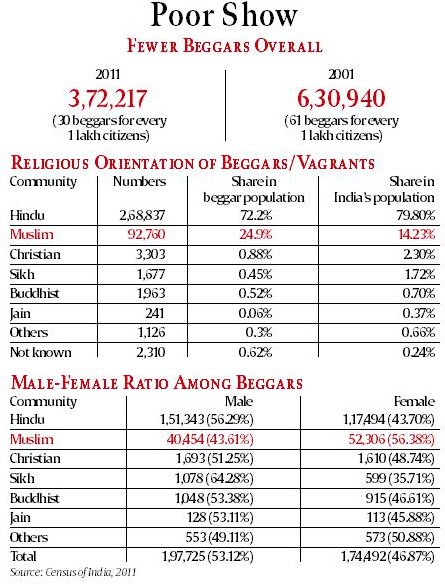
Nearly 25 percent of the 3.7 lakh Indians categorised as "beggars" in the 2011 Census are Muslims, according to data released last month. While most of beggars in India are Hindus—about 72.2 percent—Hindus are also the majority religious group in India, accounting for almost four-fifths of the country's population.

beggar

The number of Muslim beggars is significant as compared to their overall population in India, which stands at 17.22 crore as per the last Census.

A majority of the Muslim beggars are women, which is contrary to the national trend, where there are fewer women beggars compared to men.

Earlier, reports have indicated that Muslims have the lowest living standard in India, and spend less than Rs 33 every day.

Activists claim that the data — released last month — on the religious orientation of those deemed non workers' in Census 2011, highlights, once again, the limited or unequal access that certain communities or groups of citizens have to government schemes and services, which pushes them to destitution.

Non workers' are defined in the Census as individuals who do not participate in any economic activity — paid or unpaid — household duties, or cultivation.

As per Census data, of the total 72.89 crore non workers, 3.7 lakh are beggars. This number fell 41% since the last Census of 2001, which recorded the number of beggars at 6.3 lakh.

Muslims make up an unusually high percentage of individuals who have been categorised as beggars. A total of 92,760 Muslims are categorised thus — a quarter of the country's total beggar population of 3.7 lakh.

Hindus are 79.8% of India's population, but with 2.68 lakh individuals, make up 72.22% of its beggar population. Christians, who are 2.3% of the population, make up 0.88% of the beggar population (3,303 individuals). Buddhists (0.52%), Sikhs (0.45%), Jains (0.06%) and others (0.30%) follow.

Interestingly, more Muslim women seem to be begging as compared to Muslim men, a trend that is opposite to that of all communities except those categorised as Others'. The national average is 53.13% male beggars to 46.87% female beggars; for Muslims, the ratio is 43.61% male beggars and 56.38% female.
begger

Begging is illegal

Beggary is illegal in India, and is punishable by imprisonment of 3-10 years. The Bombay Prevention of Begging Act, 1959 has been followed by almost all states in the country. Activists say the Act provides no clear categorisation of beggars, and even homeless and landless labourers who have migrated to different cities are categorised as beggars. Like many of India's laws, the anti-beggary legislation is based on an archaic British law against vagrants.

Under the Bombay Prevention of Begging Act, 1959, anyone having no visible means of subsistence and found wandering about in a public space is deemed as a beggar. All those who solicit alms in a public place under any pretence including singing, dancing, fortune-telling or street performing are also deemed as beggars.

The Act gives discretionary powers to the police to pick up anyone on suspicion that he is a beggar or a destitute with no means of fending for himself.

Activists say the law, rather than rehabilitating destitutes, criminalises the poor and those suffering from mental illnesses. Some states like Bihar have undertaken a programme for the rehabilitation of beggars. But other states like Maharashtra and West Bengal can put away an individual found on the street to prison. 

Comments

mohammad.n
 - 
Friday, 29 Jul 2016

Beggers are beggers, why religion is coming in everything nowadays?!

Satyameva Jayate
 - 
Friday, 29 Jul 2016

@kr.....
whats your problem yaar, convent ho ya private...what it has to go with beggers....?

kr
 - 
Friday, 29 Jul 2016

Half of Hindu population are studying in convent school... How many muslim study in convent.... They say is non Islamic.... I heard my neighborhood saying it

Add new comment

  • Coastaldigest.com reserves the right to delete or block any comments.
  • Coastaldigset.com is not responsible for its readers’ comments.
  • Comments that are abusive, incendiary or irrelevant are strictly prohibited.
  • Please use a genuine email ID and provide your name to avoid reject.
News Network
December 4,2025

Udupi: A 40-year-old NRI from Udupi has reportedly lost more than Rs 12.25 lakh in an online investment scam operated through Telegram.

According to a complaint filed at the CEN police station, Leo Jerome Mendonsa, who has been working in Dubai for the past 15 years in computer accessories sales, maintains NRI accounts in Karkala and Nitte.

On November 12, 2025, Mendonsa was added to a Telegram group called Instaflow Earnings by unknown individuals. Users identified as Priya and Dipannita persuaded him to invest in “Revenue Tasks.” Initially, Mendonsa transferred Rs 1,100 multiple times and received the promised returns, encouraging him to continue.

On November 14, another user, Nishmitha Shetty, directed him to register on a website, digitvisionuoce.cc, and invest Rs 4 lakh in various shares. Over the next few days, he made multiple transfers totaling Rs 12,25,000, including Rs 50,000 via Google Pay, believing the scheme was legitimate.

After receiving the money, the alleged handlers stopped responding, and neither the invested amount nor the promised profits were returned.

The CEN police have registered a case under Sections 66(C) and 66(D) of the IT Act and Section 318(4) of the Bharatiya Nyaya Sanhita (BNS), and investigations are ongoing.

Comments

Add new comment

  • Coastaldigest.com reserves the right to delete or block any comments.
  • Coastaldigset.com is not responsible for its readers’ comments.
  • Comments that are abusive, incendiary or irrelevant are strictly prohibited.
  • Please use a genuine email ID and provide your name to avoid reject.
News Network
December 1,2025

hindutvaboy.jpg

Udupi, Dec 1: A horrific case of alleged rape has unfolded in Udupi, where a worker from a Hindutva organisation, previously arrested and released on bail for harassing a young woman, is now accused of waylaying and sexually assaulting her.

The arrested individual has been identified as Pradeep Poojary (26), a member of the Hindu Jagarana Vedike's Nairkode unit in Perdur.

Poojary had allegedly been relentlessly harassing the young woman, pressuring her to marry him. When she bravely stood up to him and refused his demands, she filed a formal complaint at the Hiriyadka police station. He was subsequently arrested in that initial harassment case but was later granted bail.

According to police reports, driven by the same malicious grudge, Poojary allegedly intercepted the woman again on November 29. While she was walking through a deserted area, the accused is claimed to have threatened her by grabbing her neck. When she again refused to marry him, he allegedly proceeded to rape her.

The survivor immediately informed her family about the traumatic assault. Following this, her parents lodged a complaint at the Udupi women’s police station.

Police arrested Poojary again and produced him before the court. He has since been remanded to judicial custody.

Comments

Add new comment

  • Coastaldigest.com reserves the right to delete or block any comments.
  • Coastaldigset.com is not responsible for its readers’ comments.
  • Comments that are abusive, incendiary or irrelevant are strictly prohibited.
  • Please use a genuine email ID and provide your name to avoid reject.
News Network
December 7,2025

Mangaluru, Dec 7: A 34-year-old fruit and vegetable trader in Mangaluru has reportedly lost ₹33.1 lakh after falling victim to an online investment scam run through a fake mobile app.

Police said the scam began in September, when the victim received a link on Facebook. Clicking it connected him to a WhatsApp number, where an unidentified person introduced a high-return investment scheme and instructed him to download an app.

To build trust, the fraudster asked him to invest ₹30,000 on September 24. The trader soon received ₹34,000 as “profit,” convincing him the scheme was genuine. Over the next two months, he transferred money in multiple instalments via Google Pay and IMPS to different scanner codes and bank accounts shared by the scammers. Between September 24 and December 3, he ended up sending a total of ₹33.1 lakh.

When he later requested a refund of his investment and promised returns, the scammers demanded additional payments, claiming he needed to pay a “service tax” first. Even after he paid a small amount, no money was returned, and the scammers continued pressuring him for more.

A case has been registered at the CEN Crime Police Station.

Comments

Add new comment

  • Coastaldigest.com reserves the right to delete or block any comments.
  • Coastaldigset.com is not responsible for its readers’ comments.
  • Comments that are abusive, incendiary or irrelevant are strictly prohibited.
  • Please use a genuine email ID and provide your name to avoid reject.