Horrific Achhe Din: India 100th on hunger index; worse than Nepal, Bangladesh

Agencies
October 13, 2017

New Delhi, Oct 13: India has a “serious” hunger problem and ranks 100th out of 119 countries on the global hunger index — behind North Korea, Bangladesh and Iraq but ahead of Pakistan, according to a report.

The country’s serious hunger level is driven by high child malnutrition and underlines need for stronger commitment to the social sector, the International Food Policy Research Institute (IFPRI) said in its report.

India stood at 97th position in last year’s rankings.

“India is ranked 100th out of 119 countries, and has the third highest score 
in all of Asia — only Afghanistan and Pakistan are ranked worse,” IFPRI said in a statement.

“At 31.4, India’s 2017 GHI (Global Hunger Index) score is at the high end of the ‘serious’ category, and is one of the main factors pushing South Asia to the category of worst performing region on the GHI this year, followed closely by Africa South of the Sahara,” it added.

As per the report, India ranks below many of its neighbouring countries such as China (29th rank), Nepal (72), Myanmar (77), Sri Lank (84) and Bangladesh (88). It is ahead of Pakistan (106) and Afghanistan (107).

North Korea ranks 93rd while Iraq is at 78th position.

The GHI, now in its 12th year, ranks countries based on four key indicators — undernourishment, child mortality, child wasting and child stunting.

The report ranked 119 countries in the developing world, nearly half of which have ‘extremely alarming,’ ‘alarming’ or ’serious’ hunger levels.

“India’s high ranking on the Global Hunger Index [GHI] again this year brings to the fore the disturbing reality of the country’s stubbornly high proportions of malnourished children,” the statement said.

IFPRI pointed out that more than one-fifth of Indian children under five weigh too little for their height and over a third are too short for their age.

“Even with the massive scale up of national nutrition-focused programmes in India, drought and structural deficiencies have left large number of poor in India at risk of malnourishment in 2017,” said P.K. Joshi, IFPRI Director for South Asia.

However, he said that the on-going efforts are expected to make significant changes in improving the existing situation.

Mr. Joshi appreciated that India has developed and launched an action plan on ‘undernourishment free India’ by 2022. The plan shows stronger commitment and greater investments in tackling malnutrition in the coming years.

“As of 2015-16, more than a fifth [21%] of children in India suffer from wasting [low weight for height] — up from 20% in 2005-2006,” IFPRI said.

Only three other countries in this year’s GHI — Djibouti, Sri Lanka and South Sudan — show child wasting above 20%. India’s child wasting rate has not shown any substantial improvement over the past 25 years.

However, India has made considerable improvement in reducing its child stunting rate, down 29% since 2000, but even that progress leaves India with a relatively high stunting rate of 38.4.

Comments

Indian
 - 
Friday, 13 Oct 2017

No corruption itself is achhe din for me,..There may be incorrect decisions but govt is not sleeping , every day they take decision
This is achhe din for me

D'souza
 - 
Friday, 13 Oct 2017

Finally the voters deserve what they get. The bjp can easily inflame communal passions and is already nurturing its vote bank. It has now understood the arithmetic behind winning election. It won a brute majority with only 30 percent of votes. Now with a nonexistent opposition it might win more seats with lesser votes. The door buster sale of India will truly be over by them. One nation, one market.. for whom exactly? We all know it is for the corporates.

Kumar
 - 
Friday, 13 Oct 2017

Both Republic TV and NDTV are cheddi TV. They proved it many times

Unknown
 - 
Friday, 13 Oct 2017

Just 2 days back a media was showing how the GREAT INDIAN BANK LOOT took place under the previous UPA govt where state owned Banks were asked to disburse LOANS IN LAKHS OF CRORES and how corporates took advantage of this system.

Jay
 - 
Friday, 13 Oct 2017

Ha...This is what from day one of Modi his baiters have been telling ...some acting as though they voted and now changed mind ...are you guys serious about contesting Modi...give a good reason to change and show a better cleaner politician to depend on else this will be the same old story repeated even in 2024 ...

Rudresh
 - 
Friday, 13 Oct 2017

To those who are painting rosy picture , its not about Modi or BJP its about Indian Economy , we failed to take advantage of lower oil price for past three years . Just turn around and see how many children of friends and relatives who came out of college are jobless . Those who have graduated in last two years are struggling to find job and those who are already in job are looking scary . Is this not enough to understand how economy is doing ? Also look at the small businesses and see how they are impacted . RBI Governor escapes parliamentary committee meeting like a student escaping class exams .

Add new comment

  • Coastaldigest.com reserves the right to delete or block any comments.
  • Coastaldigset.com is not responsible for its readers’ comments.
  • Comments that are abusive, incendiary or irrelevant are strictly prohibited.
  • Please use a genuine email ID and provide your name to avoid reject.
News Network
December 2,2025

DKSsiddu.jpg

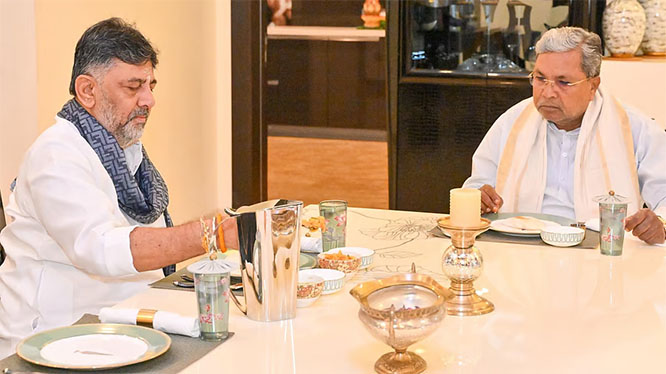
Bengaluru: 'Nati koli saaru' (country chicken curry) considered one of Chief Minister Siddaramaiah’s favourites along with steaming hot idlis was on the breakfast menu at Deputy CM D K Shivakumar’s residence on Tuesday, according to official sources.

The spread also included 'nati koli' fry, vada and pongal, among other items, they said.

In an apparent show of unity, Siddaramaiah visited Shivakumar’s residence for breakfast, just days after the two leaders shared a meal amid a simmering power tussle in the state Congress.

Siddaramaiah drove to the Deputy CM’s residence in Sadashivanagar, where he was received by Shivakumar and his brother D K Suresh, who is a former Congress MP.

Suresh and Kunigal MLA H D Ranganath, a relative of Shivakumar, joined them for breakfast, which featured a mix of vegetarian and non-vegetarian dishes.

Speaking to reporters later, Siddaramaiah said Shivakumar had invited him during his visit to the CM’s residence for breakfast on Saturday.

Asked about the difference between the two meals, the chief minister said, "At his (Shivakumar’s) house it was non-veg, while at my house it was veg. He is a vegetarian, I am a non-vegetarian. I had not prepared non-veg. I told DK to get chicken from the village as you won’t get the original in Bengaluru."

Shivakumar said he had initially invited Siddaramaiah to his residence, but the CM had suggested visiting his place first and reciprocating later. "It was a vegetarian breakfast at the CM’s house on Saturday," he noted.

"Today, I invited him (the CM) to my house. He enjoyed the breakfast, which had his Mysuru taste," Shivakumar added. At this point, Siddaramaiah remarked that Shivakumar’s wife is also from Mysuru.

Saturday’s breakfast at Siddaramaiah’s official residence, held as part of efforts by the Congress high command to ease tensions in the leadership dispute between the two, reportedly included idlis and sambar, according to official sources.

Comments

Add new comment

  • Coastaldigest.com reserves the right to delete or block any comments.
  • Coastaldigset.com is not responsible for its readers’ comments.
  • Comments that are abusive, incendiary or irrelevant are strictly prohibited.
  • Please use a genuine email ID and provide your name to avoid reject.
News Network
November 26,2025

Mangaluru, Nov 26: Assembly Speaker and local MLA U.T. Khader has initiated a high-level push to resolve one of Mangaluru’s longest-standing traffic headaches: the narrow, high-density stretch of National Highway-66 between Nanthoor and Talapady.

He announced on Tuesday that a formal proposal has been submitted to the Union Ministry of Road Transport and Highways (MoRTH) seeking approval to prepare a Detailed Project Report (DPR) for the widening of this crucial corridor.

The plan specifically aims to expand the existing 45-meter road width to a full 60 meters, coupled with the construction of dedicated service roads. Khader highlighted that land for a 60-meter highway was originally acquired during the initial four-laning project, but only 45 meters were developed, leading to a perpetual bottleneck.

"With vehicle density rising sharply, the expansion has become unavoidable," Khader stated, stressing that the upgrade is essential for ensuring smoother traffic flow and improving safety at the city's main entry and exit points.

The stretch between Nanthoor and Talapady is a vital link on the busy Kochi-Panvel coastal highway and connects to major city junctions. The move to utilize the previously acquired land for the full 60-meter width is seen as a necessary measure to catch up with the region's rapid vehicular growth and prevent further traffic gridlocks.

Comments

Add new comment

  • Coastaldigest.com reserves the right to delete or block any comments.
  • Coastaldigset.com is not responsible for its readers’ comments.
  • Comments that are abusive, incendiary or irrelevant are strictly prohibited.
  • Please use a genuine email ID and provide your name to avoid reject.
News Network
December 4,2025

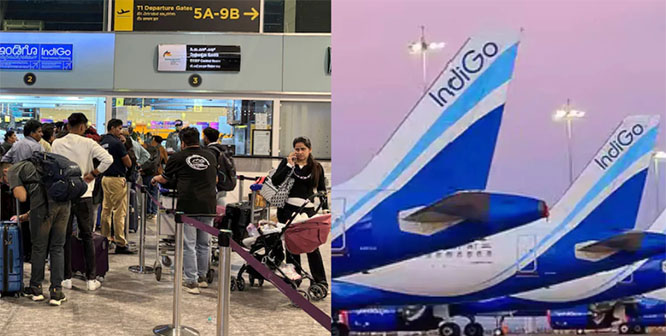
indigocrisis.jpg

Angry outbursts, long queues, and desperate appeals filled airports across India today as IndiGo grappled with a severe operational breakdown. Hundreds of flights have been cancelled or delayed, leaving thousands of passengers stranded through the night and forcing many to spend long hours at helpdesks.

Social media was flooded with videos of fliers pleading for assistance, accusing the airline of misleading updates, and demanding accommodation after being stuck for 10 to 12 hours at airports such as Hyderabad and Bengaluru.

What Triggered the Meltdown?

IndiGo has attributed the widespread disruption to “a multitude of unforeseen operational challenges.” These include:

•    Minor technology glitches
•    Winter-season schedule adjustments
•    Bad weather
•    Congestion in the aviation network
•    New crew rostering rules (Flight Duty Time Limitations or FDTL)

Among these, the most disruptive has been the implementation of the updated FDTL norms introduced by the Directorate General of Civil Aviation (DGCA) in January 2024.

These rules were designed to reduce pilot fatigue and improve passenger safety. Key changes include:

•    Longer weekly rest periods for flight crew
•    A revised definition of “night,” extending it by an extra hour
•    Tighter caps on flight duty timing and night landings
•    Cutting night shifts for pilots and crew from six per roster cycle to just two

Once these norms became fully enforceable, airlines were required to overhaul rosters well in advance. For IndiGo, this triggered a sudden shortage of crew available for duty, leading to cascading delays and cancellations.

Why IndiGo Was Hit the Hardest

IndiGo is India’s largest airline by a wide margin, operating over 2,200 flights daily. That’s roughly double the number operated by Air India.

When an airline of this size experiences even a 10–20% disruption, it translates to 200–400 flights being delayed or grounded — producing massive spillover effects across the country.

IndiGo also relies heavily on high-frequency overnight operations, a model typical of low-cost carriers that aim to maximise aircraft utilisation and reduce downtime. The stricter FDTL norms clash with these overnight-heavy schedules, forcing the airline to pull back services.

Aviation bodies have also criticised IndiGo’s preparedness. The Airline Pilots' Association of India (ALPA) said airlines were given a two-year window to plan for the new rules but “started preparing rather late.” IndiGo, it said, failed to rebuild crew rosters 15 days in advance as required.

The Federation of Indian Pilots (FIP) went further, calling the crisis the result of IndiGo’s “prolonged and unorthodox lean manpower strategy,” and alleging that the airline adopted a hiring freeze even as it knew the new rules would require more careful staffing.

How Many Flights Are Affected?

In the past 48 hours, over 300 flights have been cancelled. At least 100 more are expected to be cancelled today.

City-wise impact:

•    Hyderabad: 33 expected cancellations; several fliers stranded overnight
•    Bengaluru: over 70 expected cancellations
•    Delhi, Mumbai, Chennai, Kolkata: widespread delays and missed connections

Passengers shared distressing accounts online.

One customer at Hyderabad airport said they waited from 6 PM to 9 AM with “no action taken” regarding their delayed Pune flight. Another said IndiGo repeatedly told them the crew was “arriving soon,” only for the delay to stretch over 12 hours.

IndiGo has apologised for the disruption and promised that operations will stabilise within 48 hours, adding that “calibrated adjustments” are being made to contain the chaos.

What Should Passengers Do Now?

For those flying in the next few days, especially with IndiGo, here are key precautions:

1. Keep Checking Flight Status
Monitor your flight closely before leaving for the airport, as delays may be announced last-minute.

2. Arrive Early
Expect long queues at counters and security due to crowding and rescheduling.

3. Carry Essentials
Pack snacks, water, basic medicines, chargers, and items for children or senior citizens. Extended waiting times should be anticipated.

4. Use Flexible Booking Options
If you booked tickets with a free-date-change or cancellation option, consider using them.
If you haven’t booked yet, prefer refundable or flexible fares, or even consider alternate airlines.

5. Follow IndiGo’s Updates
Keep an eye on IndiGo’s official social media channels and contact customer support for rebooking and refund queries.

What Needs to Change?

Pilot groups have raised concerns not just about staffing but also the planning practices behind it.
The Federation of Indian Pilots accused IndiGo of:

•    Imposing an unexplained hiring freeze despite knowing the FDTL changes were coming
•    Entering non-poaching agreements that limited talent movement
•    Keeping pilot pay frozen
•    Underestimating the need to restructure operations in advance

They have urged DGCA to approve seasonal schedules only after airlines prove they have adequate pilot strength under the new norms.

ALPA also warned that some airlines might be using the delays as an “immature pressure tactic” to push DGCA for relaxations in the new rules — which, if granted, could compromise the very safety standards the norms were meant to protect.

Both pilot bodies stressed that no exemption should dilute safety, and any deviations should be based solely on scientific risk assessment.

Is a Solution in Sight?

While IndiGo says normalcy will return within two days, aviation experts believe that fully stabilising operations could take longer, depending on how quickly the airline can:
•    Re-align rosters
•    Mobilise rested crew
•    Boost staffing
•    Adjust its winter schedule to match regulatory requirements
Passengers are advised to remain prepared for continued delays over the next few days as the airline works through its backlog. 

Comments

Add new comment

  • Coastaldigest.com reserves the right to delete or block any comments.
  • Coastaldigset.com is not responsible for its readers’ comments.
  • Comments that are abusive, incendiary or irrelevant are strictly prohibited.
  • Please use a genuine email ID and provide your name to avoid reject.