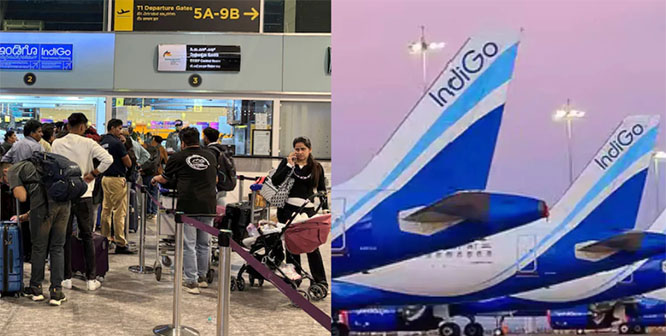
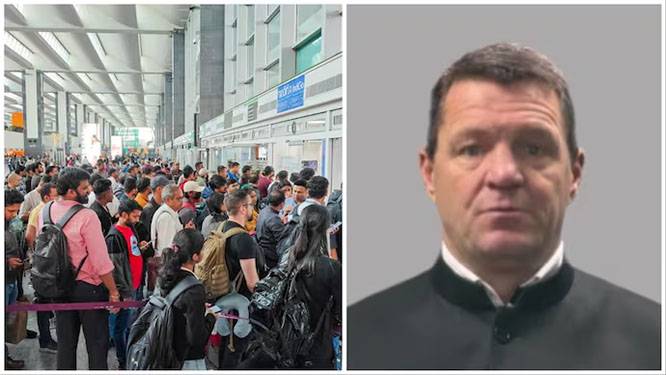
Angry outbursts, long queues, and desperate appeals filled airports across India today as IndiGo grappled with a severe operational breakdown. Hundreds of flights have been cancelled or delayed, leaving thousands of passengers stranded through the night and forcing many to spend long hours at helpdesks.
Social media was flooded with videos of fliers pleading for assistance, accusing the airline of misleading updates, and demanding accommodation after being stuck for 10 to 12 hours at airports such as Hyderabad and Bengaluru.
What Triggered the Meltdown?
IndiGo has attributed the widespread disruption to “a multitude of unforeseen operational challenges.” These include:
• Minor technology glitches
• Winter-season schedule adjustments
• Bad weather
• Congestion in the aviation network
• New crew rostering rules (Flight Duty Time Limitations or FDTL)
Among these, the most disruptive has been the implementation of the updated FDTL norms introduced by the Directorate General of Civil Aviation (DGCA) in January 2024.
These rules were designed to reduce pilot fatigue and improve passenger safety. Key changes include:
• Longer weekly rest periods for flight crew
• A revised definition of “night,” extending it by an extra hour
• Tighter caps on flight duty timing and night landings
• Cutting night shifts for pilots and crew from six per roster cycle to just two
Once these norms became fully enforceable, airlines were required to overhaul rosters well in advance. For IndiGo, this triggered a sudden shortage of crew available for duty, leading to cascading delays and cancellations.
Why IndiGo Was Hit the Hardest
IndiGo is India’s largest airline by a wide margin, operating over 2,200 flights daily. That’s roughly double the number operated by Air India.
When an airline of this size experiences even a 10–20% disruption, it translates to 200–400 flights being delayed or grounded — producing massive spillover effects across the country.
IndiGo also relies heavily on high-frequency overnight operations, a model typical of low-cost carriers that aim to maximise aircraft utilisation and reduce downtime. The stricter FDTL norms clash with these overnight-heavy schedules, forcing the airline to pull back services.
Aviation bodies have also criticised IndiGo’s preparedness. The Airline Pilots' Association of India (ALPA) said airlines were given a two-year window to plan for the new rules but “started preparing rather late.” IndiGo, it said, failed to rebuild crew rosters 15 days in advance as required.
The Federation of Indian Pilots (FIP) went further, calling the crisis the result of IndiGo’s “prolonged and unorthodox lean manpower strategy,” and alleging that the airline adopted a hiring freeze even as it knew the new rules would require more careful staffing.
How Many Flights Are Affected?
In the past 48 hours, over 300 flights have been cancelled. At least 100 more are expected to be cancelled today.
City-wise impact:
• Hyderabad: 33 expected cancellations; several fliers stranded overnight
• Bengaluru: over 70 expected cancellations
• Delhi, Mumbai, Chennai, Kolkata: widespread delays and missed connections
Passengers shared distressing accounts online.
One customer at Hyderabad airport said they waited from 6 PM to 9 AM with “no action taken” regarding their delayed Pune flight. Another said IndiGo repeatedly told them the crew was “arriving soon,” only for the delay to stretch over 12 hours.
IndiGo has apologised for the disruption and promised that operations will stabilise within 48 hours, adding that “calibrated adjustments” are being made to contain the chaos.
What Should Passengers Do Now?
For those flying in the next few days, especially with IndiGo, here are key precautions:
1. Keep Checking Flight Status
Monitor your flight closely before leaving for the airport, as delays may be announced last-minute.
2. Arrive Early
Expect long queues at counters and security due to crowding and rescheduling.
3. Carry Essentials
Pack snacks, water, basic medicines, chargers, and items for children or senior citizens. Extended waiting times should be anticipated.
4. Use Flexible Booking Options
If you booked tickets with a free-date-change or cancellation option, consider using them.
If you haven’t booked yet, prefer refundable or flexible fares, or even consider alternate airlines.
5. Follow IndiGo’s Updates
Keep an eye on IndiGo’s official social media channels and contact customer support for rebooking and refund queries.
What Needs to Change?
Pilot groups have raised concerns not just about staffing but also the planning practices behind it.
The Federation of Indian Pilots accused IndiGo of:
• Imposing an unexplained hiring freeze despite knowing the FDTL changes were coming
• Entering non-poaching agreements that limited talent movement
• Keeping pilot pay frozen
• Underestimating the need to restructure operations in advance
They have urged DGCA to approve seasonal schedules only after airlines prove they have adequate pilot strength under the new norms.
ALPA also warned that some airlines might be using the delays as an “immature pressure tactic” to push DGCA for relaxations in the new rules — which, if granted, could compromise the very safety standards the norms were meant to protect.
Both pilot bodies stressed that no exemption should dilute safety, and any deviations should be based solely on scientific risk assessment.
Is a Solution in Sight?
While IndiGo says normalcy will return within two days, aviation experts believe that fully stabilising operations could take longer, depending on how quickly the airline can:
• Re-align rosters
• Mobilise rested crew
• Boost staffing
• Adjust its winter schedule to match regulatory requirements
Passengers are advised to remain prepared for continued delays over the next few days as the airline works through its backlog.





Comments
Hahahah... What a joke!!!
What these RSS Terrorists contributed for India? They supported British. If you search in history Muslims taught them everything. Even they were not knowing how to bath, how to wear clothes, how to cook, how to build buildings. All the food recipe they learnt from Muslims. These aryans run away from Iran and now looting our India. All the Buildings and culture they are using were built by Muslims. What did they build??? Toilets????
AS PER WIKIPEDIA,
The Mughal Empire (Urdu: مغلیہ سلطنت, translit. Mughliyah Salṭanat)[7] or Mogul Empire,[8] self-designated as Gurkani (Persian: گورکانیان, Gūrkāniyān, meaning "son-in-law"),[9] was an empire in the Indian subcontinent, founded in 1526. It was established and ruled by a Muslim dynasty with Turco-Mongol Chagatai roots from Central Asia,[10][11][12] but with significant Indian Rajput and Persian ancestry through marriage alliances;[13][14] only the first two Mughal emperors were fully Central Asian, while successive emperors were of predominantly Rajput and Persian ancestry.[15] The dynasty was Indo-Persian in culture,[16] combining Persianateculture[8][17] with local Indian cultural influences[16] visible in its traits and customs.[18]
The Mughal Empire at its peak extended over nearly all of the Indian subcontinent[5] and large parts of Afghanistan. It was the second largest empire to have existed in the Indian subcontinent, spanning four million square kilometres at its zenith,[4] after only the Maurya Empire, which spanned five million square kilometres. The Mughal Empire began a period of proto-industrialization,[19]and Mughal India became the world's largest economic power, with 24.4% of world GDP,[20] and the world leader in manufacturing,[21] producing 25% of global industrial output up until the 18th century.[22] The Mughal Empire is considered "India's last golden age"[23] and one of the three Islamic Gunpowder Empires (along with the Ottoman Empire and Safavid Persia).[24]
The beginning of the empire is conventionally dated to the victory by its founder Babur over Ibrahim Lodi, the last ruler of the Delhi Sultanate, in the First Battle of Panipat (1526). The Mughal emperors had roots in the Turco-Mongol Timurid dynasty of Central Asia, claiming direct descent from both Genghis Khan (founder of the Mongol Empire, through his son Chagatai Khan) and Timur (Turco-Mongol conqueror who founded the Timurid Empire). During the reign of Humayun, the successor of Babur, the empire was briefly interrupted by the Sur Empire. The "classic period" of the Mughal Empire started in 1556 with the ascension of Akbar the Great to the throne. Under the rule of Akbar and his son Jahangir, the region enjoyed economic progress as well as religious harmony, and the monarchs were interested in local religious and cultural traditions. Akbar was a successful warrior who also forged alliances with several Hindu Rajput kingdoms. Some Rajput kingdoms continued to pose a significant threat to the Mughal dominance of northwestern India, but most of them were subdued by Akbar. All Mughal emperors were Muslims; Akbar, however, propounded a syncretic religion in the latter part of his life called Dīn-i Ilāhī, as recorded in historical books like Ain-i-Akbari and Dabistān-i Mazāhib.[25]
The Mughal Empire did not try to intervene in the local societies during most of its existence, but rather balanced and pacified them through new administrative practices[26][27] and diverse and inclusive ruling elites,[28] leading to more systematic, centralised, and uniform rule.[29] Traditional and newly coherent social groups in northern and western India, such as the Marathas, the Rajputs, the Pashtuns, the Hindu Jats and the Sikhs, gained military and governing ambitions during Mughal rule, which, through collaboration or adversity, gave them both recognition and military experience.[30][31][32][33]
The reign of Shah Jahan, the fifth emperor, between 1628 and 1658 was the golden age of Mughal architecture. He erected several large monuments, the best known of which is the Taj Mahal at Agra, as well as the Moti Masjid, Agra, the Red Fort, the Jama Masjid, Delhi, and the Lahore Fort. The Mughal Empire reached the zenith of its territorial expanse during the reign of Aurangzeb and also started its terminal decline in his reign due to Maratha military resurgence under Shivaji Bhosale. During his lifetime, victories in the south expanded the Mughal Empire to its greatest extent, ruling over more than 150 million subjects, nearly one quarter of the world's population at the time, with a GDP of over $90 billion.[34][35]
By the mid-18th century, the Marathas had routed Mughal armies and won over several Mughal provinces from the Punjab to Bengal.[36] Internal dissatisfaction arose due to the weakness of the empire's administrative and economic systems, leading to its break-up and declarations of independence of its former provinces by the Nawab of Bengal, the Nawab of Awadh, the Nizam of Hyderabad and other small states. In 1739, the Mughals were crushingly defeated in the Battle of Karnal by the forces of Nader Shah, the founder of the Afsharid dynasty in Persia, and Delhi was sacked and looted, drastically accelerating their decline. During the following century Mughal power had become severely limited, and the last emperor, Bahadur Shah II, had authority over only the city of Shahjahanabad. He issued a firman supporting the Indian Rebellion of 1857 and following the defeat was therefore tried by the British East India Company for treason, imprisoned and exiled to Rangoon.[37] The last remnants of the empire were formally taken over by the British, and the Government of India Act 1858 let the British Crown formally assume direct control of India in the form of the new British Raj.
Aryan cowboys who invaded India, enslved the original inhabitants destroying their culture, imposed Vedic divisive foreign inhuman cast system. India is still suffering from their terror mindset. They are the people who supported the British and responsible for death of millions of Indian freedom fighters. These traitors who licked the British boots, now lecuring us about patriotism. When Mughals came to this land, there was no India, they built India and contributed richly to its history. If these anti-human gang cant digest the truth, let them NOT use any of the Mughal or Muslims contribution and jump into Sarayu or Ganga enmasse.
If Owais is committing intolerance, Oh Blind, deaf, dumb BJP chelas, puffets, what the hell is happening specially in UP, is it tolerance? Killing in the name of gow rakshaks, killing small children, is it tolerance?
Add new comment