



No Haj subsidy from this year: Naqvi

Agencies
January 16, 2018

New Delhi, Jan 16: There will be no subsidy for Haj from this year, minority affairs minister Mukhtar Abbas Naqvi said today.

Naqvi told reporters that despite the subsidy withdrawal, a record number of 1.75 lakh Muslims will undertake the pilgrimage this year from India.

Naqvi also said that the Saudi Arabian government has in principle agreed to allow Haj journey from India by ships and officials of the two countries will sit together to finalise the modalities.

"This is part of our policy to empower minorities with dignity and without appeasement," Naqvi told reporters and cited a host of measures for the welfare of minorities.

Earlier this year, Naqvi had said that the Centre would abolish the subsidy for Haj pilgrims in accordance with a Supreme Court order.

"A constitutional bench of the Supreme Court had, during the Congress regime in 2012, directed that the Haj subsidy is done away with. Hence, in the new policy, as per the recommendations of a committee, we have decided to do away with the Haj subsidy gradually," he had said.

Comments

Salam Bava
 - 
Wednesday, 17 Jan 2018

An Indian Haj subsidy that did not exist!

Thank you Prime Minister Modi for ending Haj subsidy that never existed.

I completely welcome this move making the announcement, minister Mukhtar Abbas Naqvi said: “We believe in empowerment without appeasement.”Naqvi did not elaborate what he meant by “appeasement” but for decades, Haj subsidy remained a whip in the hands of right-wing parties to attack political rivals. Bharatiya Janata Party to embarrass rivals by accusing them of “appeasing” Muslims by subsiding expenses involved in the pilgrimage to Makkah and Madina. Angered by this attack, several Muslims have been demanding an end to the subsidy. 

However, it is important to understand what this subsidy was and whether Muslims actually benefitted from it. In 2016-17, the government budgeted Rs 4.5 billion subsidy for around 100,000 Muslims who performed Haj last year. Each pilgrim paid around Rs 220,000 (amount varies each year) for airfare; stay in Makkah and Madina and for miscellaneous expenses. This money is paid to government-managed Haj committees which then transfers this money to other agencies. In other words, each Muslim pays for his/her own Haj expenses.

A significant chunk of money paid by Muslims goes to India’s government-owned national carrier Air India which enjoys a virtual monopoly on Haj circuit. The airline picks up passengers from around a dozen cities and flies them to Jeddah. The Air India inflates India-Jeddah tickets during the Haj season. This so-called government subsidy is used to pay for tickets that are always higher than the prevailing airfare charged by other airlines. A breakdown would show that an Air India ticket to Jeddah would cost more than a trip to Los Angeles from India. Essentially, the government takes money from one pocket and puts it back in another. Muslim have always demanded global tenders for Haj flights and for providing accommodation in Makkah and Madina..

However, while Naqvi sought to take a high moral ground by claiming that his party appeases no section of the society, his own government spends billions of rupees on organizing Hindu pilgrimages every year

Parson
 - 
Wednesday, 17 Jan 2018

Naqvi saab, this is what you learnt in Madrasa? U r Back-Stabbing Muslims. There is no 1% quality of muslim in you. After joining BJP you have lost it. First learn humanity. Almighty will give answers for all problems you have created for others. 

Add new comment

  • Coastaldigest.com reserves the right to delete or block any comments.
  • Coastaldigset.com is not responsible for its readers’ comments.
  • Comments that are abusive, incendiary or irrelevant are strictly prohibited.
  • Please use a genuine email ID and provide your name to avoid reject.
News Network
December 3,2025

arrival.jpg

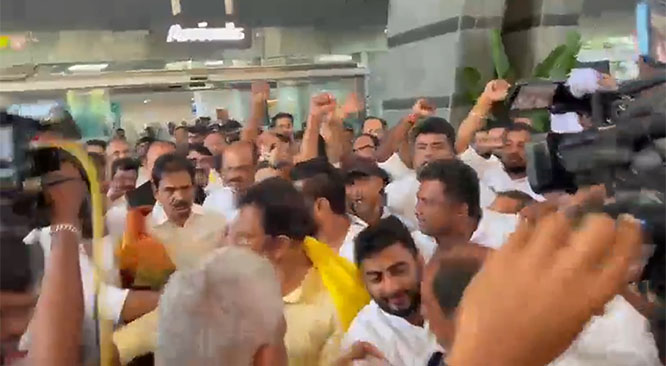
Mangaluru, Dec 3: A group of Congress workers gathered at the Mangaluru International Airport on Wednesday to welcome AICC general secretary K C Venugopal, but the reception quickly turned into a display of support for Deputy Chief Minister D K Shivakumar.

Venugopal arrived in the city to participate in the centenary commemoration of the historic dialogue between Mahatma Gandhi and Narayana Guru. The event, organised by the Sivagiri Mutt, Varkala, in association with the Mangalore University Sri Narayana Guru Study Chair, is being held on the university’s Konaje campus.

KPCC general secretary Mithun Rai and several party workers had assembled at the airport to receive Venugopal. However, the moment he stepped out, workers began raising slogans backing Shivakumar.

The university programme will be inaugurated by Chief Minister Siddaramaiah.

This show of support comes just a day after Siddaramaiah remarked that Shivakumar would lead the government “when the high command decides.” The chief minister made the comment after a breakfast meeting at Shivakumar’s residence—another public display of camaraderie between the two leaders amid ongoing attempts by the party high command to downplay their leadership rivalry.

Comments

Add new comment

  • Coastaldigest.com reserves the right to delete or block any comments.
  • Coastaldigset.com is not responsible for its readers’ comments.
  • Comments that are abusive, incendiary or irrelevant are strictly prohibited.
  • Please use a genuine email ID and provide your name to avoid reject.
News Network
December 3,2025

arrival.jpg

Mangaluru, Dec 3: A group of Congress workers gathered at the Mangaluru International Airport on Wednesday to welcome AICC general secretary K C Venugopal, but the reception quickly turned into a display of support for Deputy Chief Minister D K Shivakumar.

Venugopal arrived in the city to participate in the centenary commemoration of the historic dialogue between Mahatma Gandhi and Narayana Guru. The event, organised by the Sivagiri Mutt, Varkala, in association with the Mangalore University Sri Narayana Guru Study Chair, is being held on the university’s Konaje campus.

KPCC general secretary Mithun Rai and several party workers had assembled at the airport to receive Venugopal. However, the moment he stepped out, workers began raising slogans backing Shivakumar.

The university programme will be inaugurated by Chief Minister Siddaramaiah.

This show of support comes just a day after Siddaramaiah remarked that Shivakumar would lead the government “when the high command decides.” The chief minister made the comment after a breakfast meeting at Shivakumar’s residence—another public display of camaraderie between the two leaders amid ongoing attempts by the party high command to downplay their leadership rivalry.

Comments

Add new comment

  • Coastaldigest.com reserves the right to delete or block any comments.
  • Coastaldigset.com is not responsible for its readers’ comments.
  • Comments that are abusive, incendiary or irrelevant are strictly prohibited.
  • Please use a genuine email ID and provide your name to avoid reject.
News Network
December 6,2025

pilot.jpg

New Delhi: IndiGo, India’s largest airline, faced major operational turbulence this week after failing to prepare for new pilot-fatigue regulations issued by the Directorate General of Civil Aviation (DGCA). The stricter rules—designed to improve flight safety—took effect in phases through 2024, with the latest implementation on November 1. IndiGo has acknowledged that inadequate roster planning led to widespread cancellations and delays.

Below are the key DGCA rules that affected IndiGo’s operations:

1. Longer Mandatory Weekly Rest

Weekly rest for pilots has been increased from 36 hours to 48 hours.

The government says the extended break is essential to curb cumulative fatigue. This rule remains in force despite the current crisis.

2. Cap on Night Landings

Pilots can now perform only two night landings per week—a steep reduction from the earlier limit of six.

Night hours, defined as midnight to early morning, are considered the least alert period for pilots.

Given the disruptions, this rule has been temporarily relaxed for IndiGo until February 10.

3. Reduced Maximum Night Flight Duty

Flight duty that stretches into the night is now capped at 10 hours.

This measure has also been kept on hold for IndiGo until February 10 to stabilize operations.

4. Weekly Rest Cannot Be Replaced With Personal Leave

Airlines can no longer count a pilot’s personal leave as part of the mandatory 48-hour rest.

Pilots say this closes a loophole that previously reduced actual rest time.

Currently, all airlines are exempt from this rule to normalise travel.

5. Mandatory Fatigue Monitoring

Airlines must submit quarterly fatigue reports along with corrective actions to DGCA.

This system aims to create a transparent fatigue-tracking framework across the industry.

The DGCA has stressed that these rules were crafted to strengthen flight safety and align India with global fatigue-management standards. The temporary relaxations are expected to remain until February 2025, giving IndiGo time to stabilise its schedules and restore normal air travel.

Comments

Add new comment

  • Coastaldigest.com reserves the right to delete or block any comments.
  • Coastaldigset.com is not responsible for its readers’ comments.
  • Comments that are abusive, incendiary or irrelevant are strictly prohibited.
  • Please use a genuine email ID and provide your name to avoid reject.
