Shocking: India's richest 1% corner 73% of wealth generation

Agencies
January 22, 2018

Davos, Jan 22: The richest 1 per cent in India cornered 73 per cent of the wealth generated in the country last year, a new survey showed today, presenting a worrying picture of rising income inequality.

Besides, 67 crore Indians comprising the population's poorest half saw their wealth rise by just 1 per cent, as per the survey released by the international rights group Oxfam hours before the start of the annual congregation of the rich and powerful from across the world in this resort town.

The situation appears even more grim globally, where 82 per cent of the wealth generated last year worldwide went to the 1 per cent, while 3.7 billion people that account for the poorest half of population saw no increase in their wealth.

The annual Oxfam survey is keenly watched and is discussed in detail at the World Economic Forum Annual Meeting where rising income and gender inequality is among the key talking points for the world leaders.

Last year's survey had showed that India's richest 1 per cent held a huge 58 per cent of the country's total wealth -- higher than the global figure of about 50 per cent.

This year's survey also showed that the wealth of India's richest 1 per cent increased by over Rs 20.9 lakh crore during 2017 -- an amount equivalent to total budget of the central government in 2017-18, Oxfam India said.

The report titled 'Reward Work, Not Wealth', Oxfam said, reveals how the global economy enables wealthy elite to accumulate vast wealth even as hundreds of millions of people struggle to survive on poverty pay.

"2017 saw an unprecedented increase in the number of billionaires, at a rate of one every two days. Billionaire wealth has risen by an average of 13 per cent a year since 2010 -- six times faster than the wages of ordinary workers, which have risen by a yearly average of just 2 per cent," it said.

In India, it will take 941 years for a minimum wage worker in rural India to earn what the top paid executive at a leading Indian garment firm earns in a year, the study found.

In the US, it takes slightly over one working day for a CEO to earn what an ordinary worker makes in a year, it added.

Citing results of the global survey of 70,000 people surveyed in 10 countries, Oxfam said it demonstrates a groundswell of support for action on inequality and nearly two-thirds of all respondents think the gap between the rich and the poor needs to be urgently addressed.

With Prime Minister Narendra Modi attending the WEF meeting in Davos, Oxfam India urged the Indian government to ensure that the country's economy works for everyone and not just the fortunate few.

It asked the government to promote inclusive growth by encouraging labour-intensive sectors that will create more jobs; investing in agriculture; and effectively implementing the social protection schemes that exist.

Oxfam also sought sealing of the "leaking wealth bucket" by taking stringent measures against tax evasion and avoidance, imposing higher tax on super-rich and removing corporate tax breaks.

The survey respondents in countries like the US, UK and India also favoured 60 per cent pay cut for CEOs.

The key factors driving up rewards for shareholders and corporate bosses at the expense of workers' pay and conditions, Oxfam said, include erosion of workers' rights; excessive influence of big business over government policy- making; and the relentless corporate drive to minimise costs in order to maximise returns to shareholders.

About India, it said the country added 17 new billionaires last year, taking the total number to 101. The Indian billionaires' wealth increased to over Rs 20.7 lakh crore -- increasing during last year by Rs 4.89 lakh crore, an amount sufficient to finance 85 per cent of the all states' budget on health and education.

It also said India's top 10 per cent of population holds 73 per cent of the wealth and 37 per cent of India's billionaires have inherited family wealth. They control 51 per cent of the total wealth of billionaires in the country.

Oxfam India CEO Nisha Agrawal said it is alarming that the benefits of economic growth in India continue to concentrate in fewer hands.

"The billionaire boom is not a sign of a thriving economy but a symptom of a failing economic system. Those working hard, growing food for the country, building infrastructure, working in factories are struggling to fund their child's education, buy medicines for family members and manage two meals a day. The growing divide undermines democracy and promotes corruption and cronyism," she said.

The survey also showed that women workers often find themselves at the bottom of the heap and nine out of 10 billionaires are men.

In India, there are only four women billionaires and three of them inherited family wealth.

"It would take around 17.5 days for the best paid executive at a top Indian garment company to earn what a minimum wage worker in rural India will earn in their lifetime (presuming 50 years at work)," Oxfam said.

Comments

Ajay
 - 
Monday, 22 Jan 2018

In reality only 1% understand the value of money, rest 99% are busy with padmaavati to be released or not or celebrating the victory in bhima koreogaon

Babu Gowda
 - 
Monday, 22 Jan 2018

The black money held by some sections of the population in India might not have been accounted in the 73% money made by 1% of population. If all the money is accounted, it could be much more than 82%. In poorer countries like India, disparity between the rich and poor will be very high and widening year after year. It is a time bomb. 

Mohan
 - 
Monday, 22 Jan 2018

Still government says ...working for Poor ... but reality is opposite ...Working for rich and corporates .. 

Ravi
 - 
Monday, 22 Jan 2018

Increasing disparity always lead to social disorder and sometime revolts and civil war too !!! Rich''s should at their own should deploy their wealth for upliftment of downtrodden people else their wealth would not remain secured

Ganesh
 - 
Monday, 22 Jan 2018

it is evident that the nexus between politicians taking favourable decisions to benefit business tycoons and most of them are from same state where top leaders from! Why the hell other states are ignored!!

Chakravarthy
 - 
Monday, 22 Jan 2018

Rich save for generation and corner money where as poor do not know what will be their financial position tomorrow.The wide gap is not good for the country.

Karthik
 - 
Monday, 22 Jan 2018

Modi, what you have done?

Jinesh
 - 
Monday, 22 Jan 2018

A study should be done how this one percent spend their money, whether this wealth is getting invested in India or taken abroad

Add new comment

  • Coastaldigest.com reserves the right to delete or block any comments.
  • Coastaldigset.com is not responsible for its readers’ comments.
  • Comments that are abusive, incendiary or irrelevant are strictly prohibited.
  • Please use a genuine email ID and provide your name to avoid reject.
News Network
November 29,2025

DKSsiddu.jpg

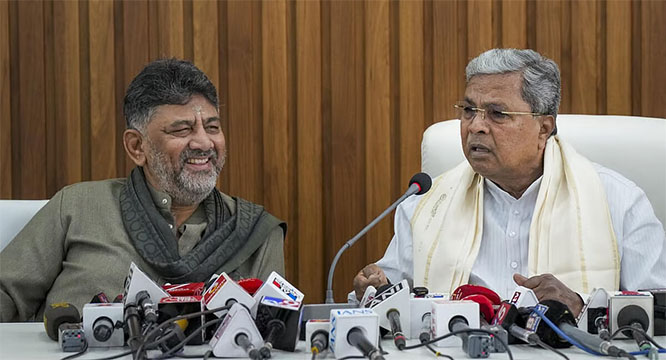
New Delhi: Karnataka chief minister Siddaramaiah and deputy CM DK Shivakumar on Saturday put up a dramatic display of unity at a closely watched joint press briefing, firmly dismissing weeks of speculation about a power-sharing tussle within the Congress. With the high command nudging both leaders to sit together and settle the dust, the meeting became a political spectacle, ending with the duo declaring that there was “no confusion, no differences.”

Calling the reports of a rift “manufactured confusion,” Siddaramaiah said the talks had gone smoothly, even joking about their breakfast. “Breakfast was very good. All three of us enjoyed it,” he said. “We want to end this confusion once and for all. For local elections and for 2028, our mission is clear — Congress must return to power. There is no difference between me and DKS, not now, not before.”

He blamed the media for fuelling rumours and reiterated absolute adherence to the party leadership. “From tomorrow, let there be no confusion. What the high command says, we will follow.”

Siddaramaiah also assured that the Assembly session starting December 8 would run smoothly and vowed that Congress would take on the BJP and JD(S) “together.”

Shivakumar echoed the chief minister word for word, stressing loyalty and discipline. “People have given us a massive mandate. It is our duty to deliver,” he said. “This government was formed under Siddaramaiah’s leadership. We both have complete trust in the high command. If they tell me to wait, I will wait.”

He added that the two leaders had discussed strategy for the 2028 Assembly elections. “Whatever the CM says, I agree. We are loyal soldiers of the party. The party may be facing challenges nationally, but we will keep it strong in Karnataka.”

Shivakumar also said Siddaramaiah would soon visit his home for lunch or dinner — another symbolic gesture meant to underline their unity.

Both leaders later posted on social media describing the breakfast meeting as “productive” and focused on “Karnataka’s priorities.”

The BJP, however, rejected the show of camaraderie as “pure bunkum,” accusing Congress of trying to paper over an internal power struggle. But Siddaramaiah and Shivakumar insisted their united front would continue — and that there was “no confusion” within the state leadership.

Comments

Add new comment

  • Coastaldigest.com reserves the right to delete or block any comments.
  • Coastaldigset.com is not responsible for its readers’ comments.
  • Comments that are abusive, incendiary or irrelevant are strictly prohibited.
  • Please use a genuine email ID and provide your name to avoid reject.
News Network
December 3,2025

arrival.jpg

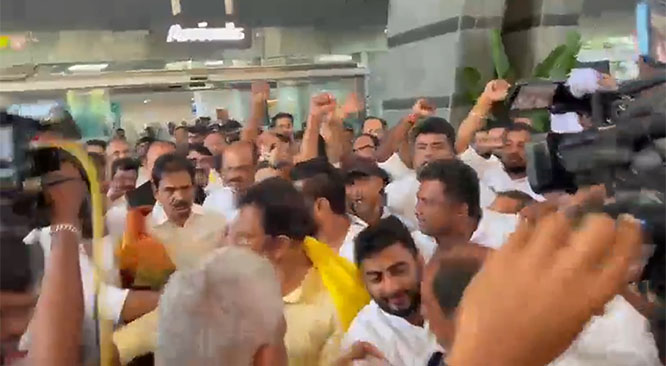
Mangaluru, Dec 3: A group of Congress workers gathered at the Mangaluru International Airport on Wednesday to welcome AICC general secretary K C Venugopal, but the reception quickly turned into a display of support for Deputy Chief Minister D K Shivakumar.

Venugopal arrived in the city to participate in the centenary commemoration of the historic dialogue between Mahatma Gandhi and Narayana Guru. The event, organised by the Sivagiri Mutt, Varkala, in association with the Mangalore University Sri Narayana Guru Study Chair, is being held on the university’s Konaje campus.

KPCC general secretary Mithun Rai and several party workers had assembled at the airport to receive Venugopal. However, the moment he stepped out, workers began raising slogans backing Shivakumar.

The university programme will be inaugurated by Chief Minister Siddaramaiah.

This show of support comes just a day after Siddaramaiah remarked that Shivakumar would lead the government “when the high command decides.” The chief minister made the comment after a breakfast meeting at Shivakumar’s residence—another public display of camaraderie between the two leaders amid ongoing attempts by the party high command to downplay their leadership rivalry.

Comments

Add new comment

  • Coastaldigest.com reserves the right to delete or block any comments.
  • Coastaldigset.com is not responsible for its readers’ comments.
  • Comments that are abusive, incendiary or irrelevant are strictly prohibited.
  • Please use a genuine email ID and provide your name to avoid reject.
News Network
November 26,2025

Mangaluru, Nov 26: Assembly Speaker and local MLA U.T. Khader has initiated a high-level push to resolve one of Mangaluru’s longest-standing traffic headaches: the narrow, high-density stretch of National Highway-66 between Nanthoor and Talapady.

He announced on Tuesday that a formal proposal has been submitted to the Union Ministry of Road Transport and Highways (MoRTH) seeking approval to prepare a Detailed Project Report (DPR) for the widening of this crucial corridor.

The plan specifically aims to expand the existing 45-meter road width to a full 60 meters, coupled with the construction of dedicated service roads. Khader highlighted that land for a 60-meter highway was originally acquired during the initial four-laning project, but only 45 meters were developed, leading to a perpetual bottleneck.

"With vehicle density rising sharply, the expansion has become unavoidable," Khader stated, stressing that the upgrade is essential for ensuring smoother traffic flow and improving safety at the city's main entry and exit points.

The stretch between Nanthoor and Talapady is a vital link on the busy Kochi-Panvel coastal highway and connects to major city junctions. The move to utilize the previously acquired land for the full 60-meter width is seen as a necessary measure to catch up with the region's rapid vehicular growth and prevent further traffic gridlocks.

Comments

Add new comment

  • Coastaldigest.com reserves the right to delete or block any comments.
  • Coastaldigset.com is not responsible for its readers’ comments.
  • Comments that are abusive, incendiary or irrelevant are strictly prohibited.
  • Please use a genuine email ID and provide your name to avoid reject.