



Shocking: India's richest 1% corner 73% of wealth generation

Agencies
January 22, 2018

Davos, Jan 22: The richest 1 per cent in India cornered 73 per cent of the wealth generated in the country last year, a new survey showed today, presenting a worrying picture of rising income inequality.

Besides, 67 crore Indians comprising the population's poorest half saw their wealth rise by just 1 per cent, as per the survey released by the international rights group Oxfam hours before the start of the annual congregation of the rich and powerful from across the world in this resort town.

The situation appears even more grim globally, where 82 per cent of the wealth generated last year worldwide went to the 1 per cent, while 3.7 billion people that account for the poorest half of population saw no increase in their wealth.

The annual Oxfam survey is keenly watched and is discussed in detail at the World Economic Forum Annual Meeting where rising income and gender inequality is among the key talking points for the world leaders.

Last year's survey had showed that India's richest 1 per cent held a huge 58 per cent of the country's total wealth -- higher than the global figure of about 50 per cent.

This year's survey also showed that the wealth of India's richest 1 per cent increased by over Rs 20.9 lakh crore during 2017 -- an amount equivalent to total budget of the central government in 2017-18, Oxfam India said.

The report titled 'Reward Work, Not Wealth', Oxfam said, reveals how the global economy enables wealthy elite to accumulate vast wealth even as hundreds of millions of people struggle to survive on poverty pay.

"2017 saw an unprecedented increase in the number of billionaires, at a rate of one every two days. Billionaire wealth has risen by an average of 13 per cent a year since 2010 -- six times faster than the wages of ordinary workers, which have risen by a yearly average of just 2 per cent," it said.

In India, it will take 941 years for a minimum wage worker in rural India to earn what the top paid executive at a leading Indian garment firm earns in a year, the study found.

In the US, it takes slightly over one working day for a CEO to earn what an ordinary worker makes in a year, it added.

Citing results of the global survey of 70,000 people surveyed in 10 countries, Oxfam said it demonstrates a groundswell of support for action on inequality and nearly two-thirds of all respondents think the gap between the rich and the poor needs to be urgently addressed.

With Prime Minister Narendra Modi attending the WEF meeting in Davos, Oxfam India urged the Indian government to ensure that the country's economy works for everyone and not just the fortunate few.

It asked the government to promote inclusive growth by encouraging labour-intensive sectors that will create more jobs; investing in agriculture; and effectively implementing the social protection schemes that exist.

Oxfam also sought sealing of the "leaking wealth bucket" by taking stringent measures against tax evasion and avoidance, imposing higher tax on super-rich and removing corporate tax breaks.

The survey respondents in countries like the US, UK and India also favoured 60 per cent pay cut for CEOs.

The key factors driving up rewards for shareholders and corporate bosses at the expense of workers' pay and conditions, Oxfam said, include erosion of workers' rights; excessive influence of big business over government policy- making; and the relentless corporate drive to minimise costs in order to maximise returns to shareholders.

About India, it said the country added 17 new billionaires last year, taking the total number to 101. The Indian billionaires' wealth increased to over Rs 20.7 lakh crore -- increasing during last year by Rs 4.89 lakh crore, an amount sufficient to finance 85 per cent of the all states' budget on health and education.

It also said India's top 10 per cent of population holds 73 per cent of the wealth and 37 per cent of India's billionaires have inherited family wealth. They control 51 per cent of the total wealth of billionaires in the country.

Oxfam India CEO Nisha Agrawal said it is alarming that the benefits of economic growth in India continue to concentrate in fewer hands.

"The billionaire boom is not a sign of a thriving economy but a symptom of a failing economic system. Those working hard, growing food for the country, building infrastructure, working in factories are struggling to fund their child's education, buy medicines for family members and manage two meals a day. The growing divide undermines democracy and promotes corruption and cronyism," she said.

The survey also showed that women workers often find themselves at the bottom of the heap and nine out of 10 billionaires are men.

In India, there are only four women billionaires and three of them inherited family wealth.

"It would take around 17.5 days for the best paid executive at a top Indian garment company to earn what a minimum wage worker in rural India will earn in their lifetime (presuming 50 years at work)," Oxfam said.

Comments

Ajay
 - 
Monday, 22 Jan 2018

In reality only 1% understand the value of money, rest 99% are busy with padmaavati to be released or not or celebrating the victory in bhima koreogaon

Babu Gowda
 - 
Monday, 22 Jan 2018

The black money held by some sections of the population in India might not have been accounted in the 73% money made by 1% of population. If all the money is accounted, it could be much more than 82%. In poorer countries like India, disparity between the rich and poor will be very high and widening year after year. It is a time bomb. 

Mohan
 - 
Monday, 22 Jan 2018

Still government says ...working for Poor ... but reality is opposite ...Working for rich and corporates .. 

Ravi
 - 
Monday, 22 Jan 2018

Increasing disparity always lead to social disorder and sometime revolts and civil war too !!! Rich''s should at their own should deploy their wealth for upliftment of downtrodden people else their wealth would not remain secured

Ganesh
 - 
Monday, 22 Jan 2018

it is evident that the nexus between politicians taking favourable decisions to benefit business tycoons and most of them are from same state where top leaders from! Why the hell other states are ignored!!

Chakravarthy
 - 
Monday, 22 Jan 2018

Rich save for generation and corner money where as poor do not know what will be their financial position tomorrow.The wide gap is not good for the country.

Karthik
 - 
Monday, 22 Jan 2018

Modi, what you have done?

Jinesh
 - 
Monday, 22 Jan 2018

A study should be done how this one percent spend their money, whether this wealth is getting invested in India or taken abroad

Add new comment

  • Coastaldigest.com reserves the right to delete or block any comments.
  • Coastaldigset.com is not responsible for its readers’ comments.
  • Comments that are abusive, incendiary or irrelevant are strictly prohibited.
  • Please use a genuine email ID and provide your name to avoid reject.
News Network
December 2,2025

A major upgrade in safety and monitoring is planned for Haj 2026, with every Indian pilgrim set to receive a Haj Suvidha smart wristband linked to the official Haj Suvidha mobile app. The initiative aims to support pilgrims—especially senior citizens—who may struggle with smartphones during the 45-day journey.

What the Smart Wristband Will Do

Officials said the device will come with:
•    Location tracking
•    Pedometer
•    SOS emergency button
•    Qibla compass
•    Prayer timings
•    Basic health monitoring

SP Tiwari, secretary of the UP State Haj Committee, said the goal is to make the pilgrimage safer and more comfortable.

“Most Hajis are elderly and not comfortable with mobile apps,” he said. “The smartwatch will help locate pilgrims who forget their way or cannot communicate their location.”

The wristbands will be monitored by the Consulate General of India in Saudi Arabia, similar to mobile tracking via the Haj Suvidha App.

Free Distribution and Training

•    Smart wristbands will be given free of cost.
•    Training for pilgrims will be conducted between January and February 2026.
•    Sample units will reach state Haj committees soon.
•    Final devices will be distributed as pilgrims begin their journey.

New Rules for Accommodation

Two major decisions have also been finalised for Haj 2026:
1.    Separate rooms for men and women – including married couples. They may stay on the same floor but must occupy different rooms, following stricter Saudi guidelines.
2.    Cooking banned – gas cylinders will not be allowed; all meals will be provided through official catering services arranged by the Haj Committee of India.

These decisions were finalised during a meeting of the Haj Committee of India and state representatives in Mumbai.

Haj Suvidha App Launched Earlier

The government launched the Haj Suvidha App in 2024, offering:

•    Training modules
•    Accommodation and flight details
•    Baggage information
•    SOS and translation tools
•    Grievance redressal

Haj 2026 Quota and Key States

•    India’s total Haj quota for 2026: 1,75,025 pilgrims
•    70% (1,25,000) allotted to the Haj Committee of India
•    30% (around 50,000) reserved for Haj Group Organisers

Uttar Pradesh has the largest allocation (around 30,000 seats), though approximately 18,000 pilgrims are expected to go this year. States with high pilgrim numbers include Kerala, Maharashtra and Gujarat.

Dates of Haj 2026

The pilgrimage is scheduled to take place from 24 May to 29 May, 2026 (tentative).
Haj is one of the five pillars of Islam and is mandatory for Muslims who meet the required conditions.

Comments

Add new comment

  • Coastaldigest.com reserves the right to delete or block any comments.
  • Coastaldigset.com is not responsible for its readers’ comments.
  • Comments that are abusive, incendiary or irrelevant are strictly prohibited.
  • Please use a genuine email ID and provide your name to avoid reject.
News Network
November 28,2025

ministerPM.jpg

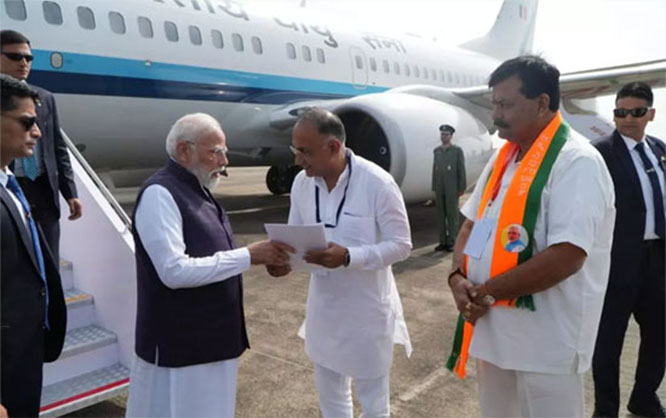
Mangaluru, Nov 28: Karnataka Health Minister and Dakshina Kannada district in-charge minister Dinesh Gundu Rao on Friday handed over Chief Minister Siddaramaiah’s letter to Prime Minister Narendra Modi, highlighting the severe distress faced by farmers due to crashing crop prices.

PM Modi arrived at the Mangaluru International Airport en route to Udupi, where Gundu Rao welcomed him and submitted the letter. The chief minister’s message stressed that farmers are suffering heavy losses because maize and green gram are being bought far below the Minimum Support Price (MSP). The state urged the Centre to immediately begin procurement at MSP.

According to the letter, Karnataka has a bumper harvest this year—over 54.74 lakh metric tons of maize and 1.98 lakh metric tons of green gram—yet farmers are unable to secure fair prices. Against the MSP of ₹2,400/MT for maize and ₹8,768/MT for green gram, market rates have plunged to ₹1,600–₹1,800 and ₹5,400 respectively.

The chief minister has requested the Centre to:

• Direct NAFED, FCI and NCCF to start MSP procurement immediately.
• Ensure ethanol units purchase maize directly from farmers or FPOs.
• Increase Karnataka’s ethanol allocation, citing high production capacity.
• Stop maize imports, which have depressed domestic prices.
• Relax quality norms for green gram, allowing up to 10% discoloration due to rains.

The letter stresses that MSP is crucial for farmer dignity and income stability and calls for swift central intervention to prevent a deepening crisis.

Comments

Add new comment

  • Coastaldigest.com reserves the right to delete or block any comments.
  • Coastaldigset.com is not responsible for its readers’ comments.
  • Comments that are abusive, incendiary or irrelevant are strictly prohibited.
  • Please use a genuine email ID and provide your name to avoid reject.
News Network
December 4,2025

Mangaluru: Chaos erupted at Mangaluru International Airport (MIA) after IndiGo flight 6E 5150, bound for Mumbai, was repeatedly delayed and ultimately cancelled, leaving around 100 passengers stranded overnight. The incident highlights the ongoing country-wide operational disruptions affecting the airline, largely due to the implementation of new Flight Duty Time Limitations (FDTL) norms for crew.

The flight was initially scheduled for 9:25 PM on Tuesday but was first postponed to 11:40 PM, then midnight, before being cancelled around 3:00 AM. Passengers expressed frustration over last-minute communication and the lack of clarity, with elderly and ailing travellers particularly affected. “Though the airline arranged food, there was no proper communication, leaving us confused,” said one family member.

An IndiGo executive at MIA cited the FDTL rules, designed to prevent pilot fatigue by limiting crew working hours, as the cause of the cancellation. While alternative arrangements, including hotel stays, were offered, about 100 passengers chose to remain at the airport, creating tension. A replacement flight was arranged but also faced delays due to the same constraints, finally departing for Mumbai around 1:45 PM on Wednesday. Passengers either flew, requested refunds, or postponed their travel.

The Mangaluru delay is part of a broader crisis for IndiGo. The airline has been forced to make “calibrated schedule adjustments”—a euphemism for widespread cancellations and delays—after stricter FDTL norms came into effect on November 1.

While an IndiGo spokesperson acknowledged unavoidable flight disruptions due to technology issues, operational requirements, and the updated crew rostering rules, the DGCA has intervened, summoning senior airline officials to explain the chaos and outline corrective measures.

The ripple effect has been felt across the country, with major hubs like Bengaluru and Mumbai reporting numerous cancellations. The Mangaluru incident underscores the systemic operational strain currently confronting India’s largest carrier, leaving passengers nationwide grappling with uncertainty and delays.

Comments

Add new comment

  • Coastaldigest.com reserves the right to delete or block any comments.
  • Coastaldigset.com is not responsible for its readers’ comments.
  • Comments that are abusive, incendiary or irrelevant are strictly prohibited.
  • Please use a genuine email ID and provide your name to avoid reject.