



Saudi Arabia bans foreign workers in 12 sectors; Indian expats to be affected

Agencies
February 6, 2018

New Delhi, Feb 6: In a bid to pressure companies into hiring more Saudi citizens and reduce unemployment in the country, the Kingdom of Saudi Arabia has imposed a restriction on the expatriates from working in 12 sectors.

The tighter policy has been approved by Labor Minister Ali bin Nasser al-Ghafis, a report in Prabhat Khabar said.

The new rule could potentially affect large numbers of people since about 12 million foreigners work in Saudi Arabia, doing many of the strenuous, dangerous and lower-paid jobs shunned by 20 million Saudi citizens.

The restriction is also likely to affect over 30 lakh Indians who live and work in Saudi Arabia.

Minister of Labour and Social Development will restrict working in these 12 sectors in a phased manner.

The following sectors will be restricted for hiring of expatriates from September 11, 2018:

- Car and motorbike showrooms

- Readymade clothes stores

- Home and office furniture stores

- Home appliances and kitchen utensils stores

The following sectors will be restricted for hiring of expatriates from November 9, 2018

- Electronics stores

- Watches and clocks stores

- Optics stores

The following sectors will be restricted for hiring of expatriates from January 7, 2019

- Medical equipment and supplies stores

- Building material stores

- Auto spare parts stores

- Carpet selling stores

- Sweet shops

The jobless rate among Saudis aged 15 to 24 stood at 32.6 percent last year, according to the International Labour Organisation. Saudi Arabia posted an economic contraction in 2017 for the first time in eight years due to severe austerity measures.

The new rule is a part of the ongoing economic reforms launched last year to ease joblessness among Saudis by 2020. Saudi Arabia is India's fourth largest trade partner after China, the US and the UAE.

The country is a major source of India's energy requirement as it accounts for almost one-fifth of India's crude oil requirement.

Comments

Nagesh
 - 
Tuesday, 6 Feb 2018

maybe they could sell pakodas there.


Hari
 - 
Tuesday, 6 Feb 2018

Why it affects only workers? What about the people who running companies or business there? Through them country getting benefit. so those people needed..!

Kumar
 - 
Tuesday, 6 Feb 2018

It will affect more to Indian economy. Indian economy bulit by arab countries money... by indian people who work in arab countries

Danish
 - 
Tuesday, 6 Feb 2018

Indirectly they are doing Swadeshi movement. many countries following the same thing.

Mohan
 - 
Tuesday, 6 Feb 2018

India should do the same for creating more job oppurtunities to Indian citizens

Ganesh
 - 
Tuesday, 6 Feb 2018

Many countries doing the same for protecting their people. Foreigners doing work their may create lack of jobs for citizens.

Add new comment

  • Coastaldigest.com reserves the right to delete or block any comments.
  • Coastaldigset.com is not responsible for its readers’ comments.
  • Comments that are abusive, incendiary or irrelevant are strictly prohibited.
  • Please use a genuine email ID and provide your name to avoid reject.
News Network
December 4,2025

Udupi: A 40-year-old NRI from Udupi has reportedly lost more than Rs 12.25 lakh in an online investment scam operated through Telegram.

According to a complaint filed at the CEN police station, Leo Jerome Mendonsa, who has been working in Dubai for the past 15 years in computer accessories sales, maintains NRI accounts in Karkala and Nitte.

On November 12, 2025, Mendonsa was added to a Telegram group called Instaflow Earnings by unknown individuals. Users identified as Priya and Dipannita persuaded him to invest in “Revenue Tasks.” Initially, Mendonsa transferred Rs 1,100 multiple times and received the promised returns, encouraging him to continue.

On November 14, another user, Nishmitha Shetty, directed him to register on a website, digitvisionuoce.cc, and invest Rs 4 lakh in various shares. Over the next few days, he made multiple transfers totaling Rs 12,25,000, including Rs 50,000 via Google Pay, believing the scheme was legitimate.

After receiving the money, the alleged handlers stopped responding, and neither the invested amount nor the promised profits were returned.

The CEN police have registered a case under Sections 66(C) and 66(D) of the IT Act and Section 318(4) of the Bharatiya Nyaya Sanhita (BNS), and investigations are ongoing.

Comments

Add new comment

  • Coastaldigest.com reserves the right to delete or block any comments.
  • Coastaldigset.com is not responsible for its readers’ comments.
  • Comments that are abusive, incendiary or irrelevant are strictly prohibited.
  • Please use a genuine email ID and provide your name to avoid reject.
News Network
November 29,2025

DKSsiddu.jpg

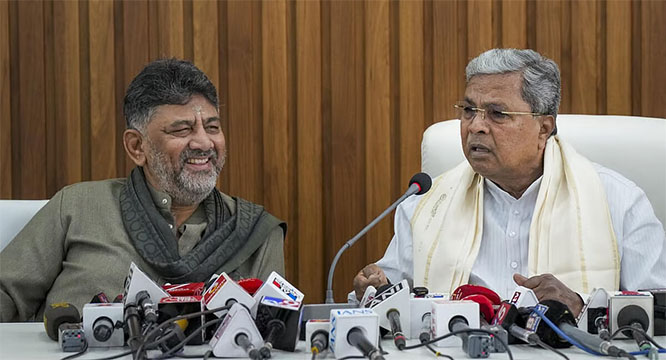
New Delhi: Karnataka chief minister Siddaramaiah and deputy CM DK Shivakumar on Saturday put up a dramatic display of unity at a closely watched joint press briefing, firmly dismissing weeks of speculation about a power-sharing tussle within the Congress. With the high command nudging both leaders to sit together and settle the dust, the meeting became a political spectacle, ending with the duo declaring that there was “no confusion, no differences.”

Calling the reports of a rift “manufactured confusion,” Siddaramaiah said the talks had gone smoothly, even joking about their breakfast. “Breakfast was very good. All three of us enjoyed it,” he said. “We want to end this confusion once and for all. For local elections and for 2028, our mission is clear — Congress must return to power. There is no difference between me and DKS, not now, not before.”

He blamed the media for fuelling rumours and reiterated absolute adherence to the party leadership. “From tomorrow, let there be no confusion. What the high command says, we will follow.”

Siddaramaiah also assured that the Assembly session starting December 8 would run smoothly and vowed that Congress would take on the BJP and JD(S) “together.”

Shivakumar echoed the chief minister word for word, stressing loyalty and discipline. “People have given us a massive mandate. It is our duty to deliver,” he said. “This government was formed under Siddaramaiah’s leadership. We both have complete trust in the high command. If they tell me to wait, I will wait.”

He added that the two leaders had discussed strategy for the 2028 Assembly elections. “Whatever the CM says, I agree. We are loyal soldiers of the party. The party may be facing challenges nationally, but we will keep it strong in Karnataka.”

Shivakumar also said Siddaramaiah would soon visit his home for lunch or dinner — another symbolic gesture meant to underline their unity.

Both leaders later posted on social media describing the breakfast meeting as “productive” and focused on “Karnataka’s priorities.”

The BJP, however, rejected the show of camaraderie as “pure bunkum,” accusing Congress of trying to paper over an internal power struggle. But Siddaramaiah and Shivakumar insisted their united front would continue — and that there was “no confusion” within the state leadership.

Comments

Add new comment

  • Coastaldigest.com reserves the right to delete or block any comments.
  • Coastaldigset.com is not responsible for its readers’ comments.
  • Comments that are abusive, incendiary or irrelevant are strictly prohibited.
  • Please use a genuine email ID and provide your name to avoid reject.
News Network
December 6,2025

pilot.jpg

New Delhi: IndiGo, India’s largest airline, faced major operational turbulence this week after failing to prepare for new pilot-fatigue regulations issued by the Directorate General of Civil Aviation (DGCA). The stricter rules—designed to improve flight safety—took effect in phases through 2024, with the latest implementation on November 1. IndiGo has acknowledged that inadequate roster planning led to widespread cancellations and delays.

Below are the key DGCA rules that affected IndiGo’s operations:

1. Longer Mandatory Weekly Rest

Weekly rest for pilots has been increased from 36 hours to 48 hours.

The government says the extended break is essential to curb cumulative fatigue. This rule remains in force despite the current crisis.

2. Cap on Night Landings

Pilots can now perform only two night landings per week—a steep reduction from the earlier limit of six.

Night hours, defined as midnight to early morning, are considered the least alert period for pilots.

Given the disruptions, this rule has been temporarily relaxed for IndiGo until February 10.

3. Reduced Maximum Night Flight Duty

Flight duty that stretches into the night is now capped at 10 hours.

This measure has also been kept on hold for IndiGo until February 10 to stabilize operations.

4. Weekly Rest Cannot Be Replaced With Personal Leave

Airlines can no longer count a pilot’s personal leave as part of the mandatory 48-hour rest.

Pilots say this closes a loophole that previously reduced actual rest time.

Currently, all airlines are exempt from this rule to normalise travel.

5. Mandatory Fatigue Monitoring

Airlines must submit quarterly fatigue reports along with corrective actions to DGCA.

This system aims to create a transparent fatigue-tracking framework across the industry.

The DGCA has stressed that these rules were crafted to strengthen flight safety and align India with global fatigue-management standards. The temporary relaxations are expected to remain until February 2025, giving IndiGo time to stabilise its schedules and restore normal air travel.

Comments

Add new comment

  • Coastaldigest.com reserves the right to delete or block any comments.
  • Coastaldigset.com is not responsible for its readers’ comments.
  • Comments that are abusive, incendiary or irrelevant are strictly prohibited.
  • Please use a genuine email ID and provide your name to avoid reject.
