Mukesh Ambai richest Indian; Jeff Bezos tops global rich list

Agencies
March 7, 2018

New York, Mar 7: Mukesh Ambani's net worth has soared to $40.1 billion, making him the richest Indian for the 11th year in a row, while Amazon founder Jeff Bezos toppled Bill Gates as the world's wealthiest person, says Forbes.

According to Forbes' 2018 'World's Billionaires' list, Reliance Industries Chairman Mukesh Ambani's wealth surged a whopping 72.84% to $40.1 billion (Rs 2,60,622 crore) - highest among the 119 Indian billionaires on the list.

Ambani was ranked 19th globally, up from 33rd position in 2017.

"Mukesh Ambani chairs and runs $51 billion (revenues) oil and gas giant Reliance Industries, among India's most valuable companies," Forbes said.

Bezos, referred to as the "Centi-billionaire", topped the list with a net worth of $112 billion, becoming the only person to appear in the Forbes list with a 12-figure fortune.

"Shares of his e-commerce giant Amazon rose 59% in 12 months, helping boost his fortune by $39.2 billion. It was the biggest one year gain since Forbes started tracking billionaires in 1987," it said.

The Amazon founder moved ahead of Bill Gates, who is now the second richest person globally with a fortune of $90 billion.

According to Forbes, India is home to 119 billionaires, 18 more than last year.

This year's list consists of 2,043 of the richest people in the world.

The combined net worth of this elite group is a whopping $9.1 trillion, up 18% since last year. Their average net worth is a record $4.1 billion.

Azim Premji is the second richest Indian and was ranked 58th on the overall list with a net worth of $18.8 billion, followed by Lakshmi Mittal (62nd position, net worth of $18.5 billion), Shiv Nadar (98th, $14.6 billion) and Dilip Shanghvi (115th, $12.8 billion).

The 10 richest Indians include Kumar Birla, ranked 127th overall with a fortune of $11.8 billion, Uday Kotak (143, $ 10.7 billion), Radhakishan Damani (151, $10 billion), Gautam Adani (154, $ 9.7 billion) and Cyrus Poonawalla (170, $9.1 billion).

Acharya Balkrishna, the co-founder of FMCG company Patanjali Ayurved, was ranked 274th on the list with a net worth of $6.3 billion.

"Acharya Balkrishna derives his fortune from fast-growing consumer goods giant Patanjali Ayurved. Balkrishna owns 98.6% of the privately-held company, which he cofounded with politically well-connected yoga guru Baba Ramdev," Forbes said.

Meanwhile, Anil Ambani, the younger sibling of Mukesh Ambani was ranked 887th on the list with a net worth of $2.7 billion.

Indian jeweller Nirav Modi is among the drop-offs from the list, along with Papa John's Pizza founder John Schnatter, Christoffel Wiese of South Africa, and Saudi Arabia's Prince Alwaleed Bin Talal Al Saud.

Donald Trump, who became the first billionaire president in US history in January 2017, was ranked 766th on the list, down from 544, with a fortune of $3.1 billion.

Trump's fortune fell $400 million since March 2017.

There were 259 newcomers, including the first ever cryptocurrency billionaires, while 121 dropped out due to falling fortunes or political headwinds, including 10 Saudi Arabians.

Forbes further noted that the gap between the really rich and the merely rich continues to widen, as fortunes soar to new heights so much so that the 20 richest people on the planet are worth a staggering $1.2 trillion, a sum roughly equivalent to the annual economic output of Mexico.

"In aggregate, they may represent less than 1% of total billionaires but their riches amount to 13% of the total fortune of all billionaires worldwide," Forbes said.

The Forbes Worlds Billionaires list is a snapshot of wealth using stock prices and exchange rates from February 9, 2018.

Comments

JP
 - 
Wednesday, 7 Mar 2018

ACHE DIN ....ATLEAST FOR AMBANI/ADANI

Add new comment

  • Coastaldigest.com reserves the right to delete or block any comments.
  • Coastaldigset.com is not responsible for its readers’ comments.
  • Comments that are abusive, incendiary or irrelevant are strictly prohibited.
  • Please use a genuine email ID and provide your name to avoid reject.
News Network
December 7,2025

envoy.jpg

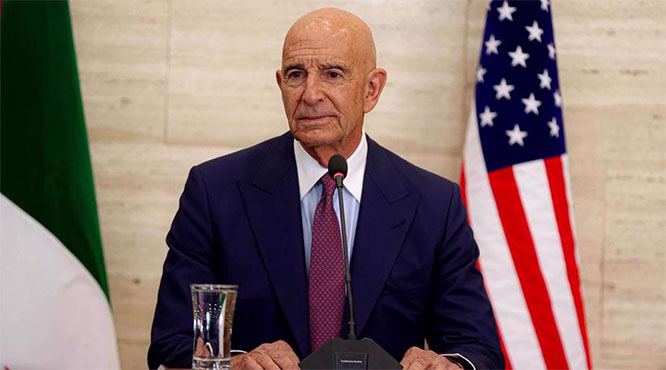
Since 1946, the United States has attempted 93 coups or “regime change” operations across the world — including two in Iran, US Special Envoy for Syria Tom Barrack has admitted.

Speaking to the UAE-based IMI Media Group, in remarks published by The National, Barrack said Washington tried twice to overthrow the Iranian government but failed both times. 

“For (Trump) then to be imputed with regime change — we had two regime changes in Iran already. Neither one worked. So I think wisely leave it to the region to solve,” said Barrack, who also serves as the US ambassador to Turkey.

His comments come six months after the US joined Israel in airstrikes against Iran during ongoing indirect nuclear negotiations between Tehran and Washington.

On June 13, Israel launched an attack on Iran that killed at least 1,064 people and hit civilian infrastructure. Days later, the United States targeted three nuclear facilities — Fordow, Natanz and Isfahan — in what Iran called a clear violation of international law. Iranian retaliation eventually forced a halt to the assault on June 24.

Barrack further claimed that US President Donald Trump and Foreign Secretary Marco Rubio are “not into regime change” and prefer a regional approach driven by Middle Eastern countries themselves. According to him, regional dialogue and non-interference by outside powers offer a more durable path forward.

He added that Washington is still open to an agreement with Tehran if Iranian authorities show “seriousness” and willingness to engage constructively.

However, Iran maintains the US has not shown readiness for meaningful talks. In an interview with Japan’s Kyodo News, Iranian Foreign Minister Abbas Araghchi said negotiations could advance only if Washington acknowledges Iran’s right to peaceful nuclear energy and lifts unilateral sanctions.

Comments

Add new comment

  • Coastaldigest.com reserves the right to delete or block any comments.
  • Coastaldigset.com is not responsible for its readers’ comments.
  • Comments that are abusive, incendiary or irrelevant are strictly prohibited.
  • Please use a genuine email ID and provide your name to avoid reject.
News Network
December 3,2025

indigo.jpg

IndiGo, India’s largest airline, is battling one of its worst operational disruptions in recent years, with hundreds of delays and cancellations throwing domestic travel into chaos.

Government data on Tuesday showed its on-time performance plunging to 35%, an unusual dip for a carrier long associated with punctuality.

By Wednesday afternoon, airports in Delhi, Mumbai, Bengaluru and Hyderabad had collectively reported close to 200 cancellations, stranding travellers across the country.

Crew Shortage After New Duty Norms

A major trigger behind the meltdown is a severe crew shortage, especially among pilots, following the rollout of revised Flight Duty Time Limitation (FDTL) norms last month.

The rules mandate longer rest hours and more humane rosters — a shift IndiGo has struggled to incorporate across its vast network.

Sources said several flights were grounded due to lack of cabin crew, while some delays stretched upwards of eight hours.

With IndiGo controlling over 60% of India’s domestic aviation market, the ripple effect has impacted airports nationwide.

IndiGo Issues Apology, Lists “Compounding Factors”

In a statement, IndiGo acknowledged the large-scale disruption:

“We sincerely apologise to customers. A series of unforeseen operational challenges — technology glitches, winter schedule changes, adverse weather, system congestion and updated FDTL norms — created a compounding impact that could not have been anticipated.”

To stabilise operations, the airline has begun calibrated schedule adjustments for the next 48 hours, aiming to restore punctuality. Affected passengers are being offered refunds or alternate travel arrangements, IndiGo said.

What the FDTL Rules Require

The FDTL norms, designed to reduce pilot fatigue, cap duty and flying hours as follows:
•    Maximum 8 hours of flying per day
•    35 hours per week
•    125 hours per month
•    1,000 hours per year

Crew must also receive rest equalling twice the flight duration, with a minimum 10-hour rest period in any 24-hour window.

The DGCA introduced these limits to enhance flight safety.

Hyderabad: 33 Flights Cancelled, Long Queues Reported

Hyderabad’s Rajiv Gandhi International Airport saw heavy early-morning crowds as 33 IndiGo flights (arrivals and departures) were cancelled.

The airport clarified on X that operations were normal, advising passengers to contact IndiGo directly for latest flight status.

Cancellations included flights to and from Visakhapatnam, Goa, Ahmedabad, Delhi, Bengaluru, Chennai, Madurai, Hubli, Bhopal and Bhubaneswar.

Bengaluru: 42 Flights Disrupted

Bengaluru’s Kempegowda International Airport recorded 42 cancellations — 22 arrivals and 20 departures — affecting routes to Delhi, Mumbai, Chennai, Hyderabad, Goa, Kolkata and Lucknow.

Passengers Vent on Social Media

Irate travellers took to X to share their experiences. One passenger stranded in Hyderabad wrote: “I have been here since 3 a.m. and missed an important meeting.”

Another said: “My flight was pushed from 1:55 PM to 2:55 PM and now 4:35 PM. I was informed only three minutes before entering the airport.”

Delhi Airport Hit by Tech Glitch

At Delhi Airport, the disruption deepened due to a slowdown in the Amadeus system — used for reservations, check-ins and departure control.

The technical issue led to longer queues and sluggish processing, adding to delays already worsened by staff shortages.

Comments

Add new comment

  • Coastaldigest.com reserves the right to delete or block any comments.
  • Coastaldigset.com is not responsible for its readers’ comments.
  • Comments that are abusive, incendiary or irrelevant are strictly prohibited.
  • Please use a genuine email ID and provide your name to avoid reject.