Govt’s attack on media, civil society: India rated as an ‘electoral autocracy’ by global institute

Agencies
March 11, 2021

The world's largest democracy is actually an 'electoral autocracy', according to a report.

According to a report by Sweden-based institute Varieties of Democracy (V-Dem), India is now among top 10 countries globally along with Brazil and Turkey where democracy has declined. 

In an electoral autocratic regime, "ruling governments first attack the media and civil society and polarise societies by disrespecting opponents and spreading false information," the report said.

Currently, countries moving toward autocratisation outnumber countries where democracy is advancing, it added.

V-Dem's report said that India's Liberal Democracy Index (LDI) "declined from 0.57 in 2010 to 0.34 in 2020, following the government led by Prime Minister Modi placing restrictions on multiple facets of democracy such as civil society and free speech."

According to the report, a "striking pattern" has emerged within (former) democracies. "After the attack on media and civil societies, there is disrespect for political opponents to feed polarisation while using the machinery of the government to spread disinformation. Finally, there is an attack on core democratic foundations: elections and formal institutions", it said.

In India, it is only after the election of the Bhartiya Janata Party and Narendra Modi in 2014 that reportedly led to India's 23-percentage point drop on the 0 to 1 LDI scale. 

It is under the regime of this government, the report finds, that the "diminishing of freedom of expression, the media, and civil society have gone the furthest" with censorship becoming a routine affair.

According to V-Dem's report, India is at the same level of autocraticity as Pakistan and is worse than Nepal and Bangladesh. The Modi-led government repeatedly used "laws on sedition, defamation and counterterrorism to silence critics," it added.

As for elections, "the overall freedom and fairness of elections also was hard hit, with the last elections held under Prime Minister Modi’s reign in 2019, precipitating a downgrading to an electoral autocracy," the report said.

The report also claims that the current government has stifled dissent in academia and opposition under the garb of the Unlawful Activities (Prevention) Act, and the government is repressing civil society organisations by controling which ones enter or exit the nation by using the Forign Contributions Regulation Act (FCRA). On the other hand, it also alleges that civil society organisations that align themselves with Hindutva movement and ideology have gained more freedom.

Last week, a US 2021 Freedom House report downgraded India's status from "free" to "partly free." It cited India's "crackdown" on critics and its "ham-fisted" Covid-19 lockdown leading to "dangerous and unplanned displacement" of millions of migrant workers as the reasons for the slip in the country's status. The Indian government, however, strongly critiqued the report's claim, calling it 'misleading, incorrect and misplaced.'

Comments

Ramesh Mishra
 - 
Saturday, 20 Mar 2021

INDIA "ELECTORAL AUTOCRACY"
I am an Uttar Pradesh Non-Resident Indian ["UP NRI"] residing in Canada since 1975, I have studied, travelled and worked around the world for over 50 years. My comment is based on my learning and experience, present India is absolutely lawless, corruption, bribery and influence-peddling have irreparably damaged the country. I witnessed illiterates, uncivilised gangsters are chosen as IAS, IPS and PCS their sole purpose to join the public service to loot the innocent public and they inflict atrocities, crimes against humanity whoever they target. The Indian Leaders mostly believe in "Might is Right", Leaders dance around IAS, IPS and PCS like dancers and worship IAS, IPS and PCS as their Gods. The majority of Leaders put a large red spot on their head and fold their hands to fool the public. The Indian Leaders at every level lack leadership having no vision for the future. India has an honest world-class High Courts and the Supreme Court justice with genuine wisdom to protect the people of India, tragically the majority of the litigants are irreparably damaged by the Subordinate Court Justices who have no legal skill and no legal mind. Tragically I became the victim, IAS, IPS and PCS who inflicted atrocities on me and my family of Canada. I Prayed Modi, Yogi and several others for the protection of my life and property, all of which turned a blind eye to my genuine prayers. The Liberal Democracy of India is a facade to hoodwinked people. A big red spot on the head and folding hands is a false facade to cheat the public. In my opinion, the future of India is uncertain.
With gratitude
Ramesh Mishra
Canada

Add new comment

  • Coastaldigest.com reserves the right to delete or block any comments.
  • Coastaldigset.com is not responsible for its readers’ comments.
  • Comments that are abusive, incendiary or irrelevant are strictly prohibited.
  • Please use a genuine email ID and provide your name to avoid reject.
P A Hameed Padubidri
November 26,2025

CD.jpg

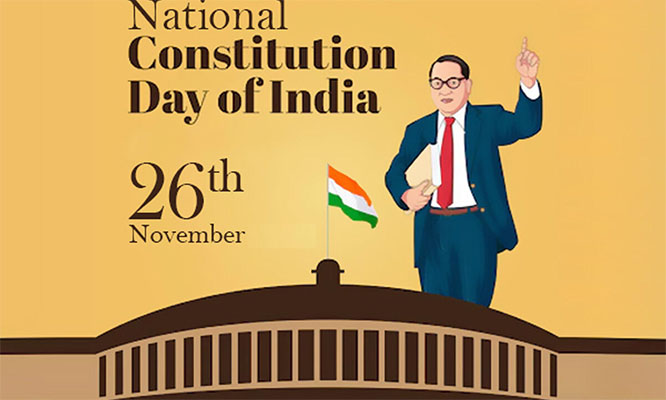
Constitution Day, also known as Samvidhan Divas, is observed every year on November 26 to honor the adoption of the Constitution of India and to recognize the visionary effort that shaped the world’s largest democracy.

Historical Background

It’s on November 26, 1949, the Constituent Assembly of India formally adopted the Constitution.This date is commemorated to acknowledge the completion of nearly three years of drafting, debate, and refinement.

On January 26, 1950, the Constitution came into force, marking India’s transition from a dominion to a sovereign republic.

The date 26 January was chosen to honor the “Purna Swaraj” declaration made in 1930 that marked the relentless efforts & sacrifices of the many. 

Why Constitution Day is Celebrated

* To honor & remember the framers of the Constitution, especially Dr. B. R. Ambedkar, the Chairman of the Drafting Committee, & many others. 

* To remind the citizens of the values, responsibilities, and rights enshrined in the Constitution.

* To promote constitutional values & literacy among students, institutions, and the general public.

* To reaffirm the nation’s commitment to justice, equality, liberty, fraternity and secular values. 

Vision and Significance of the Constitution

It establishes the fundamental political and legal framework for the nation.

Defines the structure, powers and functions of:
    •    The Executive
    •    The Legislature
    •    The Judiciary
    •    Guarantees a comprehensive set of Fundamental Rights, including:

-Equality before law
-Freedom of speech & expression
-Protection of life and personal liberty
-Freedom of religion
-Embeds Directive Principles of State Policy, guiding governance toward social justice and welfare.
-Introduces Fundamental Duties to ensure civic responsibility among citizens.

Key Features Celebrated on Constitution Day

-The Indian constitution is considered one of the longest written constitutions of the world. It’s systematically drafted considering almost all aspects that properly fits to the country. 

-Blend of multiple global constitutional principles while staying rooted in Indian values and realities.

-Framework that balances Federalism, Secularism, Democracy and Rule of Law. This makes everyone-from President to common man-below the law & are equal in the sight of law. 

-Another feature is that it’s based on built-in mechanisms for amendments, ensuring the Constitution grows with changing needs.

Message of the Day

The core ethos of this  Constitution Day is not merely about looking back at history-it’s a reminder of the continuous duty to protect democratic values, respect diversity and uphold the principles that define India as a sovereign, socialist, secular and democratic republic.

Happy Constitution Day to all my compatriots

Comments

Add new comment

  • Coastaldigest.com reserves the right to delete or block any comments.
  • Coastaldigset.com is not responsible for its readers’ comments.
  • Comments that are abusive, incendiary or irrelevant are strictly prohibited.
  • Please use a genuine email ID and provide your name to avoid reject.
News Network
December 6,2025

indigoticket.jpg

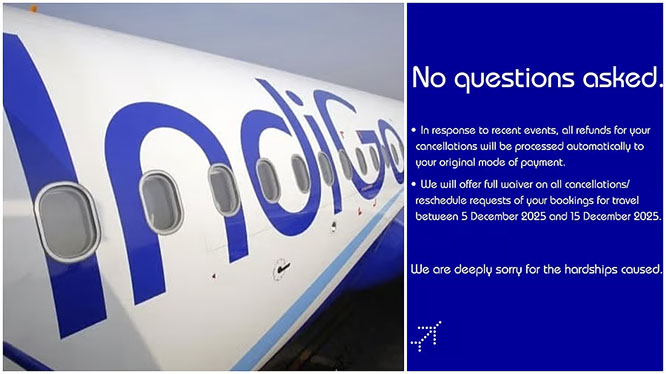
With IndiGo flight disruptions impacting thousands of passengers, the airline on Saturday said that it will offer full waiver on all cancellations/reschedule requests for travel bookings between December 5, 2025 and December 15, 2025.

Earlier in the day, the civil aviation ministry had directed the airline to complete the ticket refund process for the cancelled flights by Sunday evening, as well as ensure baggage separated from the travellers are delivered in the next two days.

In a post on X, titled 'No questions asked', IndiGo wrote, "In response to recent events, all refunds for your cancellations will be processed automatically to your original mode of payment."

"We are deeply sorry for the hardships caused," it further added.

Several passengers, however, complained of not getting full refund as promised by the airline.

Netizens have shared screenchots of getting charged for airline cancellation fee and convenience fee.

"Please tell me why u have did this airline cancellation charges when u say full amount will be refunded (sic)," a user wrote sharing a screenshot of the refund page.

"Well, but you have still debited the convenience charges," wrote another.

Passengers have also raised concerns about the "cancel" option being disabled on the IndiGo app. "First enable the 'Cancel' button on your App & offer full refund on tickets cancelled by customers between the said dates," wrote a user.

A day after the country's largest airline, IndiGo, cancelled more than 1,000 flights and caused disruptions for the fifth day on Saturday, the ministry said that any delay or non-compliance in refund processing will invite immediate regulatory action.

The refund process for all cancelled or disrupted flights must be completed by 8 pm on Sunday, the ministry said in a statement.

"Airlines have also been instructed not to levy any rescheduling charges for passengers whose travel plans were affected by cancellations," it said.

On Saturday, more than 400 flights were cancelled at various airports.

IndiGo has also been instructed to set up dedicated passenger support and refund facilitation cells.

Comments

Add new comment

  • Coastaldigest.com reserves the right to delete or block any comments.
  • Coastaldigset.com is not responsible for its readers’ comments.
  • Comments that are abusive, incendiary or irrelevant are strictly prohibited.
  • Please use a genuine email ID and provide your name to avoid reject.
News Network
December 6,2025

pilot.jpg

New Delhi: IndiGo, India’s largest airline, faced major operational turbulence this week after failing to prepare for new pilot-fatigue regulations issued by the Directorate General of Civil Aviation (DGCA). The stricter rules—designed to improve flight safety—took effect in phases through 2024, with the latest implementation on November 1. IndiGo has acknowledged that inadequate roster planning led to widespread cancellations and delays.

Below are the key DGCA rules that affected IndiGo’s operations:

1. Longer Mandatory Weekly Rest

Weekly rest for pilots has been increased from 36 hours to 48 hours.

The government says the extended break is essential to curb cumulative fatigue. This rule remains in force despite the current crisis.

2. Cap on Night Landings

Pilots can now perform only two night landings per week—a steep reduction from the earlier limit of six.

Night hours, defined as midnight to early morning, are considered the least alert period for pilots.

Given the disruptions, this rule has been temporarily relaxed for IndiGo until February 10.

3. Reduced Maximum Night Flight Duty

Flight duty that stretches into the night is now capped at 10 hours.

This measure has also been kept on hold for IndiGo until February 10 to stabilize operations.

4. Weekly Rest Cannot Be Replaced With Personal Leave

Airlines can no longer count a pilot’s personal leave as part of the mandatory 48-hour rest.

Pilots say this closes a loophole that previously reduced actual rest time.

Currently, all airlines are exempt from this rule to normalise travel.

5. Mandatory Fatigue Monitoring

Airlines must submit quarterly fatigue reports along with corrective actions to DGCA.

This system aims to create a transparent fatigue-tracking framework across the industry.

The DGCA has stressed that these rules were crafted to strengthen flight safety and align India with global fatigue-management standards. The temporary relaxations are expected to remain until February 2025, giving IndiGo time to stabilise its schedules and restore normal air travel.

Comments

Add new comment

  • Coastaldigest.com reserves the right to delete or block any comments.
  • Coastaldigset.com is not responsible for its readers’ comments.
  • Comments that are abusive, incendiary or irrelevant are strictly prohibited.
  • Please use a genuine email ID and provide your name to avoid reject.