PM Modi’s Cabinet Reboot: 43 new, old ministers taking oath

News Network
July 7, 2021

New Delhi: Forty-three new ministers will be sworn-in this evening as Prime Minister Narendra Modi tries to revamp his administration that has been heavily criticised over the handling of the coronavirus crisis, soaring prices and resentment from several sections.

The names in the cabinet reshuffle include several new entrants as well as existing ministers who will be reassigned.

In an unexpected move, Ravi Shankar Prasad, who held key portfolios of law and information technology, and Prakash Javadekar, the minister for environment, information and broadcasting and heavy industries, stepped down.

Also among the top ministers who were asked resign was Health Minister Harsh Vardhan, paying the political price for the government's struggles to cope with a devastating second wave of coronavirus infections.

In all, at least 12 ministers have resigned including prominent ones like Education Minister Ramesh Pokhriyal Nishank and junior Environment Minister Babul Supriyo.

The "big four" ministers for finance, foreign affairs, home and defence, however, are unlikely to be changed.

Before announcing his first cabinet reshuffle since winning a second term in 2019, PM Modi consulted leaders of his BJP, a government official said.

Government sources said the Prime Minister had been aiming to include younger members of his party to be ministers and also give greater representation to women and backward classes - a crucial consideration ahead of important state elections starting with Uttar Pradesh early next year.

There are plans for a ceremony to swear in new ministers at the Rashtrapati Bhavan at 6 pm. Only a small number of people will be attending the ceremony due to the coronavirus risk.

PM Modi's government has faced its most stinging criticism in years as the infections and deaths surged in April and May, overwhelming hospitals and crematoriums.

Images of bodies of presumed COVID-19 victims washed up on the banks of the Ganges river fuelled outrage over a failure to do more to protect vulnerable communities.

Senior Congress leader P Chidambaram was among the first to comment on the changes.

"The resignations of the Union Health Minister and the MoS (Minister of State) Health is a candid confession that the Modi government has utterly failed in managing the pandemic," Mr Chidambaram tweeted.

"There is a lesson for ministers in these resignations. If things go right the credit will go to the PM, if things go wrong the Minister will be the fall guy. That is the price a Minister pays for implicit obedience and unquestioning  subservience," he wrote.

Here is the list of ministers who will take oath on Wednesday for their new departments:

1. Narayan Rane
2. Sarbananda Sonowal
3. Dr. Virendra Kumar
4. Jyotiraditya M Scindia
5. Ramchandra Prasad Singh
6. Ashwini Vaishnaw
7. Pashupati Paras
8. Kiren Rijiju
9. Raj Kumar Singh
10.Hardeep Singh Puri
11.Mansukh Mandaviya
12.Bhupender Yadav
13.Parshottam Rupala
14.G. Kishan Reddy
15.Anurag Singh Thakur
16.Pankaj Choudhary
17. Anupriya Singh Patel
18.Dr. Satya Pal Singh Baghel
19. Rajeev Chandrasekhar
20.Shobha Karandlaje
21.Bhanu Pratap Singh Verma
22. Darshana Vikram Jardosh
23. Meenakshi Lekhi
24. Annapurna Devi
25.A. Narayanaswamy
26.Kaushal Kishore
27.Ajay Bhatt
28.B. L. Verma
29.Ajay Kumar
30.Chauhan Devusinh
31.Bhagwanth Khuba
32.Kapil Moreshwar Patil
33.Pratima Bhoumik
34.Dr. Subhas Sarkar
35.Dr. Bhagwat Kishanrao Karad
36.Dr. Rajkumar Ranjan Singh
37.Dr. Bharati Pravin Pawar
38.Bishweswar Tudu
39.Shantanu Thakur
40.Dr. Munjapara Mahendrabhai
41.John Barla
42.Dr. L. Murugan
43.Nisith Pramanik

Comments

Ramesh Mishra
 - 
Wednesday, 14 Jul 2021

MODI, PM OF INDIA
No Prime Minister of India has caused massive death after India obtained its independence in 1947, like Modi, PM of India and his BJP party has caused since the declaration of Covid-19, pandemic in March 2020. India not to appoint IAS and PCS, justices, in my opinion, " Uttar Pradesh IAS and PCS mostly are butchers". They are irreparably injuring the public appearing before them for justice, these butchers consider themselves above the High Courts and the Supreme Court of India and above the Rule of Law. Modi's unskilled, unwise, evil management of India during the pandemic has doomed India. Modi and his Cabinet Ministers lack the moral and ethical fibre to govern India, Modi must resign and allow an honest and qualified person to replace him. The world is not so corrupt as India under Modi's regime of terror.
Ramesh Mishra
Victoria, BC, CANADA

Add new comment

  • Coastaldigest.com reserves the right to delete or block any comments.
  • Coastaldigset.com is not responsible for its readers’ comments.
  • Comments that are abusive, incendiary or irrelevant are strictly prohibited.
  • Please use a genuine email ID and provide your name to avoid reject.
News Network
December 3,2025

indigo.jpg

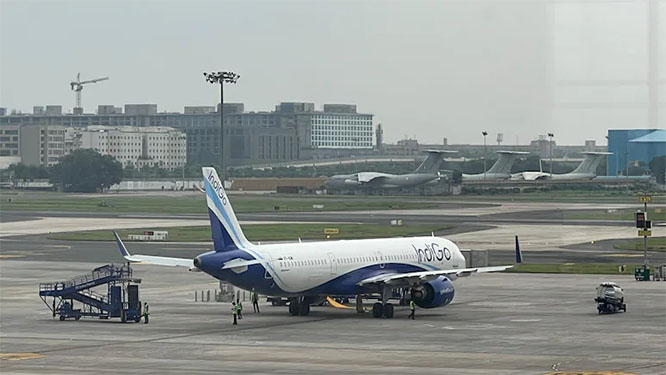
IndiGo, India’s largest airline, is battling one of its worst operational disruptions in recent years, with hundreds of delays and cancellations throwing domestic travel into chaos.

Government data on Tuesday showed its on-time performance plunging to 35%, an unusual dip for a carrier long associated with punctuality.

By Wednesday afternoon, airports in Delhi, Mumbai, Bengaluru and Hyderabad had collectively reported close to 200 cancellations, stranding travellers across the country.

Crew Shortage After New Duty Norms

A major trigger behind the meltdown is a severe crew shortage, especially among pilots, following the rollout of revised Flight Duty Time Limitation (FDTL) norms last month.

The rules mandate longer rest hours and more humane rosters — a shift IndiGo has struggled to incorporate across its vast network.

Sources said several flights were grounded due to lack of cabin crew, while some delays stretched upwards of eight hours.

With IndiGo controlling over 60% of India’s domestic aviation market, the ripple effect has impacted airports nationwide.

IndiGo Issues Apology, Lists “Compounding Factors”

In a statement, IndiGo acknowledged the large-scale disruption:

“We sincerely apologise to customers. A series of unforeseen operational challenges — technology glitches, winter schedule changes, adverse weather, system congestion and updated FDTL norms — created a compounding impact that could not have been anticipated.”

To stabilise operations, the airline has begun calibrated schedule adjustments for the next 48 hours, aiming to restore punctuality. Affected passengers are being offered refunds or alternate travel arrangements, IndiGo said.

What the FDTL Rules Require

The FDTL norms, designed to reduce pilot fatigue, cap duty and flying hours as follows:
•    Maximum 8 hours of flying per day
•    35 hours per week
•    125 hours per month
•    1,000 hours per year

Crew must also receive rest equalling twice the flight duration, with a minimum 10-hour rest period in any 24-hour window.

The DGCA introduced these limits to enhance flight safety.

Hyderabad: 33 Flights Cancelled, Long Queues Reported

Hyderabad’s Rajiv Gandhi International Airport saw heavy early-morning crowds as 33 IndiGo flights (arrivals and departures) were cancelled.

The airport clarified on X that operations were normal, advising passengers to contact IndiGo directly for latest flight status.

Cancellations included flights to and from Visakhapatnam, Goa, Ahmedabad, Delhi, Bengaluru, Chennai, Madurai, Hubli, Bhopal and Bhubaneswar.

Bengaluru: 42 Flights Disrupted

Bengaluru’s Kempegowda International Airport recorded 42 cancellations — 22 arrivals and 20 departures — affecting routes to Delhi, Mumbai, Chennai, Hyderabad, Goa, Kolkata and Lucknow.

Passengers Vent on Social Media

Irate travellers took to X to share their experiences. One passenger stranded in Hyderabad wrote: “I have been here since 3 a.m. and missed an important meeting.”

Another said: “My flight was pushed from 1:55 PM to 2:55 PM and now 4:35 PM. I was informed only three minutes before entering the airport.”

Delhi Airport Hit by Tech Glitch

At Delhi Airport, the disruption deepened due to a slowdown in the Amadeus system — used for reservations, check-ins and departure control.

The technical issue led to longer queues and sluggish processing, adding to delays already worsened by staff shortages.

Comments

Add new comment

  • Coastaldigest.com reserves the right to delete or block any comments.
  • Coastaldigset.com is not responsible for its readers’ comments.
  • Comments that are abusive, incendiary or irrelevant are strictly prohibited.
  • Please use a genuine email ID and provide your name to avoid reject.
News Network
November 28,2025

ministerPM.jpg

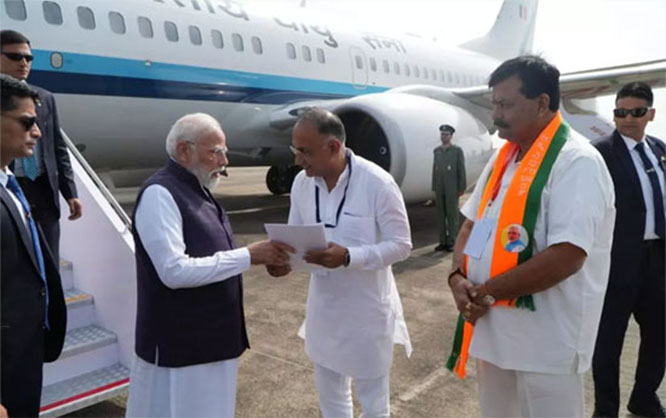
Mangaluru, Nov 28: Karnataka Health Minister and Dakshina Kannada district in-charge minister Dinesh Gundu Rao on Friday handed over Chief Minister Siddaramaiah’s letter to Prime Minister Narendra Modi, highlighting the severe distress faced by farmers due to crashing crop prices.

PM Modi arrived at the Mangaluru International Airport en route to Udupi, where Gundu Rao welcomed him and submitted the letter. The chief minister’s message stressed that farmers are suffering heavy losses because maize and green gram are being bought far below the Minimum Support Price (MSP). The state urged the Centre to immediately begin procurement at MSP.

According to the letter, Karnataka has a bumper harvest this year—over 54.74 lakh metric tons of maize and 1.98 lakh metric tons of green gram—yet farmers are unable to secure fair prices. Against the MSP of ₹2,400/MT for maize and ₹8,768/MT for green gram, market rates have plunged to ₹1,600–₹1,800 and ₹5,400 respectively.

The chief minister has requested the Centre to:

• Direct NAFED, FCI and NCCF to start MSP procurement immediately.
• Ensure ethanol units purchase maize directly from farmers or FPOs.
• Increase Karnataka’s ethanol allocation, citing high production capacity.
• Stop maize imports, which have depressed domestic prices.
• Relax quality norms for green gram, allowing up to 10% discoloration due to rains.

The letter stresses that MSP is crucial for farmer dignity and income stability and calls for swift central intervention to prevent a deepening crisis.

Comments

Add new comment

  • Coastaldigest.com reserves the right to delete or block any comments.
  • Coastaldigset.com is not responsible for its readers’ comments.
  • Comments that are abusive, incendiary or irrelevant are strictly prohibited.
  • Please use a genuine email ID and provide your name to avoid reject.
News Network
December 6,2025

pilot.jpg

New Delhi: IndiGo, India’s largest airline, faced major operational turbulence this week after failing to prepare for new pilot-fatigue regulations issued by the Directorate General of Civil Aviation (DGCA). The stricter rules—designed to improve flight safety—took effect in phases through 2024, with the latest implementation on November 1. IndiGo has acknowledged that inadequate roster planning led to widespread cancellations and delays.

Below are the key DGCA rules that affected IndiGo’s operations:

1. Longer Mandatory Weekly Rest

Weekly rest for pilots has been increased from 36 hours to 48 hours.

The government says the extended break is essential to curb cumulative fatigue. This rule remains in force despite the current crisis.

2. Cap on Night Landings

Pilots can now perform only two night landings per week—a steep reduction from the earlier limit of six.

Night hours, defined as midnight to early morning, are considered the least alert period for pilots.

Given the disruptions, this rule has been temporarily relaxed for IndiGo until February 10.

3. Reduced Maximum Night Flight Duty

Flight duty that stretches into the night is now capped at 10 hours.

This measure has also been kept on hold for IndiGo until February 10 to stabilize operations.

4. Weekly Rest Cannot Be Replaced With Personal Leave

Airlines can no longer count a pilot’s personal leave as part of the mandatory 48-hour rest.

Pilots say this closes a loophole that previously reduced actual rest time.

Currently, all airlines are exempt from this rule to normalise travel.

5. Mandatory Fatigue Monitoring

Airlines must submit quarterly fatigue reports along with corrective actions to DGCA.

This system aims to create a transparent fatigue-tracking framework across the industry.

The DGCA has stressed that these rules were crafted to strengthen flight safety and align India with global fatigue-management standards. The temporary relaxations are expected to remain until February 2025, giving IndiGo time to stabilise its schedules and restore normal air travel.

Comments

Add new comment

  • Coastaldigest.com reserves the right to delete or block any comments.
  • Coastaldigset.com is not responsible for its readers’ comments.
  • Comments that are abusive, incendiary or irrelevant are strictly prohibited.
  • Please use a genuine email ID and provide your name to avoid reject.