Former US president George H.W. Bush dead at 94

Agencies
December 1, 2018

Washington, Dec 1: George H.W. Bush -- the upper-crust war hero-turned-oilman and diplomat who steered America through the end of the Cold War as president and led a political dynasty that saw his son win the White House -- died Friday. He was 94.

George W. Bush called his father a "man of the highest character and the best dad a son or daughter could ask for," in a statement announcing his death.

"The entire Bush family is deeply grateful for 41's life and love, for the compassion of those who have cared and prayed for Dad, and for the condolences of our friends and fellow citizens."

Bush's passing comes just months after the death in April of his wife and revered first lady Barbara Bush -- his "most beloved woman in the world" -- to whom he was married for 73 years.

The 41st American president was a foreign policy realist who navigated the turbulent but largely peaceful fall of the Soviet Union in 1989 and assembled an unprecedented coalition to defeat Iraqi strongman Saddam Hussein two years later.

But the decorated war pilot and former CIA chief suffered the ignominy of being a one-term president, denied a second term over a weak economy when he lost the 1992 election to upstart Democrat Bill Clinton.

His favoring of stability and international consensus stands in sharp contrast to the provocative bluster of fellow Republican and current White House occupant Donald Trump, a man whom Bush did not vote for in 2016.

Bush presided over economic malaise at home, and infuriated his fellow Republicans during a budget battle with rival Democrats by famously breaking his vow: "Read my Lips: No new taxes."

But he was the respected patriarch of a blue-blood political dynasty -- son George spent eight years in the White House, and son Jeb served as governor of Florida.

At the time of his death, Bush was the American president to have lived the longest.

Jimmy Carter was born a few months later, so he could quickly reset the record.

"America has lost a patriot and humble servant in George Herbert Walker Bush. While our hearts are heavy today, they are also filled with gratitude," former president Barack Obama said in a statement.

George Herbert Walker Bush was born on June 12, 1924 in Milton, Massachusetts into a wealthy New England political dynasty -- the son of Prescott Bush, a successful banker and US senator for Connecticut.

Bush had a pampered upbringing and attended the prestigious Phillips Academy in Andover, but delayed his acceptance to Yale in order to enlist in the US Navy on his 18th birthday and head off to war.

He flew 58 combat missions during World War II. Shot down over the Pacific by Japanese anti-aircraft fire, he parachuted out and was rescued by a submarine after huddling in a life raft for four hours while enemy forces circled.

Bush married Barbara Pierce in January 1945, shortly before the war ended, and the couple went on to have six children, including one, Robin, who died as a child.

Instead of joining his father in banking upon graduation from Yale University, Bush headed to bleak west Texas to break into the rough-and-tumble oil business.

He surprised many with his success, and by 1958 had settled in Houston as president of an offshore drilling company.

In the 1960s, Bush, now independently wealthy, turned to politics.

He was a local Republican Party chairman, and in 1966 won a seat in the US House of Representatives. He served there until 1970, when he lost a bid for the Senate.

Over the next decade, he held several high-level posts that took him and Barbara around the world: head of the Republican National Committee, US ambassador to the United Nations, envoy to China and director of the Central Intelligence Agency, where he was praised for restoring morale after revelations of widespread illegal activity.

He served as vice president to Ronald Reagan after losing to him in the 1980 Republican primary, an eight-year period of hands-on training for the top post he would go on to win by a solid margin in 1988, as the Cold War was coming to an end.

In a major test of the post-Cold War order, Saddam's million-man army invaded Kuwait in 1990 and looked set to roll into Saudi Arabia, which would have given the Iraqi strongman more than 40 percent of the world's oil reserves.

Bush famously vowed: "This will not stand, this aggression against Kuwait."

He assembled a coalition of 32 nations to drive Iraqi forces out in a matter of weeks with a lightning air and ground assault.

Some 425,000 US troops backed by 118,000 allied soldiers took part in Operation Desert Storm, decimating Saddam's military machine without ousting him from power -- a task that would be accomplished 12 years later by Bush's son.

Buoyed by his victory in the Gulf, Bush and his hard-nosed and widely respected secretary of state James Baker cobbled together the 1991 Madrid Conference to launch the Arab-Israeli peace process.

The conference was mainly symbolic, but it set the stage for the Oslo Accords two years later.

In late 1989, Bush sent US troops to Panama to oust strongman Manuel Noriega. He also set the groundwork for the North American Free Trade Agreement.

Domestically, however, the economy stalled and Bush broke his pledge not to raise taxes in order to reach a budget deal with Democrats -- a cardinal sin in the eyes of Republicans.

In 1992, Bush lost his re-election bid to Clinton -- whose aide coined the now famous slogan "It's the economy, stupid" -- as eccentric third-party candidate Ross Perot syphoned off conservative votes.

The elder Bush's cautious realpolitik would later be contrasted to his son's far more costly ambition to transform the Middle East, but "Bush 41" refused to weigh in on the debate, insisting he was proud of the presidency of "Bush 43."

After retiring from public life, Bush fulfilled a wartime pledge to one day jump out of a plane for fun and famously went skydiving on his 75th, 80th, 85th and 90th birthdays.

He joined Clinton to raise funds for victims of the 2004 Asian tsunami and the 2010 Haiti earthquake. In 2011, Obama awarded Bush the highest US civilian honor, the Medal of Freedom.

He worked with Carter, Clinton, Obama and son George to raise money for hurricane victims in Texas in 2017.

In 2001, Bush became just the second US president after John Adams to see his son become president.

Son Jeb made his own presidential run in 2016, but fell short in the Republican primaries against Trump.

Comments

Hassanabba
 - 
Saturday, 1 Dec 2018

he must be having pain that he given a birth to such a devil son who has millions of innocent life he caused in war,


amswer is simple you lived 94 year by killing and enjoying now you life your 1000000000000000000000000000000000000000000000000000000000000000000000000000000000000000 year in hell in fire

Add new comment

  • Coastaldigest.com reserves the right to delete or block any comments.
  • Coastaldigset.com is not responsible for its readers’ comments.
  • Comments that are abusive, incendiary or irrelevant are strictly prohibited.
  • Please use a genuine email ID and provide your name to avoid reject.
News Network
January 20,2026

Mangaluru: In a major step towards strengthening rural innovation, the Office of the Principal Scientific Adviser (PSA) to the Government of India is supporting the establishment of RuTAGe Smart Village Centres (RSVCs) across the country through collaborations with academic institutions, civil society organisations and philanthropic partners.

As part of this national initiative, Nitte (Deemed to be University) will set up the first RSVCs in the region at Nitte GP in Udupi district and at the Nitte Health Centre, Sevanjali Trust, Farangipete, in Dakshina Kannada district. The centres will be inaugurated on January 21. In South India, the programme is being implemented by the Section Infin-8 Foundation (SI-8).

Speaking to reporters on Monday, SI-8 founder-director Vishwas US said experts from Nitte University and SI-8 would work closely with farmers, students, youth and local entrepreneurs to adapt and deploy technologies tailored to local needs.

Project head Prof Iddya Karunasagar, representing Nitte DU, said the RSVCs at Nitte and Farangipete would serve as demonstration hubs for a wide range of agriculture, energy, skill-development and assistive technologies. These include solar dryers for fruits, vegetables and crops; soil-testing solutions; power weeders and women-friendly farm tools; wind-powered devices for rural artisans; grain storage systems; grass-cutting and tree-climbing equipment; and liquid fertiliser production using cowshed waste.

SI-8 CEO Aravind C Kumar said the centres would also provide access to digital and knowledge-based platforms such as ISRO applications, government scheme portals, market linkage tools and gamified learning resources, along with assistive technologies for persons with visual impairments.

Highlighting the broader impact of the initiative, Principal Scientific Adviser Prof Ajay Kumar Sood said it demonstrated how applied research could bridge the rural–urban divide and help create self-reliant, technology-enabled villages.

The initiative has been made possible through philanthropic support from Dr NC Murthy of ACM Business Solutions, LLC, USA. Dr Sapna Poti, Director (Strategic Alliances) at the Office of the Principal Scientific Adviser, said the long-term objective is to build self-sufficient, technology-driven communities capable of generating sustainable livelihoods on their own.

Comments

Add new comment

  • Coastaldigest.com reserves the right to delete or block any comments.
  • Coastaldigset.com is not responsible for its readers’ comments.
  • Comments that are abusive, incendiary or irrelevant are strictly prohibited.
  • Please use a genuine email ID and provide your name to avoid reject.
News Network
January 20,2026

iran.jpg

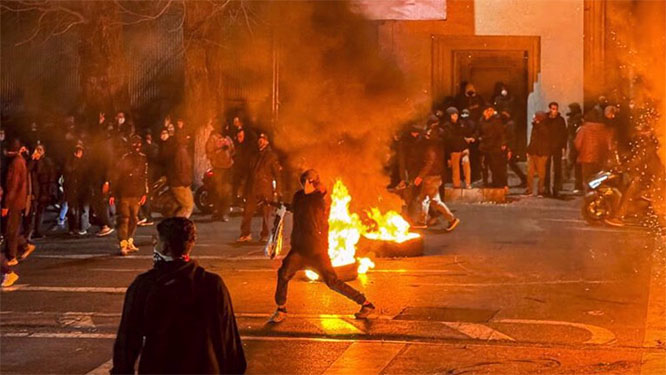
Iranian security and intelligence forces have captured more than 470 individuals in three provinces, identified as key figures behind the recent wave of violent unrest and terrorist activities linked to foreign-backed networks.

The Intelligence Ministry's provincial office in Khorasan Razavi announced on Monday the arrest of 192 armed terrorists, identified as the main agents behind recent riots in the region. 

According to an official statement, the detainees were involved in the killing of several security personnel and civilians, setting fire to mosques, public service facilities, and buses, as well as attacks on military and law enforcement centers.

The seized items from the group include several bulletproof vests, Kalashnikov rifles, hunting weapons, Winchester rifles, and various cold weapons such as daggers, swords, brass knuckles, tactical knives, crossbows, and chains.

Evidence indicates that some of the individuals were tied to hostile movements and terrorist organizations, with links overseas. Others were identified as members of violent criminal gangs, actively taking part in the unrest alongside their associates.

Simultaneously, in the western province of Lorestan, the IRGC announced the arrest of 134 individuals as the main leaders and influential field agents of a US-Israeli terrorist network.

The IRGC statement stated that these individuals formed terrorist cells during the recent unrest, committing "Daesh-like" acts.

They wounded security forces with firearms and cold weapons, and burned and destroyed public and private properties, including mosques, shops, banks, and private and public vehicles.

In the northwestern province of Zanjan, the police reported detaining 150 people identified as principal leaders and agents behind recent riots.

Authorities noted that these individuals were responsible for destroying public and private property and intentionally setting fire to vehicles in the province's squares.

Their crimes include shedding the blood of innocent people, destroying public and private property, attempting to enter military sites, disrupting public order, and spreading terror among citizens.

A variety of cold weapons were reportedly seized from the detainees.

What began late last month as peaceful protests over economic hardship across Iran turned violent after public statements by US and Israeli regime figures encouraged vandalism and disorder.

During the unrest, foreign-backed mercenaries rampaged through cities, killing security forces and civilians and damaging public property.

Comments

Add new comment

  • Coastaldigest.com reserves the right to delete or block any comments.
  • Coastaldigset.com is not responsible for its readers’ comments.
  • Comments that are abusive, incendiary or irrelevant are strictly prohibited.
  • Please use a genuine email ID and provide your name to avoid reject.
News Network
January 23,2026

Karnataka Governor Thaawarchand Gehlot read only three lines from the 122-paragraph address prepared by the Congress-led state government while addressing the joint session of the Legislature on Thursday, effectively bypassing large sections critical of the BJP-led Union government.

The omitted portions of the customary Governor’s address outlined what the state government described as a “suppressive situation in economic and policy matters” under India’s federal framework. The speech also sharply criticised the Centre’s move to replace the Mahatma Gandhi National Rural Employment Guarantee Act (MGNREGA) with the Viksit Bharat–Guarantee for Rozgar and Ajeevika Mission (Gramin) Act, commonly referred to as the VB-GRAM (G) Act.

Governor Gehlot had earlier conveyed his objection to several paragraphs that were explicitly critical of the Union government. On Thursday, he confined himself to the opening lines — “I extend a warm welcome to all of you to the joint session of the State legislature. I am extremely pleased to address this august House” — before jumping directly to the concluding sentence of the final paragraph.

He ended the address by reading the last line of paragraph 122: “Overall, my government is firmly committed to doubling the pace of the State’s economic, social and physical development. Jai Hind — Jai Karnataka.”

According to the prepared speech, the Karnataka government demanded the scrapping of the VB-GRAM (G) Act, describing it as “contractor-centric” and detrimental to rural livelihoods, and called for the full restoration of MGNREGA. The state government argued that the new law undermines decentralisation, weakens labour protections, and centralises decision-making in violation of constitutional norms.

Key points from the unread sections of the speech:

•    Karnataka facing a “suppressive” economic and policy environment within the federal system

•    Repeal of MGNREGA described as a blow to rural livelihoods

•    VB-GRAM (G) Act accused of protecting corporate and contractor interests

•    New law alleged to weaken decentralised governance

•    Decision-making said to be imposed by the Centre without consulting states

•    Rights of Adivasis, women, backward classes and agrarian communities curtailed

•    Labourers allegedly placed under contractor control

•    States facing mounting fiscal stress due to central policies

•    VB-GRAM (G) Act accused of enabling large-scale corruption

Comments

Add new comment

  • Coastaldigest.com reserves the right to delete or block any comments.
  • Coastaldigset.com is not responsible for its readers’ comments.
  • Comments that are abusive, incendiary or irrelevant are strictly prohibited.
  • Please use a genuine email ID and provide your name to avoid reject.