



Gita Gopinath joins International Monetary Fund as first female chief economist

Agencies
January 8, 2019

Washington, Jan 8: Prominent Indian-American economist Gita Gopinath has joined as the chief economist of the International Monetary Fund, becoming the first woman to occupy the top post at the global lender.

Gopinath, 47, joined last week at a time, when she believes the world is experiencing a retreat from globalisation, posing challenges to multilateral institutions.

The John Zwaanstra professor of International Studies and Economics at Harvard University, Gopinath, a US citizen, succeeds Maurice (Maury) Obstfeld as Economic Counsellor and Director of the IMF's Research Department. Obstfeld retired December 31.

Announcing her appointment on October 1, IMF Managing Director Christine Lagarde described her as "one of the world's outstanding economists with impeccable academic credentials, a proven track record of intellectual leadership and extensive international experience."

The 11th chief economist of the IMF, Mysore-born Gopinath in a recent interview to The Harvard Gazette described her appointment at the IMF as a "tremendous honour" and said the appointment of the first ever woman for this position speaks highly of IMF's Managing Director Lagarde.

"She is phenomenal, not just in her leadership of the IMF but as a role model for women around the world," she said.

Identifying some of her top priorities at the IMF, Gopinath told The Harvard Gazette that she would like the IMF to continue to be a place that provides intellectual leadership on important policy questions.

“Among the research issues that I would like to push, one would be understanding the role of dominant currencies like the dollar in international trade and finance. We could do more on the empirical side to try to understand countries' dollar exposures and on the theoretical side in terms of the implications for international spillovers, consequences of dollar shortages, etc,” she said.

Most countries invoice their trade in dollars and borrow internationally in dollars. This is a central part of the international price system and the international financial system and it will be exciting to explore its consequences in greater depth with the IMF, she said.

Gopinath considers the perceived retreat from globalisation as one of the top challenges being faced by the IMF.

"The one (biggest issues being faced by the IMF) that is absolutely clear and present is that we are seeing the first serious retreat from globalisation. This has not happened in the past 50 or 60 years when the world moved toward lower tariffs and increasing trade across countries,” she told the prestigious Harvard publication.

"Over the past several months, we have the US-imposed tariffs and retaliation to them from China and other nations. There is in general growing uncertainty about trade policy, including the one arising out of Brexit (the British move to leave the European Union).

"While the trade has reduced global poverty and raised livelihoods, its consequences for inequality, and on whether the rules of engagement are fair, are real concerns that need to be addressed,” she said.

Gopinath said there is also a concern about whether there is the right multilateral institutions and frameworks in place to make sure everybody feels that there is fairness in trade. “And the same goes for capital flows," she added.

"Foreign direct investment (FDI) was always viewed very favourably by countries. But because most of the FDI is now in tech-heavy firms, there are growing concerns about national security and international property theft. So I believe this retreat from globalisation and this retreat from multilateralism is quite unique to the times we are living in," Gopinath said.

Another important concern, she said, is the health of emerging markets as the US continues to normalize its interest rates.

The capital flows to several markets have reversed, putting pressure on their exchange rates and consequently on inflation, and on balance sheets, given that several emerging markets borrow heavily in dollars, said the IMF chief economist.

Comments

Add new comment

  • Coastaldigest.com reserves the right to delete or block any comments.
  • Coastaldigset.com is not responsible for its readers’ comments.
  • Comments that are abusive, incendiary or irrelevant are strictly prohibited.
  • Please use a genuine email ID and provide your name to avoid reject.
News Network
December 3,2025

arrival.jpg

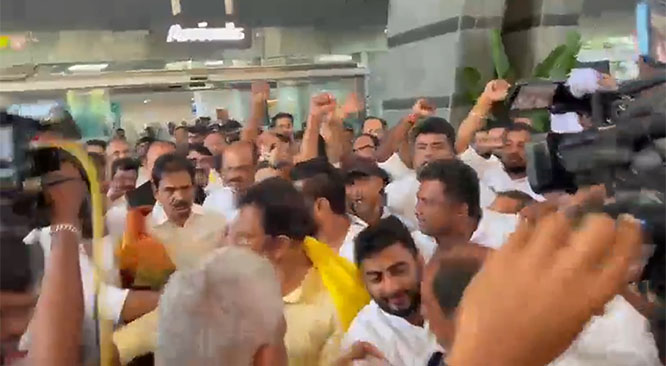
Mangaluru, Dec 3: A group of Congress workers gathered at the Mangaluru International Airport on Wednesday to welcome AICC general secretary K C Venugopal, but the reception quickly turned into a display of support for Deputy Chief Minister D K Shivakumar.

Venugopal arrived in the city to participate in the centenary commemoration of the historic dialogue between Mahatma Gandhi and Narayana Guru. The event, organised by the Sivagiri Mutt, Varkala, in association with the Mangalore University Sri Narayana Guru Study Chair, is being held on the university’s Konaje campus.

KPCC general secretary Mithun Rai and several party workers had assembled at the airport to receive Venugopal. However, the moment he stepped out, workers began raising slogans backing Shivakumar.

The university programme will be inaugurated by Chief Minister Siddaramaiah.

This show of support comes just a day after Siddaramaiah remarked that Shivakumar would lead the government “when the high command decides.” The chief minister made the comment after a breakfast meeting at Shivakumar’s residence—another public display of camaraderie between the two leaders amid ongoing attempts by the party high command to downplay their leadership rivalry.

Comments

Add new comment

  • Coastaldigest.com reserves the right to delete or block any comments.
  • Coastaldigset.com is not responsible for its readers’ comments.
  • Comments that are abusive, incendiary or irrelevant are strictly prohibited.
  • Please use a genuine email ID and provide your name to avoid reject.
News Network
December 2,2025

Mangaluru, Dec 2: Mangaluru International Airport responded to a medical emergency late on Monday night. Air India Express flight IX 522, travelling from Riyadh to Thiruvananthapuram, was diverted to Mangaluru Airport after a passenger in his late 30s experienced a medical emergency on board.

The Airport’s Operations Control Centre received an alert regarding the passenger’s health condition. The airport activated its emergency response protocol, mobilising the airport medical team and coordinating with stakeholders including CISF, immigration, and customs. 

Upon landing, airport medical personnel attended to the passenger, assessed his condition, and arranged to shift him to a local tertiary-care hospital for further treatment. The passenger’s relatives accompanied the passenger, who incidentally received necessary medical care on board, which helped stabilise the situation.

Following the handling of the emergency, the flight departed for Thiruvananthapuram at 2:05 am on Tuesday.

"We appreciate the cooperation of all parties involved, and this incident reaffirms our ongoing commitment to prioritising passenger safety and readiness to respond to unforeseen emergencies with professionalism and care," the Airport spokesperson said. 

Comments

Add new comment

  • Coastaldigest.com reserves the right to delete or block any comments.
  • Coastaldigset.com is not responsible for its readers’ comments.
  • Comments that are abusive, incendiary or irrelevant are strictly prohibited.
  • Please use a genuine email ID and provide your name to avoid reject.
News Network
December 4,2025

indigoflight.jpg

Domestic carrier IndiGo has cancelled over 180 flights from three major airports — Mumbai, Delhi and Bengaluru — on Thursday, December 4, as the airline struggles to secure the required crew to operate its flights in the wake of new flight-duty and rest-period norms for pilots.

While the number of cancellations at Mumbai airport stands at 86 (41 arrivals and 45 departures) for the day, at Bengaluru, 73 flights have been cancelled, including 41 arrivals, according to a PTI report that quoted sources.

"IndiGo cancelled over 180 flights on Thursday at three airports-Mumbai, Delhi and Bengaluru," the source told the news agency.

Besides, it had cancelled as many as 33 flights at Delhi airport for Thursday, the source said, adding, "The number of cancellations is expected to be higher by the end of the day."

The Gurugram-based airline's On-Time Performance (OTP) nosedived to 19.7 per cent at six key airports — Delhi, Mumbai, Chennai, Kolkata, Bengaluru and Hyderabad — on December 3, as it struggled to get the required crew to operate its services, down from almost half of December 2, when it was 35 per cent.

"IndiGo has been facing acute crew shortage since the implementation of the second phase of the FDTL (Flight Duty Time Limitations) norms, leading to cancellations and huge delays in its operations across the airports," a source had told PTI on Wednesday.

Chaos continued at several major airports for the third day on Thursday because of the cancellations.

A spokesperson for the Kempegowda International Airport (KIA) in Bengaluru said that 73 IndiGo flights had been cancelled on Thursday.

At least 150 flights were cancelled and dozens of others delayed on Wednesday, airport sources said, leaving thousands of travellers stranded, according to news agency Reuters.

The Directorate General of Civil Aviation (DGCA) has said it is investigating IndiGo flight disruptions and has asked the airline to submit the reasons for the current situation, as well as its plans to reduce flight cancellations and delays.

It may be mentioned here that the pilots' body, Federation of Indian Pilots (FIP), has alleged that IndiGo, despite getting a two-year preparatory window before the full implementation of new flight duty and rest period norms for cockpit crew, "inexplicably" adopted a "hiring freeze".

The FIP said it has urged the safety regulator, the DGCA, not to approve airlines' seasonal flight schedules unless they have adequate staff to operate their services "safely and reliably" in accordance with the New Flight Duty Time Limitations (FDTL) norms.

In a letter to the DGCA late on Wednesday, the FIP urged the DGCA to consider re-evaluating and reallocating slots to other airlines, which have the capacity to operate them without disruption during the peak holiday and fog season if IndiGo continues to "fail in delivering on its commitments to passengers due to its own avoidable staffing shortages."

Comments

Add new comment

  • Coastaldigest.com reserves the right to delete or block any comments.
  • Coastaldigset.com is not responsible for its readers’ comments.
  • Comments that are abusive, incendiary or irrelevant are strictly prohibited.
  • Please use a genuine email ID and provide your name to avoid reject.