Why is short-sightedness increasing in children these days?

News Network
June 17, 2021

Myopia is on the rise. In the UK, the number of children with myopia has doubled in the last 50 years. Globally, it’s projected that by 2050 half of the world’s population will be myopic.

Although myopia – also known as near-sightedness or short-sightedness – can run in families, environmental factors, such as spending too much time indoors have a large influence.

For most people, myopia develops from a mixture of both genetics and environmental factors. But while evidence shows that modern lifestyle factors contribute to myopia, scientists still aren’t entirely sure why.

For instance, research shows that the amount of time a child spends outdoors can play a significant role in their risk of developing myopia.

Not only do most studies show that children who spend more time outdoors are less likely to develop myopia, studies requiring children to spend extra time outdoors during school hours have shown the rate of myopia onset decreased compared with children who didn’t spend additional time outdoors.

But researchers still aren’t quite sure why this is the case. One theory is that the higher levels of light outdoors releases more dopamine into our retinal receptors (the nerves that process light signals in the eye), thus protecting against myopia.

Another suggestion is that the greater amount of physical activity children typically get outdoors prevents myopia. But studies have now shown that this has little effect.

It’s also been suggested that the different patterns and details we see in outdoor versus indoor spaces might explain the increase in myopia.

For example, one study suggests that the abundance of plain features and walls in indoor environments is to blame. This may also be why myopia tends to be more common in urban areas, however, more research is needed to understand this.

Modern lifestyles

Nevertheless, modern lifestyles often require us to spend a lot of our time indoors. For example, children are spending longer in formal education thanks to increases in school leaving age and more people pursuing higher education, which evidence suggests can cause myopia.

Yet what aspects of formalised education are causing increases in myopia is still unknown. Prolonged reading, learning at close distances, time spent indoors and increased screen use might all be to blame.

While one study suggests reading at a distance closer than 25cm may be a risk for developing myopia, reading probably only has a small effect on developing myopia.

The effect of greater screen use on myopia in children also has mixed results – probably because estimating screen use and controlling it in a long-term experiment is difficult. Regardless, further research is needed to understand whether excessive screen use is to blame for higher rates of myopia, and why this is the case.

Given the risk factors for developing myopia, there are also concerns now that stay-at-home orders and home learning during the pandemic may have worsened children’s eyesight.

Although there has been no study yet looking at the effect on children in the UK, early results elsewhere suggest that the pandemic may cause more children to develop myopia – but it’s anticipated the effects will be small. Whether the pandemic will have caused permanent increases in myopia is also yet to be seen.

Currently, the best advice for limiting the risk of developing myopia is to increase time spent outdoors, even by 40 minutes a day. 

 

Comments

Add new comment

  • Coastaldigest.com reserves the right to delete or block any comments.
  • Coastaldigset.com is not responsible for its readers’ comments.
  • Comments that are abusive, incendiary or irrelevant are strictly prohibited.
  • Please use a genuine email ID and provide your name to avoid reject.
News Network
December 2,2025

DKSsiddu.jpg

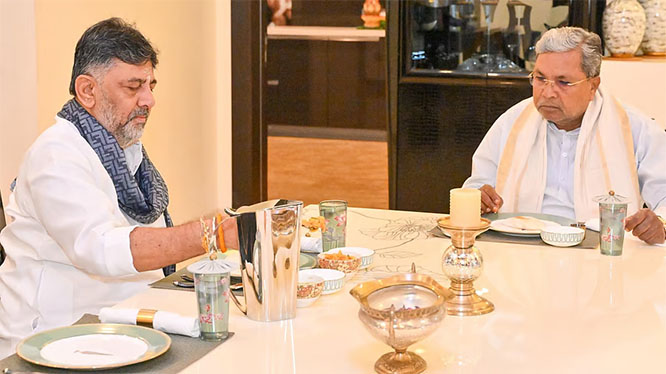
Bengaluru: 'Nati koli saaru' (country chicken curry) considered one of Chief Minister Siddaramaiah’s favourites along with steaming hot idlis was on the breakfast menu at Deputy CM D K Shivakumar’s residence on Tuesday, according to official sources.

The spread also included 'nati koli' fry, vada and pongal, among other items, they said.

In an apparent show of unity, Siddaramaiah visited Shivakumar’s residence for breakfast, just days after the two leaders shared a meal amid a simmering power tussle in the state Congress.

Siddaramaiah drove to the Deputy CM’s residence in Sadashivanagar, where he was received by Shivakumar and his brother D K Suresh, who is a former Congress MP.

Suresh and Kunigal MLA H D Ranganath, a relative of Shivakumar, joined them for breakfast, which featured a mix of vegetarian and non-vegetarian dishes.

Speaking to reporters later, Siddaramaiah said Shivakumar had invited him during his visit to the CM’s residence for breakfast on Saturday.

Asked about the difference between the two meals, the chief minister said, "At his (Shivakumar’s) house it was non-veg, while at my house it was veg. He is a vegetarian, I am a non-vegetarian. I had not prepared non-veg. I told DK to get chicken from the village as you won’t get the original in Bengaluru."

Shivakumar said he had initially invited Siddaramaiah to his residence, but the CM had suggested visiting his place first and reciprocating later. "It was a vegetarian breakfast at the CM’s house on Saturday," he noted.

"Today, I invited him (the CM) to my house. He enjoyed the breakfast, which had his Mysuru taste," Shivakumar added. At this point, Siddaramaiah remarked that Shivakumar’s wife is also from Mysuru.

Saturday’s breakfast at Siddaramaiah’s official residence, held as part of efforts by the Congress high command to ease tensions in the leadership dispute between the two, reportedly included idlis and sambar, according to official sources.

Comments

Add new comment

  • Coastaldigest.com reserves the right to delete or block any comments.
  • Coastaldigset.com is not responsible for its readers’ comments.
  • Comments that are abusive, incendiary or irrelevant are strictly prohibited.
  • Please use a genuine email ID and provide your name to avoid reject.
News Network
December 2,2025

Mangaluru, Dec 2: Mangaluru International Airport responded to a medical emergency late on Monday night. Air India Express flight IX 522, travelling from Riyadh to Thiruvananthapuram, was diverted to Mangaluru Airport after a passenger in his late 30s experienced a medical emergency on board.

The Airport’s Operations Control Centre received an alert regarding the passenger’s health condition. The airport activated its emergency response protocol, mobilising the airport medical team and coordinating with stakeholders including CISF, immigration, and customs. 

Upon landing, airport medical personnel attended to the passenger, assessed his condition, and arranged to shift him to a local tertiary-care hospital for further treatment. The passenger’s relatives accompanied the passenger, who incidentally received necessary medical care on board, which helped stabilise the situation.

Following the handling of the emergency, the flight departed for Thiruvananthapuram at 2:05 am on Tuesday.

"We appreciate the cooperation of all parties involved, and this incident reaffirms our ongoing commitment to prioritising passenger safety and readiness to respond to unforeseen emergencies with professionalism and care," the Airport spokesperson said. 

Comments

Add new comment

  • Coastaldigest.com reserves the right to delete or block any comments.
  • Coastaldigset.com is not responsible for its readers’ comments.
  • Comments that are abusive, incendiary or irrelevant are strictly prohibited.
  • Please use a genuine email ID and provide your name to avoid reject.
News Network
November 28,2025

ministerPM.jpg

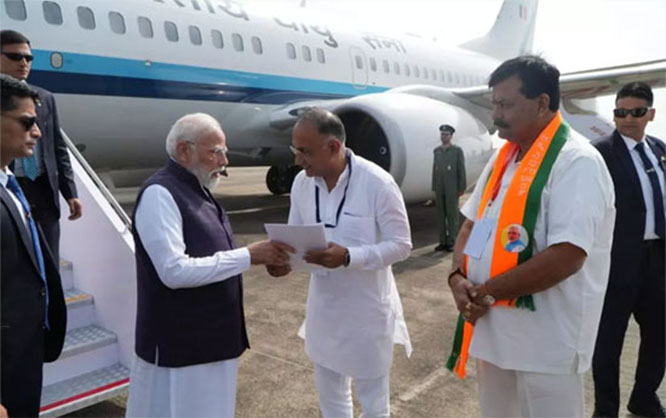
Mangaluru, Nov 28: Karnataka Health Minister and Dakshina Kannada district in-charge minister Dinesh Gundu Rao on Friday handed over Chief Minister Siddaramaiah’s letter to Prime Minister Narendra Modi, highlighting the severe distress faced by farmers due to crashing crop prices.

PM Modi arrived at the Mangaluru International Airport en route to Udupi, where Gundu Rao welcomed him and submitted the letter. The chief minister’s message stressed that farmers are suffering heavy losses because maize and green gram are being bought far below the Minimum Support Price (MSP). The state urged the Centre to immediately begin procurement at MSP.

According to the letter, Karnataka has a bumper harvest this year—over 54.74 lakh metric tons of maize and 1.98 lakh metric tons of green gram—yet farmers are unable to secure fair prices. Against the MSP of ₹2,400/MT for maize and ₹8,768/MT for green gram, market rates have plunged to ₹1,600–₹1,800 and ₹5,400 respectively.

The chief minister has requested the Centre to:

• Direct NAFED, FCI and NCCF to start MSP procurement immediately.
• Ensure ethanol units purchase maize directly from farmers or FPOs.
• Increase Karnataka’s ethanol allocation, citing high production capacity.
• Stop maize imports, which have depressed domestic prices.
• Relax quality norms for green gram, allowing up to 10% discoloration due to rains.

The letter stresses that MSP is crucial for farmer dignity and income stability and calls for swift central intervention to prevent a deepening crisis.

Comments

Add new comment

  • Coastaldigest.com reserves the right to delete or block any comments.
  • Coastaldigset.com is not responsible for its readers’ comments.
  • Comments that are abusive, incendiary or irrelevant are strictly prohibited.
  • Please use a genuine email ID and provide your name to avoid reject.