



India announces USD 1 billion credit line to Mongolia

May 17, 2015

Ulan Bator, May 17: India today announced a credit line of USD 1 billion to Mongolia to expand its economic capacity and infrastructure, as they decided to upgrade their relationship from Comprehensive to "Strategic Partnership".
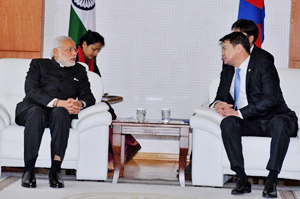
modi mangolia

Narendra Modi, the first Indian Prime Minister to visit Mongolia, held wide ranging talks with his counterpart Chimed Saikhanbileg here following which the two sides inked 14 agreements covering defence, cyber security, agriculture, renewable energy and health sector.

"I am pleased to announce that India will provide a Line of Credit of USD one billion to support expansion of Mongolia's economic capacity and infrastructure," Modi said at a joint press interaction with Saikhanbileg at State Palace.

Asserting that Mongolia is an integral part of India's Act East Policy, he said the destinies of the two countries are closely linked with the future of Asia Pacific Region.

"We can work together to help advance peace, stability and prosperity in this region," the Prime Minister said.

"In a reflection of our commitment to further deepen our relationship, we have decided to upgrade our Comprehensive Partnership to 'Strategic Partnership'," he said.

Stating that it was a great honour to be the first Prime Minister of India to visit Mangolia, Modi said, "It is a special privilege to come on the occasion of two important milestones that unite us – 25 years of democracy in Mongolia and 60 years of diplomatic relations between our two nations."

Commenting on his counterpart Saikhanbileg's remarks that India is the "spiritual neighbour and third neighbour" of Mongolia, Modi said, "We will always fulfil the responsibility that comes with this honour."

"I was very pleased with my discussions with Prime Minister today. We have strong convergence of views on bilateral relations and our regional and international partnership," he said.

"The agreements that we have just signed speak to the depth of the relationship. These cover economic relations, development partnership, defence and security, and people-to-people contacts," the Prime Minister added.

Modi said the cooperation between National Security Councils of the two countries will provide a strategic framework for cooperation.

India will also help establish a cyber security centre in Mongolia's defence and security establishment.

"We attach high importance to our security cooperation. We will continue to participate in each other's defence exercises. The agreements today will deepen our cooperation in border security and cyber security," Modi said.

Noting that the trade and investment relations between two countries are modest, Modi said, "We will take our economic partnership to a new level."

"There is huge potential in civil nuclear sector, mining, healthcare, pharmaceuticals and dairy. We should also explore the possibilities of using digital technology to expand our economic relations," he said.

He also announced to increase the ITEC training slots for Mongolia from 150 to 200 and establish an India-Mongolia Joint School.

"I conveyed to Prime Minister that we greatly value our international partnership, which is based on our friendship, shared spiritual heritage and democratic values. These also provide solid foundation for our cooperation in our region," Modi said, adding that the two countries are starting a "new era in our partnership".

The Prime Minister also thanked Mongolia for its strong support for India's permanent membership of UN Security Council.

Modi, who arrived here last night on the second leg of his three-nation tour, was earlier given a ceremonial welcome at the State Palace.

India has a strong linkage of Buddhism and democracy with Mongolia and was the first country outside the Soviet bloc to establish diplomatic relations with it.

India feels that there is excellent potential for cooperation with Mongolia in the minerals sector. Mongolia is mineral-rich country in coking coal, copper, rare earths and uranium.

India already has a civil nuclear agreement with Mongolia which provides for uranium exports to the country once the domestic laws here permit prospecting and mining.

Comments

Add new comment

  • Coastaldigest.com reserves the right to delete or block any comments.
  • Coastaldigset.com is not responsible for its readers’ comments.
  • Comments that are abusive, incendiary or irrelevant are strictly prohibited.
  • Please use a genuine email ID and provide your name to avoid reject.
News Network
December 4,2025

indigoflight.jpg

Domestic carrier IndiGo has cancelled over 180 flights from three major airports — Mumbai, Delhi and Bengaluru — on Thursday, December 4, as the airline struggles to secure the required crew to operate its flights in the wake of new flight-duty and rest-period norms for pilots.

While the number of cancellations at Mumbai airport stands at 86 (41 arrivals and 45 departures) for the day, at Bengaluru, 73 flights have been cancelled, including 41 arrivals, according to a PTI report that quoted sources.

"IndiGo cancelled over 180 flights on Thursday at three airports-Mumbai, Delhi and Bengaluru," the source told the news agency.

Besides, it had cancelled as many as 33 flights at Delhi airport for Thursday, the source said, adding, "The number of cancellations is expected to be higher by the end of the day."

The Gurugram-based airline's On-Time Performance (OTP) nosedived to 19.7 per cent at six key airports — Delhi, Mumbai, Chennai, Kolkata, Bengaluru and Hyderabad — on December 3, as it struggled to get the required crew to operate its services, down from almost half of December 2, when it was 35 per cent.

"IndiGo has been facing acute crew shortage since the implementation of the second phase of the FDTL (Flight Duty Time Limitations) norms, leading to cancellations and huge delays in its operations across the airports," a source had told PTI on Wednesday.

Chaos continued at several major airports for the third day on Thursday because of the cancellations.

A spokesperson for the Kempegowda International Airport (KIA) in Bengaluru said that 73 IndiGo flights had been cancelled on Thursday.

At least 150 flights were cancelled and dozens of others delayed on Wednesday, airport sources said, leaving thousands of travellers stranded, according to news agency Reuters.

The Directorate General of Civil Aviation (DGCA) has said it is investigating IndiGo flight disruptions and has asked the airline to submit the reasons for the current situation, as well as its plans to reduce flight cancellations and delays.

It may be mentioned here that the pilots' body, Federation of Indian Pilots (FIP), has alleged that IndiGo, despite getting a two-year preparatory window before the full implementation of new flight duty and rest period norms for cockpit crew, "inexplicably" adopted a "hiring freeze".

The FIP said it has urged the safety regulator, the DGCA, not to approve airlines' seasonal flight schedules unless they have adequate staff to operate their services "safely and reliably" in accordance with the New Flight Duty Time Limitations (FDTL) norms.

In a letter to the DGCA late on Wednesday, the FIP urged the DGCA to consider re-evaluating and reallocating slots to other airlines, which have the capacity to operate them without disruption during the peak holiday and fog season if IndiGo continues to "fail in delivering on its commitments to passengers due to its own avoidable staffing shortages."

Comments

Add new comment

  • Coastaldigest.com reserves the right to delete or block any comments.
  • Coastaldigset.com is not responsible for its readers’ comments.
  • Comments that are abusive, incendiary or irrelevant are strictly prohibited.
  • Please use a genuine email ID and provide your name to avoid reject.
News Network
December 16,2025

bengal.jpg

The deletion of over 58 lakh names from West Bengal’s draft electoral rolls following a Special Intensive Revision (SIR) has sparked widespread concern and is likely to deepen political tensions in the poll-bound state.

According to the Election Commission, the revision exercise has identified 24 lakh voters as deceased, 19 lakh as relocated, 12 lakh as missing, and 1.3 lakh as duplicate entries. The draft list, published after the completion of the first phase of SIR, aims to remove errors and duplication from the electoral rolls.

However, the scale of deletions has raised fears that a large number of eligible voters may have been wrongly excluded. The Election Commission has said that individuals whose names are missing can file objections and seek corrections. The final voter list is scheduled to be published in February next year, after which the Assembly election announcement is expected. Notably, the last Special Intensive Revision in Bengal was conducted in 2002.

The development has intensified the political row over the SIR process. Chief Minister Mamata Banerjee and her Trinamool Congress have strongly opposed the exercise, accusing the Centre and the Election Commission of attempting to disenfranchise lakhs of voters ahead of the elections.

Addressing a rally in Krishnanagar earlier this month, Banerjee urged people to protest if their names were removed from the voter list, alleging intimidation during elections and warning of serious consequences if voting rights were taken away.

The BJP, meanwhile, has defended the revision and accused the Trinamool Congress of politicising the issue to protect what it claims is an illegal voter base. Leader of the Opposition Suvendu Adhikari alleged that the ruling party fears losing power due to the removal of deceased, fake, and illegal voters.

The controversy comes amid earlier allegations by the Trinamool Congress that excessive work pressure during the SIR led to the deaths by suicide of some Booth Level Officers (BLOs), for which the party blamed the Election Commission. With the draft list now out, another round of political confrontation appears imminent.

As objections begin to be filed, the focus will be on whether the correction mechanism is accessible, transparent, and timely—critical factors in ensuring that no eligible voter is denied their democratic right ahead of a crucial election.

Comments

Add new comment

  • Coastaldigest.com reserves the right to delete or block any comments.
  • Coastaldigset.com is not responsible for its readers’ comments.
  • Comments that are abusive, incendiary or irrelevant are strictly prohibited.
  • Please use a genuine email ID and provide your name to avoid reject.
News Network
December 13,2025

New Delhi: School-going children are picking up drug and smoking habits and engaging in consumption of alcohol, with the average age of introduction to such harmful substances found to be around 13 years, suggesting a need for earlier interventions as early as primary school, a multi-city survey by AIIMS-Delhi said.

The findings also showed substance use increased in higher grades, with grade XI/XII students two times more likely to report use of substances when compared with grade VIII students. This emphasised the importance of continued prevention and intervention through middle and high school.

The study led by Dr Anju Dhawan of AIIMS's National Drug Dependence Treatment Centre, published in the National Medical Journal of India this month, looks at adolescent substance use across diverse regions.

The survey included 5,920 students from classes 8, 9, 11 and 12 in urban government, private and rural schools across 10 cities -- Bengaluru, Chandigarh, Delhi, Dibrugarh, Hyderabad, Imphal, Jammu, Lucknow, Mumbai, and Ranchi. The data were collected between May 2018 and June 2019.

The average age of initiation for any substance was 12.9 (2.8) years. It was lowest for inhalants (11.3 years) followed by heroin (12.3 years) and opioid pharmaceuticals (without prescription; 12.5 years).

Overall, 15.1 per cent of participants reported lifetime use, 10.3 per cent reported past year use, and 7.2 per cent reported use in the past month of any substance, the study found.

The most common substances used in the past year, after tobacco (4 per cent) and alcohol (3.8 per cent), were opioids (2.8 per cent), followed by cannabis (2 per cent) and inhalants (1.9 per cent). Use of non-prescribed pharmaceutical opioids was most common among opioid users (90.2 per cent).

On being asked, 'Do you think this substance is easily available for a person of your age' separately for each substance category, nearly half the students (46.3 per cent) endorsed that tobacco products and more than one-third of the students (36.5 per cent) agreed that a person of their age can easily procure alcohol products.

Similarly, for Bhang (21.9 per cent), ganja/charas (16.1 per cent), inhalants (15.2 per cent), sedatives (13.7 per cent), opium and heroin (10 per cent each), the students endorsed that these can be easily procured.

About 95 per cent of the children, irrespective of their grade, agreed with the statement that 'drug use is harmful'.

The rates of substance use (any) among boys were significantly higher than those of girls for substance use (ever), use in the past year and use in the past 30 days. Compared to grade VIII students, grade IX students were more likely, and grade XI/XII students were twice as likely to have used any substance (ever).

The likelihood of past-year use of any substance was also higher for grade IX students and for grade XI/XII students as compared to grade VIII students.

About 40 per cent of students mentioned that they had a family member who used tobacco or alcohol each. The use of cannabis (any product) and opioid (any product) by a family member was reported by 8.2 per cent and 3.9 per cent of students, respectively, while the use of other substances, such as inhalants/sedatives by family was 2-3 per cent, the study found.

A relatively smaller percentage of students reported use of tobacco or alcohol among peers as compared to among family members, while a higher percentage reported inhalants, sedatives, cannabis or opioid use among peers.

Children using substances (past year) compared to non-users reported significantly higher any substance use by their family members and peers.

There were 25.7 per cent students who replied 'yes' to the question 'conflicts/fights often occur in your family'. Most students also replied affirmatively to 'family members are aware of how their time is being spent' and 'damily members are aware of with whom they spend their time'.

Comments

Add new comment

  • Coastaldigest.com reserves the right to delete or block any comments.
  • Coastaldigset.com is not responsible for its readers’ comments.
  • Comments that are abusive, incendiary or irrelevant are strictly prohibited.
  • Please use a genuine email ID and provide your name to avoid reject.
