



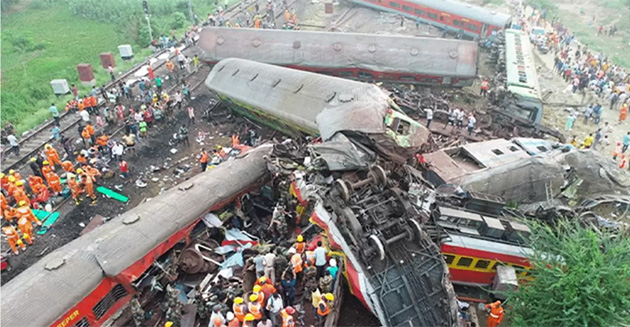
India’s worst train crash of the century: How did 3 trains collide in Odisha?

News Network
June 3, 2023

trainq.jpg

A devastating crash involving three trains in the eastern Indian state of Odisha has killed nearly 300 people and left hundreds injured, many of them seriously. Railway Minister Ashwini Vaishnaw, who has been at the site of the accident, has said "a high-level committee" will be set up to investigate the accident.

Mr Vaishnaw's cabinet colleague Dharmendra Pradhan blamed "technical reasons" for the crash, describing it as "an unfortunate incident... it shouldn't have happened".

An official said the inquiry would be helmed by the commissioner of railway safety for the south-eastern circle - which includes Balasore district where the accident occurred.

Full details of how it happened are still not available, but the railway ministry said the crash took place around 18:55 (13:25 GMT) on Friday near the Bahanaga Bazar station, about 270km south of Kolkata and 170km north of Bhubaneswar, Odisha's capital.

The accident involved three trains:
•    Coromandel Express which had started just hours before from Shalimar railway station in the state of West Bengal and was headed to the southern city of Chennai
•    Howrah Superfast Express which had started from Yesvantpur station in Bengaluru was due to reach Howrah
•    A stationary goods train which was standing at the Bahanaga Bazar station

The cause of the crash, which is being described as India's worst this century, is not yet clear.

There are varying accounts of which train derailed first and how the collision happened. But Railway spokesperson Amitabh Sharma said it was the Coromandel Express that derailed first.

"About 10 to 12 of its coaches derailed and ended up on the opposite track. A few minutes later, the Howrah Superfast Express hit the overturned carriages and three-four of its coaches also derailed," he added.

Mr Sharma did not mention the third train, but the Odisha government press release called it a "three-way accident" which involved a stationary goods train. It said 17 coaches of the two passenger trains were derailed and severely damaged.

Villagers from the nearby area and eyewitnesses to the crash also spoke of three trains being involved in the crash.

Girija Shankar Rath, who lives near the station and was among the first people to reach the accident site, told BBC Hindi that the Coromandel Express derailed and hit the goods train parked on a nearby track from behind.

"There was total chaos and the whole area was engulfed in smoke. And then we saw Shalimar Express which came hurtling down and hit some of the Coromandel wreckage and two of its coaches also derailed," he said.

Another eyewitness Tutu Biswas said he came to the accident spot when he heard a loud noise.

"Some of the coaches of the Coromandel express had gone over the goods train," Mr Biswas said. "There were lots of injured people and bodies here. I met a young boy who had lost both his parents. He was crying and then he died too," he added.

Friday's crash is among the five deadliest accidents in the history of Indian railways.

Atul Karwal, chief of the National Disaster Response Force (NDRF), said the force with which the trains collided had left several coaches crushed and mangled and they had to cut through the wreckage to reach the passengers.

Hundreds of ambulances, doctors, nurses and rescue personnel were sent to the scene and they worked for 18 hours to rescue trapped passengers and pull out bodies.

India has one of the largest train networks in the world - It runs more than 12,000 passenger trains daily and it is used by tens of millions of passengers to travel across the country daily, but a lot of the railway infrastructure needs improving.


Comments

Add new comment

  • Coastaldigest.com reserves the right to delete or block any comments.
  • Coastaldigset.com is not responsible for its readers’ comments.
  • Comments that are abusive, incendiary or irrelevant are strictly prohibited.
  • Please use a genuine email ID and provide your name to avoid reject.
coastaldigest.com news network
December 2,2025

karkala.jpg

Udupi, Dec 2: A wave of regional pride is sweeping through Udupi district as Shagun S Verma Hegde, a talented Class 9 student from Christ King English Medium High School, Karkala, has been named the captain of the Indian National Team for the Under-15 Girls’ Volleyball Championship.

Shagun holds the unique distinction of being the sole player from Karnataka selected to represent the country in the prestigious international tournament. The championship, organized by the School Games Federation, is scheduled to take place in Shangluo, China, from December 3 to 13, where Shagun will lead the national squad.

A Remarkable Journey to the Top

Shagun’s selection is a testament to her dedication and exceptional skill on the court. Her journey included several rigorous rounds of selection:

•    She was the only player from Udupi district to qualify for the state-level selection camp.

•    Out of eight players from Karnataka who advanced to the national selection camp in Pune, Maharashtra, Shagun was the only one to secure a place in the final national squad.

•    The national camp saw participation from approximately 200 players, which was shortlisted to 23. Shagun not only made the final cut but was also ranked as the second-best player overall, solidifying her leadership role.

Shagun, who is the daughter of Sandesh Verma and Shruthiraj of Kallotte, Karkala, has trained under experienced coaches Santosh D’Souza, Jeevan D’Silva, Jairaj Poojary, and Ramesh. Her selection as the team captain has brought profound honour to her family, school, the Udupi district, and the entire state of Karnataka.

Comments

Add new comment

  • Coastaldigest.com reserves the right to delete or block any comments.
  • Coastaldigset.com is not responsible for its readers’ comments.
  • Comments that are abusive, incendiary or irrelevant are strictly prohibited.
  • Please use a genuine email ID and provide your name to avoid reject.
News Network
December 4,2025

Mangaluru: Chaos erupted at Mangaluru International Airport (MIA) after IndiGo flight 6E 5150, bound for Mumbai, was repeatedly delayed and ultimately cancelled, leaving around 100 passengers stranded overnight. The incident highlights the ongoing country-wide operational disruptions affecting the airline, largely due to the implementation of new Flight Duty Time Limitations (FDTL) norms for crew.

The flight was initially scheduled for 9:25 PM on Tuesday but was first postponed to 11:40 PM, then midnight, before being cancelled around 3:00 AM. Passengers expressed frustration over last-minute communication and the lack of clarity, with elderly and ailing travellers particularly affected. “Though the airline arranged food, there was no proper communication, leaving us confused,” said one family member.

An IndiGo executive at MIA cited the FDTL rules, designed to prevent pilot fatigue by limiting crew working hours, as the cause of the cancellation. While alternative arrangements, including hotel stays, were offered, about 100 passengers chose to remain at the airport, creating tension. A replacement flight was arranged but also faced delays due to the same constraints, finally departing for Mumbai around 1:45 PM on Wednesday. Passengers either flew, requested refunds, or postponed their travel.

The Mangaluru delay is part of a broader crisis for IndiGo. The airline has been forced to make “calibrated schedule adjustments”—a euphemism for widespread cancellations and delays—after stricter FDTL norms came into effect on November 1.

While an IndiGo spokesperson acknowledged unavoidable flight disruptions due to technology issues, operational requirements, and the updated crew rostering rules, the DGCA has intervened, summoning senior airline officials to explain the chaos and outline corrective measures.

The ripple effect has been felt across the country, with major hubs like Bengaluru and Mumbai reporting numerous cancellations. The Mangaluru incident underscores the systemic operational strain currently confronting India’s largest carrier, leaving passengers nationwide grappling with uncertainty and delays.

Comments

Add new comment

  • Coastaldigest.com reserves the right to delete or block any comments.
  • Coastaldigset.com is not responsible for its readers’ comments.
  • Comments that are abusive, incendiary or irrelevant are strictly prohibited.
  • Please use a genuine email ID and provide your name to avoid reject.
News Network
November 22,2025

gaza.jpg

The Israeli regime’s forces have killed two Palestinian children in the Gaza Strip every day since the ceasefire began in early October, UNICEF has warned.

The UN children’s agency said on Friday that Israeli forces continue to attack Palestinians in Gaza even though the agreement was meant to stop the killing.

“Since 11 October, while the ceasefire has been in effect, at least 67 children have been killed in conflict-related incidents in the Gaza Strip. Dozens more have been injured. That is an average of almost two children killed every day since the ceasefire took effect,” UNICEF spokesperson Ricardo Pires said in Geneva, reminding that each number in the statistics represents a child whose life had ended violently.

“These are not statistics,” he said. “Each child had a story, a family, and a future that was stolen from them.”

Data from Palestinian factions, human rights groups, and government bodies recorded since the US-brokered ceasefire deal went into effect on October 10 show that Israeli forces have carried out numerous attacks, each constituting a separate ceasefire violation.

UNICEF teams say they repeatedly continue to witness heart-wrenching scenes of fearful Palestinian children sleeping outdoors with amputated limbs, while others live as orphans in flooded, makeshift shelters.

“I saw this myself in August. There is no safe place for them. The world cannot normalize their suffering,” Pires said, lamenting that the UN could “do a lot more if the aid that is really needed was entering faster.”

The UNICEF spokesperson warned that with the advent of winter, the risks for hundreds of thousands of displaced children will increase.

He warned, “The stakes are incredibly high” for children as winter acts as a threat multiplier, where children have no heating, no insulation, and few blankets. He said respiratory infections rise.

“Too many children have already paid the highest price,” Pires said. “Too many are still paying it, even under a ceasefire. The world promised them it would stop and that we would protect them.”

“Now we must act like it,” the UNICEF spokesperson added.

Since the Israeli regime launched its genocidal war against Palestinians in Gaza in October 2023, it has killed nearly 70,000 people in the territory, most of them women and children, and injured over 170,000 more, while reducing most of the structures in the enclave to rubble.

Comments

Add new comment

  • Coastaldigest.com reserves the right to delete or block any comments.
  • Coastaldigset.com is not responsible for its readers’ comments.
  • Comments that are abusive, incendiary or irrelevant are strictly prohibited.
  • Please use a genuine email ID and provide your name to avoid reject.