India has highest population of illiterate adults: UN report

January 29, 2014

Illiterate_adults

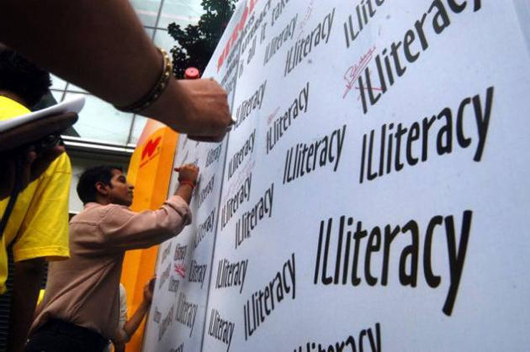
United Nations, Jan 29: India has by far the largest population of illiterate adults at 287 million, amounting to 37 per cent of the global total, a United Nations report said highlighting the huge disparities existing in education levels of the country's rich and poor.

The 2013/14 Education for All Global Monitoring Report said India's literacy rate rose from 48 per cent in 1991 to 63 per cent in 2006, the latest year it has available data, but population growth cancelled the gains so there was no change in the number of illiterate adults.

India has the highest population of illiterate adults at 287 million, the report published by United Nations Educational, Scientific and Cultural Organisation said.

The report further said that the richest young women in India have already achieved universal literacy but the poorest are projected to only do so around 2080, noting that huge disparities within India point to a failure to target support adequately towards those who need it the most.

"Post-2015 goals need to include a commitment to make sure the most disadvantaged groups achieve benchmarks set for goals. Failure to do so could mean that measurement of progress continues to mask the fact that the advantaged benefit the most," the report added.

The report said that a global learning crisis is costing governments USD 129 billion a year. Ten countries account for 557 million, or 72 per cent, of the global population of illiterate adults.

Ten per cent of global spending on primary education is being lost on poor quality education that is failing to ensure that children learn.

This situation leaves one in four young people in poor countries unable to read a single sentence.

In one of India's wealthier states, Kerala, education spending per pupil was about USD 685.

In rural India, there are wide disparities between richer and poorer states, but even within richer states, the poorest girls perform at much lower levels in mathematics.

In the wealthier states of Maharashtra and Tamil Nadu, most rural children reached grade 5 in 2012.

However, only 44 per cent of these children in the grade 5 age group in Maharashtra and 53 per cent in Tamil Nadu could perform a two-digit subtraction.

Among rich, rural children in these states, girls performed better than boys, with around two out of three girls able to do the calculations.

Despite Maharashtra's relative wealth, poor, rural girls there performed only slightly better than their counterparts in the poorer state of Madhya Pradesh.

The report said widespread poverty in Madhya Pradesh and Uttar Pradesh affects the chance of staying in school until grade 5.

In Uttar Pradesh, 70 per cent of poor children make it to grade 5 while almost all children from rich households are able to do so.

Similarly, in Madhya Pradesh, 85 per cent of poor children reach grade 5, compared with 96 per cent of rich children.

Once in school, poor girls have a lower chance of learning the basics. No more than one in five poor girls in Madhya Pradesh and Uttar Pradesh are able to do basic mathematics.

The report added that children who learn less are more likely to leave school early.

In India, children who achieved lower scores in mathematics at age 12 were more than twice as likely to drop out by age 15 than those who performed better.

In some countries, the engagement of teacher unions has improved policies aimed at helping disadvantaged groups. In India, teacher unions have a major influence on state legislatures and governments.

If days are lost because teachers are absent or devote more attention to private tuition than classroom teaching, the learning of the poorest children can be harmed.

Across India, absenteeism varied from 15 per cent in Maharashtra and 17 per cent in Gujarat – two richer states – to 38 per cent in Bihar and 42 per ccent in Jharkhand, two of the poorest states.

There is much evidence of the harm done to students’ learning because of teacher absenteeism.

In India, for example, a 10 per cent increase in teacher absence was associated with 1.8 per cent lower student attendance.

Governments should work more closely with teacher unions and teachers to formulate policies and adopt codes of conduct to tackle unprofessional behaviour such as persistent absenteeism and gender-based violence.

It said codes of practice should be consistent with legal frameworks for child rights and protection and a range of penalties, such as suspension and interdiction, clearly stipulated.

Policy-makers should ensure the curriculum focuses on securing strong foundation skills for all, is delivered at an appropriate pace and in a language children understand.

"India's curriculum, which outpaces what pupils can realistically learn and achieve in the time given, is a factor in widening learning gaps."


Comments

Add new comment

  • Coastaldigest.com reserves the right to delete or block any comments.
  • Coastaldigset.com is not responsible for its readers’ comments.
  • Comments that are abusive, incendiary or irrelevant are strictly prohibited.
  • Please use a genuine email ID and provide your name to avoid reject.
News Network
December 16,2025

jordan.jpg

Prime Minister Narendra Modi on Monday held talks with Jordan’s King Abdullah II in Amman, during which the two leaders discussed ways to further strengthen bilateral relations, with the Prime Minister outlining an eight-point vision covering key areas of cooperation.

Describing the meeting as “productive”, PM Modi said he shared a roadmap focused on trade and economy, fertilisers and agriculture, information technology, healthcare, infrastructure, critical and strategic minerals, civil nuclear cooperation, and people-to-people ties.

In a post on social media platform X, the Prime Minister praised King Abdullah II’s personal commitment to advancing India–Jordan relations, particularly as both countries mark the 75th anniversary of the establishment of diplomatic ties this year.

“Held productive discussions with His Majesty King Abdullah II in Amman. His personal commitment towards vibrant India-Jordan relations is noteworthy. This year, we are celebrating the 75th anniversary of our bilateral diplomatic relations,” PM Modi said.

The meeting took place at the Al Husseiniya Palace, where the two leaders also exchanged views on regional and global issues of mutual interest. According to the Ministry of External Affairs (MEA), both sides agreed to further deepen cooperation in areas including trade and investment, defence and security, counter-terrorism and de-radicalisation, fertilisers and agriculture, infrastructure, renewable energy, tourism, and heritage.

The MEA said both leaders reaffirmed their united stand against terrorism.

PM Modi arrived in Amman earlier on Monday and was received by Jordanian Prime Minister Jafar Hassan, who accorded him a formal welcome. Following the talks, King Abdullah II hosted a banquet dinner in honour of the Prime Minister, reflecting the warmth of bilateral ties.

Jordan is the first leg of PM Modi’s three-nation tour. From Amman, the Prime Minister will travel to Ethiopia at the invitation of Prime Minister Abiy Ahmed Ali, marking his first official visit to the African nation. The tour will conclude with a visit to Oman.

Comments

Add new comment

  • Coastaldigest.com reserves the right to delete or block any comments.
  • Coastaldigset.com is not responsible for its readers’ comments.
  • Comments that are abusive, incendiary or irrelevant are strictly prohibited.
  • Please use a genuine email ID and provide your name to avoid reject.
News Network
December 6,2025

indigoticket.jpg

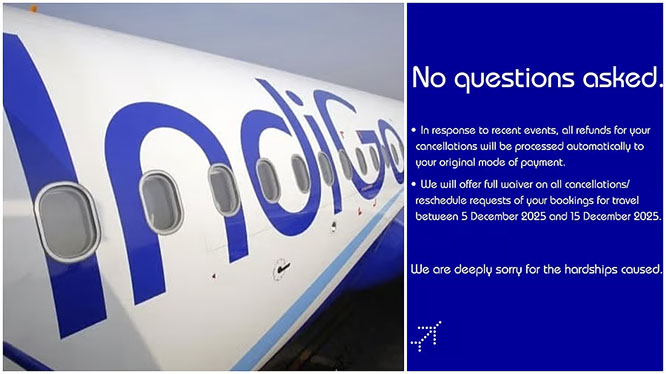
With IndiGo flight disruptions impacting thousands of passengers, the airline on Saturday said that it will offer full waiver on all cancellations/reschedule requests for travel bookings between December 5, 2025 and December 15, 2025.

Earlier in the day, the civil aviation ministry had directed the airline to complete the ticket refund process for the cancelled flights by Sunday evening, as well as ensure baggage separated from the travellers are delivered in the next two days.

In a post on X, titled 'No questions asked', IndiGo wrote, "In response to recent events, all refunds for your cancellations will be processed automatically to your original mode of payment."

"We are deeply sorry for the hardships caused," it further added.

Several passengers, however, complained of not getting full refund as promised by the airline.

Netizens have shared screenchots of getting charged for airline cancellation fee and convenience fee.

"Please tell me why u have did this airline cancellation charges when u say full amount will be refunded (sic)," a user wrote sharing a screenshot of the refund page.

"Well, but you have still debited the convenience charges," wrote another.

Passengers have also raised concerns about the "cancel" option being disabled on the IndiGo app. "First enable the 'Cancel' button on your App & offer full refund on tickets cancelled by customers between the said dates," wrote a user.

A day after the country's largest airline, IndiGo, cancelled more than 1,000 flights and caused disruptions for the fifth day on Saturday, the ministry said that any delay or non-compliance in refund processing will invite immediate regulatory action.

The refund process for all cancelled or disrupted flights must be completed by 8 pm on Sunday, the ministry said in a statement.

"Airlines have also been instructed not to levy any rescheduling charges for passengers whose travel plans were affected by cancellations," it said.

On Saturday, more than 400 flights were cancelled at various airports.

IndiGo has also been instructed to set up dedicated passenger support and refund facilitation cells.

Comments

Add new comment

  • Coastaldigest.com reserves the right to delete or block any comments.
  • Coastaldigset.com is not responsible for its readers’ comments.
  • Comments that are abusive, incendiary or irrelevant are strictly prohibited.
  • Please use a genuine email ID and provide your name to avoid reject.
News Network
December 6,2025

pilot.jpg

New Delhi: IndiGo, India’s largest airline, faced major operational turbulence this week after failing to prepare for new pilot-fatigue regulations issued by the Directorate General of Civil Aviation (DGCA). The stricter rules—designed to improve flight safety—took effect in phases through 2024, with the latest implementation on November 1. IndiGo has acknowledged that inadequate roster planning led to widespread cancellations and delays.

Below are the key DGCA rules that affected IndiGo’s operations:

1. Longer Mandatory Weekly Rest

Weekly rest for pilots has been increased from 36 hours to 48 hours.

The government says the extended break is essential to curb cumulative fatigue. This rule remains in force despite the current crisis.

2. Cap on Night Landings

Pilots can now perform only two night landings per week—a steep reduction from the earlier limit of six.

Night hours, defined as midnight to early morning, are considered the least alert period for pilots.

Given the disruptions, this rule has been temporarily relaxed for IndiGo until February 10.

3. Reduced Maximum Night Flight Duty

Flight duty that stretches into the night is now capped at 10 hours.

This measure has also been kept on hold for IndiGo until February 10 to stabilize operations.

4. Weekly Rest Cannot Be Replaced With Personal Leave

Airlines can no longer count a pilot’s personal leave as part of the mandatory 48-hour rest.

Pilots say this closes a loophole that previously reduced actual rest time.

Currently, all airlines are exempt from this rule to normalise travel.

5. Mandatory Fatigue Monitoring

Airlines must submit quarterly fatigue reports along with corrective actions to DGCA.

This system aims to create a transparent fatigue-tracking framework across the industry.

The DGCA has stressed that these rules were crafted to strengthen flight safety and align India with global fatigue-management standards. The temporary relaxations are expected to remain until February 2025, giving IndiGo time to stabilise its schedules and restore normal air travel.

Comments

Add new comment

  • Coastaldigest.com reserves the right to delete or block any comments.
  • Coastaldigset.com is not responsible for its readers’ comments.
  • Comments that are abusive, incendiary or irrelevant are strictly prohibited.
  • Please use a genuine email ID and provide your name to avoid reject.