'Amrit Kaal' for Modi, not commoners, says AAP; Mamata terms it poll budget; Cong calls it ‘pro-corporate’

News Network
February 1, 2023

duo.jpg

The Aam Aadmi Party on Wednesday questioned Union Finance Minister Nirmala Sitharaman’s claim about doubling of per capita income since 2014, saying it is ‘Amrit Kaal’ for Prime Minister Narendra Modi, not for the common people of the country.

Highlighting the achievements of the Modi dispensation so far, the finance minister in her budget speech said the government’s efforts since 2014 have ensured for all citizens a better quality of living and a life of dignity.

The per capita income has more than doubled to Rs 1.97 lakh, she added.

“Neither did the MSP of crops increase nor did the youth get employment. But this is Amrit Kaal for Modi ji. Nirmala ji is saying per capita income has doubled,” AAP’s Rajya Sabha MP Sanjay Singh, who is also the party’s national spokesperson, said in a series of tweets in Hindi, wondering “whose income” doubled.

The AAP leaders said the Union Budget for 2023-24, presented by the finance minister in Parliament, does not have any provision for the country’s farmers, soldiers and youth.

“No provision for anyone in the budget. Common people are longing for Amrit (nectar) in the Amrit Kaal,” Singh said.

Latching on to the finance minister’s proposal that 50 additional airports will be revived, the AAP MP took a swipe at Prime Minister Narendra Modi.

“Modi ji will build 50 new airports. Who will get them?” Singh said in a tweet.

Eyeing 2024 Lok Sabha elections 

Calling the Union Budget 2023-24 “anti-people” and “totally opportunistic”, West Bengal Chief Minister Wednesday slammed saying the Budget was prepared eyeing the 2024 Lok Sabha elections.

Slamming the Budget, Banerjee said the changes in the income tax slabs will not help anyone. “This Budget does not address India’s unemployment issue,” news agency PTI quoted her as saying.

Political leaders across party lines welcomed the recent tax rebates announced in the Union Budget 2023-24, but some Opposition leaders criticised the Centre for failing to adequately address the issues of unemployment and inflation in the country.

Congress MP Karti Chidambaram said that the tax cuts were a “welcome” move. “I am a believer in a low tax regime. So, any tax cuts are welcome because giving more money into the hands of the people is the best way to boost the economy,” the Congress leader told news agency ANI.

Meanwhile, noting that there were “some good things” in the Union Budget 2023-24, Congress leader Shashi Tharoor flagged that there was no mention of the rural poor, employment and inflation. He said that some “fundamental questions remained to be answered”.

“There are some good things in Union Budget 2023 but there was no mention of MNREGA, poor rural labour, employment and inflation,” Tharoor told news agency ANI. “Some fundamental questions remained to be answered.”

Congress leader K Suresh called it a “pro-corporate” budget that was only in the interest of  “Adani, Ambani and Gujarat”. “This is a pro-corporate budget. All interests of Adani are fulfilled in this budget, but the common man has been ignored,” he told ANI.

Union Minister Smriti Irani called it a “middle class bonanza budget”, but added that there was something in it for everyone. “This is a middle-class bonanza budget but PM has spoken about inclusive growth. This has been an inclusive budget. There was something for SC, ST, OBC, women and elderly,” she said.

There has been little change in the Union Budget over the last 8-9 years, according to former Jammu and Kashmir Chief Minister Mehbooba Mufti. “Taxes increased, money is not being spent on welfare schemes and subsidies,” she pointed out. ” Taxes are being collected for some crony capitalists and big businessmen.”

Bahujan Samaj Party supremo Mayawati said it would be better if the budget is for the country rather than for the party. In a tweet, she said, whenever the Centre talks about the figures of beneficiaries of schemes, it must remember that India is a vast country of about 130 crore poor, labourers, deprived, farmers who are yearning for their Amrit Kaal. 

Comments

Add new comment

  • Coastaldigest.com reserves the right to delete or block any comments.
  • Coastaldigset.com is not responsible for its readers’ comments.
  • Comments that are abusive, incendiary or irrelevant are strictly prohibited.
  • Please use a genuine email ID and provide your name to avoid reject.
News Network
February 5,2026

In an era where digital distractions are the primary rival to academic excellence, the Karnataka Education Department is taking the fight directly to the living room. As the SSLC (Class 10) annual examinations loom, officials have launched a localized "digital strike" to ensure students aren't losing their competitive edge to scrolling or soap operas.

The 7-to-9 Lockdown

The department has issued a formal directive urging—and in some cases, enforcing via home visits—a total blackout of mobile phones and television sets between 7:00 PM and 9:00 PM. This two-hour window is being designated as "sacred study time" across the state until the examinations conclude on April 2.

Key Pillars of the Initiative:

•    Doorstep Advocacy: Teachers are transitioning from classrooms to living rooms, meeting parents to explain the psychological benefits of a distraction-free environment.

•    Parental Accountability: The campaign shifts the burden of discipline from the student to the household, asking parents to lead by example and switch off their own devices.

•    The Timeline: The focus remains sharp on the upcoming exam block, scheduled from March 18 to April 2.

"The objective is simple: uninterrupted focus. We are reclaiming the evening hours for the students, ensuring their environment is as prepared as their minds," stated a senior department official.

Student vs. Reality

While the student community has largely welcomed the "forced focus"—with many admitting they lack the willpower to ignore notifications—the move has sparked a debate on enforceability. Without a "TV Police," the success of this initiative rests entirely on the shoulders of parents and the persuasive power of visiting educators.

Comments

Add new comment

  • Coastaldigest.com reserves the right to delete or block any comments.
  • Coastaldigset.com is not responsible for its readers’ comments.
  • Comments that are abusive, incendiary or irrelevant are strictly prohibited.
  • Please use a genuine email ID and provide your name to avoid reject.
News Network
January 23,2026

Mangaluru: The Karnataka Government Polytechnic (KPT), Mangaluru, has achieved autonomous status from the All India Council for Technical Education (AICTE), becoming the first government polytechnic in the country to receive such recognition in its 78-year history. The status was granted by AICTE, New Delhi, and subsequently approved by the Karnataka Board of Technical Education in October last year.

Officials said the autonomy was conferred a few months ago. Until recently, AICTE extended autonomous status only to engineering colleges, excluding diploma institutions. However, with a renewed national focus on skill development, several government polytechnics across India have now been granted autonomy.

KPT, the second-largest polytechnic in Karnataka, was established in 1946 with four branches and has since expanded to offer eight diploma programmes, including computer science and polymer technology. The institution is spread across a 19-acre campus.

Ravindra M Keni, the first dean of the institution, told The Times of India that AICTE had proposed autonomous status for polytechnic institutions that are over 25 years old. “Many colleges applied. In the first round, 100 institutions were shortlisted, which was further narrowed down to 15 in the second round. We have already completed one semester after becoming an autonomous institution,” he said. He added that nearly 500 students are admitted annually across eight three-year diploma courses.

Explaining the factors that helped KPT secure autonomy, Keni said the institution has consistently recorded 100 per cent admissions and placements for its graduates. He also noted its strong performance in sports, with the college emerging champions for 12 consecutive years, along with active student participation in NCC and NSS activities.

Autonomous status allows KPT to design industry-oriented curricula, conduct examinations, prepare question papers, and manage academic documentation independently. The institution can also directly collaborate with industries and receive priority funding from AICTE or the Ministry of Education. While academic autonomy has been granted, financial control will continue to rest with the state government.

“There will be separate committees for examinations, question paper setting, boards of studies, and boards of examiners. The institution will now have the freedom to conduct admissions without government notifications and issue its own marks cards,” Keni said, adding that new academic initiatives would be planned after a year of functioning under the autonomous framework.

Comments

Add new comment

  • Coastaldigest.com reserves the right to delete or block any comments.
  • Coastaldigset.com is not responsible for its readers’ comments.
  • Comments that are abusive, incendiary or irrelevant are strictly prohibited.
  • Please use a genuine email ID and provide your name to avoid reject.
News Network
January 23,2026

modIKERALA.jpg

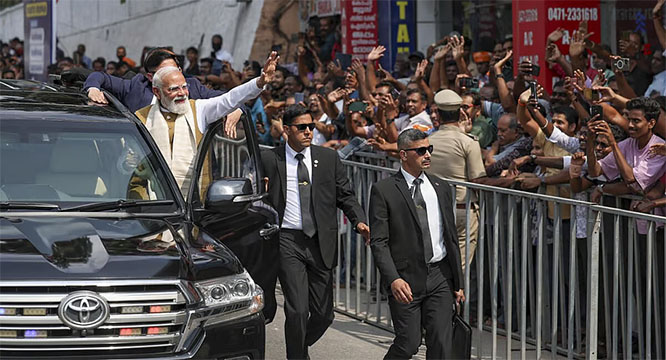
Prime Minister Narendra Modi, during his visit to Thiruvananthapuram on Friday, January 23, indicated that the Bharatiya Janata Party (BJP) is aiming to expand its political footprint in Kerala ahead of the Assembly elections scheduled in the coming months.

Speaking at a BJP-organised public meeting, Modi drew parallels between the party’s early electoral gains in Gujarat and its recent victory in the Thiruvananthapuram Municipal Corporation. The civic body win, which ended decades of Left control, was cited by the Prime Minister as a possible starting point for the party’s broader ambitions in the state.

Recalling BJP’s political trajectory in Gujarat, Modi said the party was largely insignificant before 1987 and received little media attention. He pointed out that the BJP’s first major breakthrough came with its victory in the Ahmedabad Municipal Corporation that year.

“Just as our journey in Gujarat began with one city, Kerala’s journey has also started with a single city,” Modi said, suggesting that the party’s municipal-level success could translate into wider electoral acceptance.

The Prime Minister alleged that successive governments led by the Left Democratic Front (LDF) and the United Democratic Front (UDF) had failed to adequately develop Thiruvananthapuram. He accused both fronts of corruption and neglect, claiming that basic infrastructure and facilities were denied to the capital city for decades.

According to Modi, the BJP’s control of the civic body represents a shift driven by public dissatisfaction with the existing political alternatives. He asserted that the BJP administration in Thiruvananthapuram had begun working towards development, though no specific details or timelines were outlined.

Addressing the gathering at Putharikandam Maidan, Modi said the BJP intended to project Thiruvananthapuram as a “model city,” reiterating his party’s commitment to governance-led change.

The Prime Minister’s visit to Kerala also included the inauguration of several development projects and the flagging off of new train services, as the BJP intensifies its political outreach in the poll-bound state.

Comments

Add new comment

  • Coastaldigest.com reserves the right to delete or block any comments.
  • Coastaldigset.com is not responsible for its readers’ comments.
  • Comments that are abusive, incendiary or irrelevant are strictly prohibited.
  • Please use a genuine email ID and provide your name to avoid reject.