Assam govt introduces Bill in Assembly to shut 600 madrasas

Agencies
December 28, 2020

adrasas.jpg

Guwahati, Dec 28: The Assam government introduced a Bill in the Assembly on Monday to shut over 600 madrasas run by it, which was strongly opposed by the opposition Congress and AIUDF.

Assam Education and Finance Minister Himanta Biswa Sarma introduced the Assam Madrassas Education (Provincialisation) Act of 1995 on the opening day of the three-day Winter Session.

"Once the Bill is passed (by the House), the practice of running madrasas by the government in Assam will come to an end, a practice which was started by the Muslim League government in pre-Independence Assam," Sarma said in a tweet.

The Congress and All India United Democratic Front (AIUDF) strongly opposed the Bill and said that they would restart the madrasa education after coming to the power in the Assembly polls due in April-May next year.

Earlier, Sarma had said that the state government had decided to make education 'secular' and 620 madrasas administered by the state government would be shut.

The Assam Cabinet earlier in a meeting chaired by Chief Minister Sarbananda Sonowal approved the proposal to close down all government-run madrasas and Sanskrit tols (schools) in the state.

"All the 620 government-run madrasas will be converted into the general schools and 97 Sanskrit tols handed over to Kumar Bhaskarvarma Sanskrit University. These Sanskrit tols will be converted into centres of learning and research where Indian culture, civilisation and nationalism will be studied. Irrespective of religion, Indian culture, civilisation and nationalism will be taught in these converted educational institutions, making Assam the first Indian state to teach on these themes," Sarma told the media.

He, however, said that madrasas run by private organisations in Assam would not be shut.

Sarma said that the state government had been spending Rs 260 crore annually for running the madrasas and "the government cannot spend public money for religious teaching".

"In order to bring uniformity, teaching the Quran at the cost of government exchequer cannot be allowed to continue," he had said.

Sarma claimed that most students enrolled in the madrasas want to become doctors and engineers and are not aware of the fact that these are not regular schools.

A survey conducted by a Gauhati University Professor, who is a Muslim, found that the parents and guardians of most madrasa students are not aware that their children are not taught regular subjects but imparted lessons mostly in theology.

The Minister claimed that most Islamic scholars are also not in favour of madrasas run by the government and added that these are a legacy of the Muslim League.


Comments

Add new comment

  • Coastaldigest.com reserves the right to delete or block any comments.
  • Coastaldigset.com is not responsible for its readers’ comments.
  • Comments that are abusive, incendiary or irrelevant are strictly prohibited.
  • Please use a genuine email ID and provide your name to avoid reject.
News Network
December 6,2025

pilot.jpg

New Delhi: IndiGo, India’s largest airline, faced major operational turbulence this week after failing to prepare for new pilot-fatigue regulations issued by the Directorate General of Civil Aviation (DGCA). The stricter rules—designed to improve flight safety—took effect in phases through 2024, with the latest implementation on November 1. IndiGo has acknowledged that inadequate roster planning led to widespread cancellations and delays.

Below are the key DGCA rules that affected IndiGo’s operations:

1. Longer Mandatory Weekly Rest

Weekly rest for pilots has been increased from 36 hours to 48 hours.

The government says the extended break is essential to curb cumulative fatigue. This rule remains in force despite the current crisis.

2. Cap on Night Landings

Pilots can now perform only two night landings per week—a steep reduction from the earlier limit of six.

Night hours, defined as midnight to early morning, are considered the least alert period for pilots.

Given the disruptions, this rule has been temporarily relaxed for IndiGo until February 10.

3. Reduced Maximum Night Flight Duty

Flight duty that stretches into the night is now capped at 10 hours.

This measure has also been kept on hold for IndiGo until February 10 to stabilize operations.

4. Weekly Rest Cannot Be Replaced With Personal Leave

Airlines can no longer count a pilot’s personal leave as part of the mandatory 48-hour rest.

Pilots say this closes a loophole that previously reduced actual rest time.

Currently, all airlines are exempt from this rule to normalise travel.

5. Mandatory Fatigue Monitoring

Airlines must submit quarterly fatigue reports along with corrective actions to DGCA.

This system aims to create a transparent fatigue-tracking framework across the industry.

The DGCA has stressed that these rules were crafted to strengthen flight safety and align India with global fatigue-management standards. The temporary relaxations are expected to remain until February 2025, giving IndiGo time to stabilise its schedules and restore normal air travel.

Comments

Add new comment

  • Coastaldigest.com reserves the right to delete or block any comments.
  • Coastaldigset.com is not responsible for its readers’ comments.
  • Comments that are abusive, incendiary or irrelevant are strictly prohibited.
  • Please use a genuine email ID and provide your name to avoid reject.
News Network
December 5,2025

indigoCEO.jpg

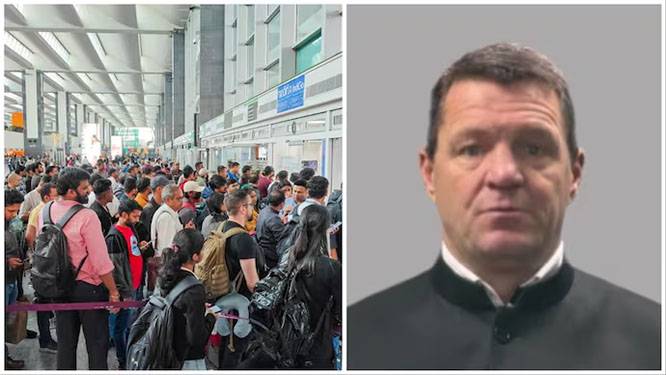
New Delhi, Dec 5: IndiGo CEO Pieter Elbers issued a public apology this evening after more than a thousand flights were cancelled today, making it the "most severely impacted day" in terms of cancellations. The biggest airline of the country cancelled "more than half" of its daily number of flights on Friday, said Elbers. He also said that even though the crisis will persist on Saturday, the airline anticipates fewer than 1,000 flight cancellations.

"Full normalisation is expected between December 10 and 15, though IndiGo cautions that recovery will take time due to the scale of operations," the IndiGo CEO said. 

IndiGo operates around 2,300 domestic and international flights daily.

Pieter Elbers, while apologising for the major inconvenience due to delays and cancellations, said the situation is a result of various causes.

The crisis at IndiGo stems from new regulations that boost pilots' weekly rest requirements by 12 hours to 48 and allow only two night-time landings per week, down from six. IndiGo has attributed the mass cancellations to "misjudgment and planning gaps".

Elbers also listed three lines of action that the airline will adopt to address the issue.

"Firstly, customer communication and addressing your needs, for this, messages have been sent on social media. And just now, a more detailed communication with information, refunds, cancellations and other customer support measures was sent," he said.

The airline has also stepped up its call centre capacity.

"Secondly, due to yesterday's situation, we had customers stranded mostly at the nation's largest airports. Our focus was for all of them to be able to travel today itself, which will be achieved. For this, we also ask customers whose flights are cancelled not to come to the airports as notifications are sent," the CEO said.

"Thirdly, cancellations were made for today to align our crew and planes to be where they need to start tomorrow morning afresh. Earlier measures of the last few days, regrettable, have proven not to be enough, but we have decided today to reboot all our systems and schedules, resulting in the highest numbers of cancellations so far, but imperative for progressive improvements starting from tomorrow," he added.

As airports witnessed chaotic scenes, the Directorate General of Civil Aviation (DGCA) stepped in to grant IndiGo a temporary exemption from stricter night duty rules for pilots. It also allowed substitution of leaves with a weekly rest period. 

Civil Aviation Minister Ram Mohan Naidu has said a high-level inquiry will be ordered and accountability will be fixed.

Comments

Add new comment

  • Coastaldigest.com reserves the right to delete or block any comments.
  • Coastaldigset.com is not responsible for its readers’ comments.
  • Comments that are abusive, incendiary or irrelevant are strictly prohibited.
  • Please use a genuine email ID and provide your name to avoid reject.
News Network
November 29,2025

DKSsiddu.jpg

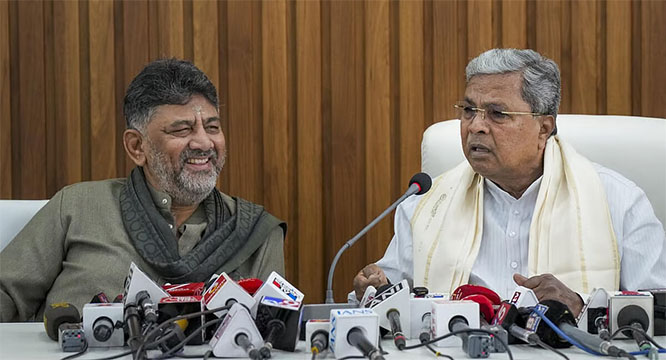
New Delhi: Karnataka chief minister Siddaramaiah and deputy CM DK Shivakumar on Saturday put up a dramatic display of unity at a closely watched joint press briefing, firmly dismissing weeks of speculation about a power-sharing tussle within the Congress. With the high command nudging both leaders to sit together and settle the dust, the meeting became a political spectacle, ending with the duo declaring that there was “no confusion, no differences.”

Calling the reports of a rift “manufactured confusion,” Siddaramaiah said the talks had gone smoothly, even joking about their breakfast. “Breakfast was very good. All three of us enjoyed it,” he said. “We want to end this confusion once and for all. For local elections and for 2028, our mission is clear — Congress must return to power. There is no difference between me and DKS, not now, not before.”

He blamed the media for fuelling rumours and reiterated absolute adherence to the party leadership. “From tomorrow, let there be no confusion. What the high command says, we will follow.”

Siddaramaiah also assured that the Assembly session starting December 8 would run smoothly and vowed that Congress would take on the BJP and JD(S) “together.”

Shivakumar echoed the chief minister word for word, stressing loyalty and discipline. “People have given us a massive mandate. It is our duty to deliver,” he said. “This government was formed under Siddaramaiah’s leadership. We both have complete trust in the high command. If they tell me to wait, I will wait.”

He added that the two leaders had discussed strategy for the 2028 Assembly elections. “Whatever the CM says, I agree. We are loyal soldiers of the party. The party may be facing challenges nationally, but we will keep it strong in Karnataka.”

Shivakumar also said Siddaramaiah would soon visit his home for lunch or dinner — another symbolic gesture meant to underline their unity.

Both leaders later posted on social media describing the breakfast meeting as “productive” and focused on “Karnataka’s priorities.”

The BJP, however, rejected the show of camaraderie as “pure bunkum,” accusing Congress of trying to paper over an internal power struggle. But Siddaramaiah and Shivakumar insisted their united front would continue — and that there was “no confusion” within the state leadership.

Comments

Add new comment

  • Coastaldigest.com reserves the right to delete or block any comments.
  • Coastaldigset.com is not responsible for its readers’ comments.
  • Comments that are abusive, incendiary or irrelevant are strictly prohibited.
  • Please use a genuine email ID and provide your name to avoid reject.