



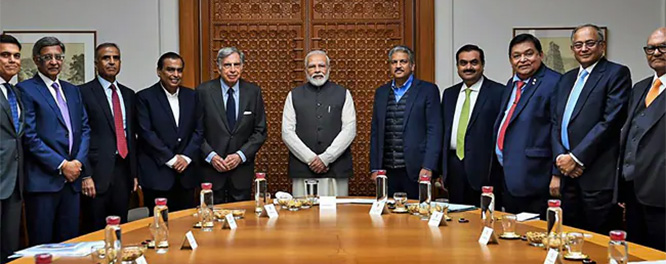
‘Billionaire Raj’: India now more unequal than in British Raj; top 1% income, wealth shares reach historical highs

News Network
March 21, 2024

billionairs.jpg

New Delhi: India has now become more unequal in terms of wealth concentration than the British colonial period as income and wealth of the top 1% of the country’s population have hit historical highs, according to a paper released by World Inequality Lab.

By 2022-23, the top 1 per cent income share in India was 22.6 per cent and the top 1 per cent wealth share rose to 40.1 per cent, with India’s top 1 per cent income share among the very highest in the world, higher than even South Africa, Brazil and the US.

Co-authored by economists Nitin Kumar Bharti, Lucas Chancel, Thomas Piketty, and Anmol Somanchi, the paper stated that the “Billionaire Raj” headed by “India’s modern bourgeoisie” is now more unequal than the British Raj headed by the colonialist forces. 

The paper said there is evidence to suggest the Indian tax system might be “regressive when viewed from the lens of net wealth”. A restructuring of the tax code is needed, the paper said, adding that a levy of a “super tax” of 2 per cent on the net wealth of 167 wealthiest families would yield 0.5 per cent of national income in revenues and create space for investments.

“A restructuring of the tax code to account for both income and wealth, and broad-based public investments in health, education and nutrition are needed to enable the average Indian, and not just the elites, to meaningfully benefit from the ongoing wave of globalisation. Besides serving as a tool to fight inequality, a “super tax” of 2% on the net wealth of the 167 wealthiest families in 2022-23 would yield 0.5% of national income in revenues and create valuable fiscal space to facilitate such investments,” the paper said. 

The paper has analysed data based on the annual tax tabulations published by the Indian income tax authorities to extract the distribution of top income earners between 1922-2020.

The share of national income going to the top 10 per cent fell from 37 per cent in 1951 to 30 per cent by 1982 after which it began steadily rising. From the early 1990s onwards, the top 10 per cent share increased substantially over the next three decades, nearly touching 60 per cent in the most recent years, the paper said. This compares with the bottom 50 per cent getting only 15 per cent of India’s national income in 2022-23.

 The top 1 per cent earn on average Rs 5.3 million, 23 times the average Indian (Rs 0.23 million). Average incomes for the bottom 50 per cent and the middle 40 per cent stood at Rs 71,000 (0.3 times national average) and Rs 1,65,000 (0.7 times national average), respectively.
The richest, nearly 10,000 individuals (of 92 million Indian adults) earn on average Rs 480 million (2,069 times the average Indian). “To get a sense of just how skewed the distribution is, one would have to be at nearly the 90th percentile to earn the average income in India,” the paper said.

In 2022, just the top 0.1 per cent in India earned nearly 10 per cent of the national income, while the top 0.01 per cent earned 4.3 per cent share of the national income and top 0.001 per cent earned 2.1 per cent of the national income.

Enlisting the probable reasons for sharp rise in top 1 per cent income shares, the paper said public and private sector wage growth could have played a part till the late 1990s, adding that there are good reasons to believe capital incomes likely played a role in subsequent years. For the shares of the bottom 50 per cent and middle 40 per cent remaining depressed, the paper said, the primary reason has been the lack of quality broad-based education, focused on the masses and not just the elites.

“One reason to be concerned with such high levels of inequality is that extreme concentration of incomes and wealth is likely to facilitate disproportionate influence on society and government. This is even more so in contexts with weak democratic institutions. After largely being a role model among post-colonial nations in this regard, the integrity of various key institutions in India appears to have been compromised in recent years. This makes the possibility of India’s slide towards plutocracy even more real. If only for this reason, income and wealth inequality in India must be closely tracked and challenged,” it said.

Comments

Add new comment

  • Coastaldigest.com reserves the right to delete or block any comments.
  • Coastaldigset.com is not responsible for its readers’ comments.
  • Comments that are abusive, incendiary or irrelevant are strictly prohibited.
  • Please use a genuine email ID and provide your name to avoid reject.
News Network
November 24,2025

lebanon.jpg

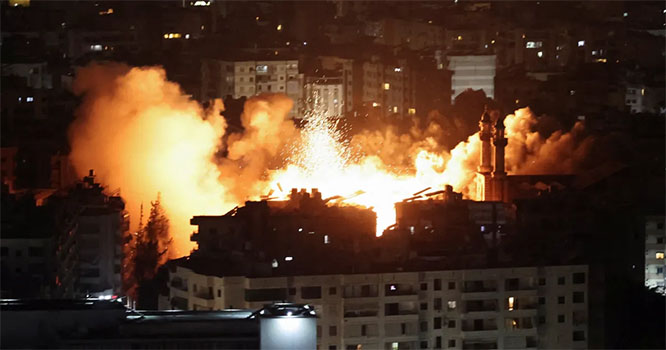
Israel has launched a new act of aggression on a residential neighborhood in Lebanon's capital, Beirut, killing and injuring about two dozen civilians.

The Israeli regime's military said in a statement that its forces carried out a so-called precise strike in a residential apartment in Dahiyeh in the southern suburbs of Beirut on Sunday.

The aggression targeted residential areas, killing at least five people and injuring more than 28 people, Lebanon's Health Ministry said. 

Hezbollah announced the martyrdom of senior Hezbollah commander Haytham Ali Tabatabai and four resistance fighters.

Lebanese President Michel Aoun condemned the airstrike, calling it a clear demonstration of Tel Aviv’s disregard for repeated international calls to halt violations on Lebanese soil.

“Israel refuses to implement international resolutions and all efforts aimed at ending the escalation and restoring stability,” Aoun said, urging the international community to take action to prevent further aggression.

The Palestinian Islamic Jihad movement also condemned the attack, holding the international community accountable. 

“The international community bears responsibility and continues to provide cover for these attacks as long as it does not restrain the occupiers,” said Ali Abu Shahin, a member of the group’s political bureau.

Israeli prime minister Benjamin Netanyahu’s office announced that the Israeli army carried out a strike “in the heart of Beirut."

Netanyahu reportedly approved the operation following recommendations from top Israeli security officials.

Two senior US officials commented on the Israeli strike.

The first official said that Israel did not notify Americans in advance about the attack. "We were informed immediately after the strike was carried out."

The second senior official said that the "US knew for several days that Israel was planning to escalate its strikes in Lebanon, but did not know in advance the timing, location, or target of the strike."

Speaking from the site of the Israeli strike, Lebanese MP Ali Ammar condemned the attack as part of a broader campaign of aggression that has targeted "all of Lebanon since the Washington-sponsored ceasefire."

He stated that "any attack on Lebanon is a violation of red lines; this aggression is part and parcel of the entity that targets Lebanon's dignity, sovereignty, and security of citizens."

Ammar went on to say the resistance is responding with "utmost wisdom, patience, and will confront the enemy at the appropriate time."

"Unfortunately, the enemy is emboldened to commit its aggression by voices within Lebanon that have turned themselves into tools that support its aggression," he added.

The Israeli attack on the southern suburbs of the Lebanese capital is the latest blatant violation of the ceasefire Israel signed with Hezbollah in November 2024, which was intended to end hostilities that had escalated into full-scale war.

An Israeli strike on the Ain al-Hilweh camp near Sidon in southern Lebanon late Tuesday killed at least 14 people. It wounded several others, including young students, according to the Lebanese health ministry.

The military claimed the attack targeted “a Hamas training compound” used to plan and carry out attacks against the regime -- a claim that has frequently been made without evidence.

Hamas rejected the allegations as “a blatant lie aimed at justifying the massacre,” stating it had “no military installations in the Palestinian camps in Lebanon” and that the targeted site was merely “an open sports field.”

According to Lebanese authorities, Israeli attacks have killed approximately 4,000 people and displaced more than 1.2 million residents across the country since October 2023.

Comments

Add new comment

  • Coastaldigest.com reserves the right to delete or block any comments.
  • Coastaldigset.com is not responsible for its readers’ comments.
  • Comments that are abusive, incendiary or irrelevant are strictly prohibited.
  • Please use a genuine email ID and provide your name to avoid reject.