Centre issues covid guidelines for children; Remdesivir not recommended

News Network
June 9, 2021

New Delhi, June 9: The government has come out with comprehensive guidelines for the management of Covid-19 among children in which Remdesivir has not been recommended and rational use of HRCT imaging has been suggested.

The guidelines issued by the Directorate General of Health Services (DGHS) under the health ministry also said that steroids are harmful in asymptomatic and mild cases of infection.

The DGHS recommended steroids only in hospitalised moderately severe and critically ill Covid-19 cases under strict supervision.

"Steroids should be used at the right time, in the right dose and for the right duration. Self-medication of steroids must be avoided," it said.

The guidelines also said Remdesivir (an emergency use authorization drug) is not recommended in children.

"There is lack of sufficient safety and efficacy data with respect to Remdesivir in children below 18 years of age," the guidelines said.

The guidelines suggested rational use of High-resolution CT (HRCT) for seeing the extent and nature of lung involvement in patients with Covid-19.

"However, any additional information gained from HRCT scan of the chest often has little impact on treatment decisions, which are based almost entirely on clinical severity and physiological impairment.

"Therefore, treating physicians should be highly selective in ordering HRCT imaging of the chest in Covid-19 patients," the guidelines said.

They said Covid-19 is a viral infection, and antimicrobials have no role in the prevention or treatment of uncomplicated Covid-19 infection.

For asymptomatic and mild cases, the guidelines said antimicrobials are not recommended for therapy or prophylaxis while for moderate and severe cases antimicrobials should not be prescribed unless there is clinical suspicion of a superadded infection.

Hospital admission increases the risk of healthcare-associated infections with multidrug-resistant organisms.

For asymptomatic infection among children, the guidelines recommended no specific medication and promoted Covid-appropriate behaviour (mask, strict hand hygiene, physical distancing) and suggested giving nutritious diet.

The guidelines said that for mild infection paracetamol 10-15mg/kg/dose may be given every 4-6 hours for fever and throat soothing agents and warm saline gargles in older children and adolescents have been recommended for cough.

In case of moderate infection, the guidelines suggested initiating immediate oxygen therapy.

"Corticosteroids are not required in all children with moderate illness; they may be administered in rapidly progressive disease and anticoagulants may also be indicated," the guidelines said.

For severe Covid-19 among children, the guidelines said if Acute Respiratory Distress Syndrome (ARDS) develops, necessary management to be initiated.

"In case shock develops, necessary management should be initiated. Antimicrobials to be administered if there is evidence/strong suspicion of superadded bacterial infection.  May need organ support in case of organ dysfunction, e.g. renal replacement therapy," it said.

The guidelines also recommended a six-minute walk test for children above 12 years under the supervision of parents/guardians.

"It is a simple clinical test to assess cardiopulmonary exercise tolerance and is used to unmask hypoxia.  Attach a pulse oximeter to his/her finger and ask the child to walk in the confines of their room for six minutes continuously," it said. 

Comments

Add new comment

  • Coastaldigest.com reserves the right to delete or block any comments.
  • Coastaldigset.com is not responsible for its readers’ comments.
  • Comments that are abusive, incendiary or irrelevant are strictly prohibited.
  • Please use a genuine email ID and provide your name to avoid reject.
News Network
November 28,2025

ministerPM.jpg

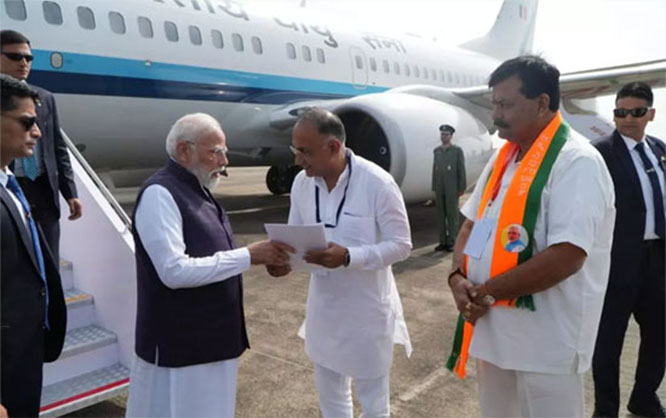
Mangaluru, Nov 28: Karnataka Health Minister and Dakshina Kannada district in-charge minister Dinesh Gundu Rao on Friday handed over Chief Minister Siddaramaiah’s letter to Prime Minister Narendra Modi, highlighting the severe distress faced by farmers due to crashing crop prices.

PM Modi arrived at the Mangaluru International Airport en route to Udupi, where Gundu Rao welcomed him and submitted the letter. The chief minister’s message stressed that farmers are suffering heavy losses because maize and green gram are being bought far below the Minimum Support Price (MSP). The state urged the Centre to immediately begin procurement at MSP.

According to the letter, Karnataka has a bumper harvest this year—over 54.74 lakh metric tons of maize and 1.98 lakh metric tons of green gram—yet farmers are unable to secure fair prices. Against the MSP of ₹2,400/MT for maize and ₹8,768/MT for green gram, market rates have plunged to ₹1,600–₹1,800 and ₹5,400 respectively.

The chief minister has requested the Centre to:

• Direct NAFED, FCI and NCCF to start MSP procurement immediately.
• Ensure ethanol units purchase maize directly from farmers or FPOs.
• Increase Karnataka’s ethanol allocation, citing high production capacity.
• Stop maize imports, which have depressed domestic prices.
• Relax quality norms for green gram, allowing up to 10% discoloration due to rains.

The letter stresses that MSP is crucial for farmer dignity and income stability and calls for swift central intervention to prevent a deepening crisis.

Comments

Add new comment

  • Coastaldigest.com reserves the right to delete or block any comments.
  • Coastaldigset.com is not responsible for its readers’ comments.
  • Comments that are abusive, incendiary or irrelevant are strictly prohibited.
  • Please use a genuine email ID and provide your name to avoid reject.
News Network
December 6,2025

pilot.jpg

New Delhi: IndiGo, India’s largest airline, faced major operational turbulence this week after failing to prepare for new pilot-fatigue regulations issued by the Directorate General of Civil Aviation (DGCA). The stricter rules—designed to improve flight safety—took effect in phases through 2024, with the latest implementation on November 1. IndiGo has acknowledged that inadequate roster planning led to widespread cancellations and delays.

Below are the key DGCA rules that affected IndiGo’s operations:

1. Longer Mandatory Weekly Rest

Weekly rest for pilots has been increased from 36 hours to 48 hours.

The government says the extended break is essential to curb cumulative fatigue. This rule remains in force despite the current crisis.

2. Cap on Night Landings

Pilots can now perform only two night landings per week—a steep reduction from the earlier limit of six.

Night hours, defined as midnight to early morning, are considered the least alert period for pilots.

Given the disruptions, this rule has been temporarily relaxed for IndiGo until February 10.

3. Reduced Maximum Night Flight Duty

Flight duty that stretches into the night is now capped at 10 hours.

This measure has also been kept on hold for IndiGo until February 10 to stabilize operations.

4. Weekly Rest Cannot Be Replaced With Personal Leave

Airlines can no longer count a pilot’s personal leave as part of the mandatory 48-hour rest.

Pilots say this closes a loophole that previously reduced actual rest time.

Currently, all airlines are exempt from this rule to normalise travel.

5. Mandatory Fatigue Monitoring

Airlines must submit quarterly fatigue reports along with corrective actions to DGCA.

This system aims to create a transparent fatigue-tracking framework across the industry.

The DGCA has stressed that these rules were crafted to strengthen flight safety and align India with global fatigue-management standards. The temporary relaxations are expected to remain until February 2025, giving IndiGo time to stabilise its schedules and restore normal air travel.

Comments

Add new comment

  • Coastaldigest.com reserves the right to delete or block any comments.
  • Coastaldigset.com is not responsible for its readers’ comments.
  • Comments that are abusive, incendiary or irrelevant are strictly prohibited.
  • Please use a genuine email ID and provide your name to avoid reject.
News Network
December 3,2025

indigo.jpg

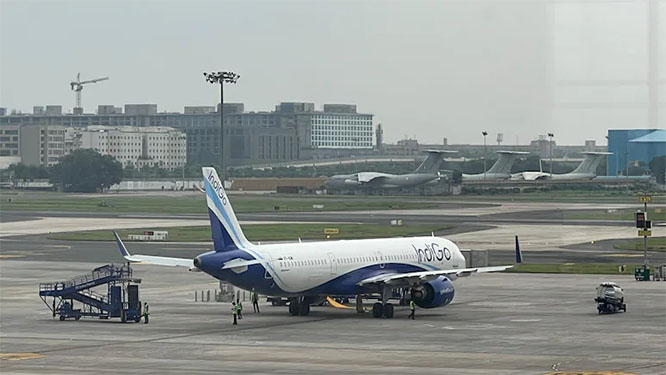
IndiGo, India’s largest airline, is battling one of its worst operational disruptions in recent years, with hundreds of delays and cancellations throwing domestic travel into chaos.

Government data on Tuesday showed its on-time performance plunging to 35%, an unusual dip for a carrier long associated with punctuality.

By Wednesday afternoon, airports in Delhi, Mumbai, Bengaluru and Hyderabad had collectively reported close to 200 cancellations, stranding travellers across the country.

Crew Shortage After New Duty Norms

A major trigger behind the meltdown is a severe crew shortage, especially among pilots, following the rollout of revised Flight Duty Time Limitation (FDTL) norms last month.

The rules mandate longer rest hours and more humane rosters — a shift IndiGo has struggled to incorporate across its vast network.

Sources said several flights were grounded due to lack of cabin crew, while some delays stretched upwards of eight hours.

With IndiGo controlling over 60% of India’s domestic aviation market, the ripple effect has impacted airports nationwide.

IndiGo Issues Apology, Lists “Compounding Factors”

In a statement, IndiGo acknowledged the large-scale disruption:

“We sincerely apologise to customers. A series of unforeseen operational challenges — technology glitches, winter schedule changes, adverse weather, system congestion and updated FDTL norms — created a compounding impact that could not have been anticipated.”

To stabilise operations, the airline has begun calibrated schedule adjustments for the next 48 hours, aiming to restore punctuality. Affected passengers are being offered refunds or alternate travel arrangements, IndiGo said.

What the FDTL Rules Require

The FDTL norms, designed to reduce pilot fatigue, cap duty and flying hours as follows:
•    Maximum 8 hours of flying per day
•    35 hours per week
•    125 hours per month
•    1,000 hours per year

Crew must also receive rest equalling twice the flight duration, with a minimum 10-hour rest period in any 24-hour window.

The DGCA introduced these limits to enhance flight safety.

Hyderabad: 33 Flights Cancelled, Long Queues Reported

Hyderabad’s Rajiv Gandhi International Airport saw heavy early-morning crowds as 33 IndiGo flights (arrivals and departures) were cancelled.

The airport clarified on X that operations were normal, advising passengers to contact IndiGo directly for latest flight status.

Cancellations included flights to and from Visakhapatnam, Goa, Ahmedabad, Delhi, Bengaluru, Chennai, Madurai, Hubli, Bhopal and Bhubaneswar.

Bengaluru: 42 Flights Disrupted

Bengaluru’s Kempegowda International Airport recorded 42 cancellations — 22 arrivals and 20 departures — affecting routes to Delhi, Mumbai, Chennai, Hyderabad, Goa, Kolkata and Lucknow.

Passengers Vent on Social Media

Irate travellers took to X to share their experiences. One passenger stranded in Hyderabad wrote: “I have been here since 3 a.m. and missed an important meeting.”

Another said: “My flight was pushed from 1:55 PM to 2:55 PM and now 4:35 PM. I was informed only three minutes before entering the airport.”

Delhi Airport Hit by Tech Glitch

At Delhi Airport, the disruption deepened due to a slowdown in the Amadeus system — used for reservations, check-ins and departure control.

The technical issue led to longer queues and sluggish processing, adding to delays already worsened by staff shortages.

Comments

Add new comment

  • Coastaldigest.com reserves the right to delete or block any comments.
  • Coastaldigset.com is not responsible for its readers’ comments.
  • Comments that are abusive, incendiary or irrelevant are strictly prohibited.
  • Please use a genuine email ID and provide your name to avoid reject.