



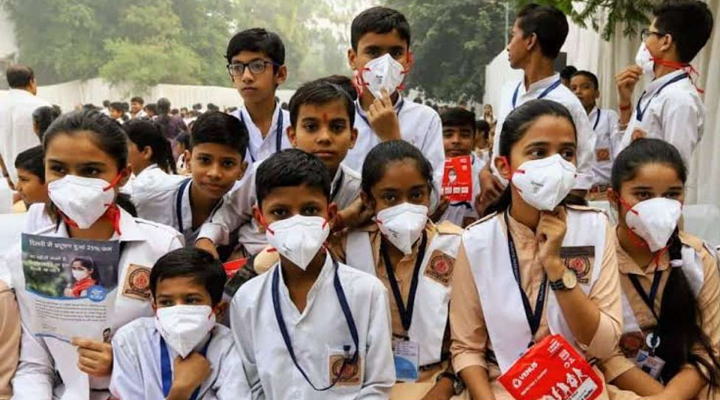
New Delhi, Sept 10: The Union health ministry on September 8 announced that higher educational institutions as well as skill training centres can resume their classes from September 21. Releasing a standard operating procedure (SOP), the ministry asked institutions to implement staggered classroom activities with separate time slots, mandatory six feet distance between desks and carry out disinfection of premises, among other COVID-19 safety measures. All States/UTs are expected to comply with the COVID-19 related guidelines issued by Ministry of Home Affairs and Ministry of Health & Family Welfare.
Check out the complete SOP guideline for the partial reopening of Schools for students of 9th to 12th classes on a voluntary basis, for taking guidance from their teachers
Generic Preventive Measures
The generic preventive measures include simple public health measures that are to be followed to reduce the risk of COVID-19. These measures need to be observed by all (teachers, employees and students) in these places at all times. These include:
• Physical distancing of at least 6 feet to be followed as far as feasible.
• Use of face covers/masks to be made mandatory.
• Frequent hand washing with soap (for at least 40-60 seconds) even when hands are not visibly dirty. Use of alcohol-based hand sanitizers (for at least 20 seconds) can be done wherever feasible.
• Respiratory etiquettes to be strictly followed. This involves strict practice of covering one’s mouth and nose while coughing/sneezing with a tissue/handkerchief/flexed elbow and disposing off used tissues properly.
• Self-monitoring of health by all and reporting any illness at the earliest.
• Spitting shall be strictly prohibited.
• Installation & use of Aarogya Setu App may be advised wherever feasible.
Before opening up of the school
Planning of reopening of school
• School outside the containment zones only shall be allowed to open. Further, students, teachers and employees living in containment zones will not be allowed to attend the school. Students, teachers and employees shall also be advised not to visit areas falling within containment zones.
• Prior to resumption of activities, all work areas intended for teaching/demonstrations etc., including laboratories, other common utility areas shall be sanitized with 1% sodium hypochlorite solution, with particular attention to frequently touched surfaces.
• Schools that were used as quarantine centres will be properly sanitized and deep cleaned before partial functioning is resumed. The concerned teaching and non-teaching employees (up to 50 % of the strength) may be called to schools for online teaching/tele-counselling and related work.
• Students from class 9th to 12th will have the option of attending the classes remotely/virtually or physically only on a voluntary basis for guidance from their teachers subject to written permission of parent / guardian.
• Instead of biometric attendance alternate arrangements for contactless attendance shall be made by the school administration.
• At all times, the teachers and students shall maintain a physical distancing of 6 feet apart, wherever feasible. Scheduling of activities and seating plan shall be made accordingly.
• Ensure hand washing facilities along with provision of soap.
• For ensuring queue management, inside and outside the premises, specific markings on the floor with a gap of 6 feet may be made. Similarly, physical distancing shall also be maintained in staff rooms, office areas (including reception area), and other places (mess, libraries, cafeterias, etc.)
• Weather permitting, outdoor spaces may be utilized for conducting teacher student interactions, keeping in view the safety and security of students and physical distancing protocols.
• Assemblies, sports and events that can lead to overcrowding are strictly prohibited.
• The school should display State helpline numbers and also numbers of local health authorities etc. to teachers /students / employees to contact in case of any emergency.
• For air-conditioning/ventilation, the guidelines of CPWD shall be followed which emphasizes that the temperature setting of all air conditioning devices should be in the range of 24-30oC, relative humidity should be in the range of 40-70%, intake of fresh air should be as much as possible and cross ventilation should be adequate.
• Lockers of students will remain in use, as long as physical distancing and regular disinfection is maintained.
• Gymnasiums shall follow MoHFW guidelines
• Swimming Pool (wherever applicable) shall remain closed.
Planning and scheduling of activities
All employees who are at higher risk i.e. older employees, pregnant employees and employees who have underlying medical conditions to take extra precautions. They should preferably not be exposed to any front-line work requiring direct contact with the students.
Availability and management of supplies
• Appropriate back-up stock of personal protection items like face covers/masks, visors, hand sanitizers etc. shall be made available by management to the teachers and employee.
• Provide an adequate supply of thermal guns, alcohol wipes or 1% sodium hypochlorite solutions and disposable paper towels, soap, IEC materials on COVID.
• Pulse oximeter to check oxygen saturation levels of any symptomatic person must be arranged.
• Ensure availability of sufficient covered dustbins and trash cans
• Provision for proper disposal of used personal protective items and general waste in accordance with CPCB guidelines
• Housekeeping employee to be informed & trained about norms for waste management & disposal
After opening of the schools
At the entry point
• Entrance to have mandatory hand hygiene (sanitizer dispenser) and thermal screening provisions. Multiple gates/separate gates, if feasible, should be used for entry and exit.
• Only asymptomatic persons (teachers, employees and students) to be allowed in the premises. If a teacher/employee/student is found to be symptomatic, he/she should be referred to nearest health center.
• Posters/standees on preventive measures about COVID-19 to be displayed prominently.
• Proper crowd management in the parking lots, in corridors and in elevators – duly following physical distancing norms shall be organized.
• Entry of visitors should be strictly regulated/restricted.
Conduct of guidance activities in the rooms or open spaces within the school campus
• Seating arrangement to ensure a distance of 6 feet between chairs, desks etc.
• Staggering of guidance activities to be done, with separate timing slots, to allow for adequate physical distancing and disinfection of classroom premises
• The teaching faculty will ensure that they themselves and students wear masks throughout the conduct of the teaching/guidance activities.
• Sharing of items like notebook, pens/pencil, eraser, water bottle etc. amongst students should not be allowed.
Conduct of skill based training in workshops/laboratories
• For practical activities in laboratories maximum capacity per session based on redesigned spaces, may be planned and scheduled accordingly.
• Ensure that the equipments have been disinfected, particularly the frequently touched surfaces before and after each use.
• Ensure a floor area of 4m2 per person is available for working on equipment/work station.
• Ensure that members sanitize their hands before and after using training equipment. For such purpose hand sanitizer should be provided at workstations/simulation labs etc.
Activities in common areas – library, mess/canteen, common rooms, gymnasium etc.
• Physical distancing of 6 feet needs to be maintained
• Persons using the common areas need to use mask/face cover all the time
• Cafeteria/mess facility, if any within the premises, shall remain closed.
Transportation to and from the institution
If transportation facility is being managed by the school, proper physical distancing, sanitization of buses/other transport vehicles (with 1% sodium hypochlorite) shall be ensured.
Hygiene and Sanitation
• Daily cleaning of the floors shall be taken up.
• Provision of soap in toilets and hand sanitizers in other common areas in sufficient quantity must be ensured.
• Cleaning and regular disinfection (using 1% sodium hypochlorite) of frequently touched surfaces (door knobs, elevator buttons, hand rails, chairs, benches, washroom fixtures, etc.) to be made Page 5 of 5 mandatory in all class rooms, laboratories, lockers, parking areas, other common areas etc. before beginning of classes and at the end of the day.
• Teaching materials, computers, laptops, printers, shall be disinfected with 70% alcohol wipes.
• Deep cleaning of all drinking and hand washing stations, washrooms and lavatories shall be ensured.
• Students and employee should be advised to dispose of used face covers / masks in separate covered bins placed in classrooms, work stations and other common areas. The same may remain stored in the bins for 3 days and disposed of as dry general solid waste after cutting/shredding.
• Students should not be involved in any of the cleaning activities for health safety reasons.
SOP to be followed in case a student/teacher/employee develops symptoms (fever, cough, difficulty in breathing)
• Place the ill person in a room or area where they are isolated from others.
• Inform parents/guardians as the case may be.
• Patient will remain isolated while wearing a mask/face cover till such time they are examined by a doctor.
• Immediately inform the nearest medical facility (hospital/clinic) or call the state or district helpline.
• A risk assessment shall be undertaken by the designated public health authority (district RRT/treating physician) and accordingly further action be initiated regarding management of case, their contacts and need for disinfection.
• Disinfection of the premises to be taken up if the person is found positive.

Comments
Add new comment