



Corpses wait in 20-hour queues for last rites at crematoriums in Delhi

News Network
April 27, 2021

New Delhi, Apr 27: Under the high tin roof, 50 funeral pyres burned fiercely on Tuesday, the hot air filled with smoke, fine ash and muted sobs of shell-shocked famlies.  

Nearby, lying unattended on the floor, and in scores of parked vehicles, more corpses awaited their turn, which relatives were told would come 16 to 20 hours later. 

Shaking Delhi's spirit and soul, an unimaginable tragedy is unfolding at New Delhi's crematoriums struggling to cope with the deluge of the dead arriving at frightening pace.  

"I have not seen such a bad situation ever before in my life. People are moving with the dead bodies of their loved ones from pillar to post ... almost all Delhi crematoriums are flooded with dead bodies," Vineeta Massey, the owner of Massey Funerals, told PTI.   

By official count, 3,601 people have died this month, of them 2,267 in the last seven days alone in the second wave of the Covid-19 pandemic which is terrorising and tormenting the city. In all of February, the death toll was 57, and in March 117. 

As if the trauma of losing a loved one to the virus so suddenly is not enough, there is more grief in store for relatives who are not even able to give them a proper send-off.

They arrive at crematoriums with bodies, only to be turned away. They drive to another facility, and yet another, traversing the city with the mortal remains in personal cars or ambulances, desperately seeking a graceful exit for their father, mother, son or daughter from the material world.

The trauma is no less for the relatives of those who died of non-Covid causes but are being swept up in the collective national tragedy driven by the pandemic.  

Aman Arora, a young entrepreneur from West Delhi's Ashok Nagar, lost his father M.L. Arora to a heart attack on Monday afternoon. 

"We rushed him to many private hospitals when he started feeling discomfort in his chest but he was not even checked by the medical staff there. They demanded that we produce a Covid-negative report. He eventually passed away," said Aman.  

On Monday afternoon, Aman was told by the staff in west Delhi’s Subhash Nagar crematorium to wait until Tuesday morning to perform the last rites.   

When Aman realised there was no point in pleading, he arranged for a refrigerator to prevent his father's dead body from decaying.  

"What could I have done when there was no space? We kept the body in a rented fridge and have come early today (Tuesday)," said Aman, waiting for his turn as many other people milled around silently with dead bodies lying on the floor.  

Outside, ambulances and  cars honked and competed for parking space but inside all one could hear was the crackling of dry wood from the burning pyres -- all 50 of them roaring simultaneously.  

A few sobs arose over the sound of the fires,  and one could hear the unemotional intonations of instructions being given by the crematorium staff.  

"Apna dead body uthao aur udhar line mein ja ke khade ho jao (Pick up your dead body and go stand in line)," said a young staffer.  

A woman in her 40s was so stunned she couldn't make out what was 'nabhi' (navel) or 'chhati' (chest) when a staff member asked her to place sandalwood sticks on the body of her father who had died of Covid.

The body was still packed in a white sack, which was placed on the pyre without opening.

Holding the sandalwood sticks in trembling hands, she moved around the body before being helped by someone.

"I didn't even see the face of my father," wailed the woman, who was alone.      

Manmeet Singh, a 40-year-old assistant professor, also carried his father Gurpal Singh's dead body in his car to the Subhash Nagar crematorium on Monday afternoon.

But the staff politely told him his father couldn't be cremated because the pyre chambers were already full and the CNG crematorium at the centre could only accommodate two bodies at one time.

It takes about 90 minutes to dispose of one body in a CNG chamber and a PTI correspondent counted 24 bodies waiting in queue for a slot.  

With no option left, Manmeet left for the MCD crematorium in Pashchim Vihar about six kilometres away and luckily got space with the help of an MCD inspector.

"If you can't provide oxygen to the patients in hospitals, then at least provide some space in the cremation ground so that people leave the world comfortably," said Manmeet.  

The ground at the crematorium was full of filth and covered with leftovers of the previous cremation. It was muddy and rotten fruits were scattered all over. Plastic bags, sacks, buckets, mugs littered the ground. But none of that mattered to the relatives. What mattered was enough space to light  a pyre.

According to rules, said a senior official at the Delhi Health Department, if somebody dies of Covid-19 in hospital, the district administration has to arrange a hearse van, and the hospital is supposed to deploy staff for the disposal of the dead body at the crematorium and graveyard.

But the crush of the dead has made it impossible for hospitals to provide hearses. So relatives are simply taking the bodies in their vehicles. 

"If family members move with the body of their loved ones in their personal vehicles, there are chances of being infected," another government official said.   

Ajeet, a staff member at the MCD crematorium, told PTI they have created more than 100 extra makeshift chambers in an adjacent space to accommodate the increasing number of dead people -- both Covid-19 and natural deaths.  

"I can't move my arms, I am dead tired. The whole day we arrange for cremation and then in the night we have to take care of the pyres, so that the fire consumes the bodies properly," said Ajeet.

The chaos at the crematoriums has raised questions about the Delhi government's preparedness for the second wave, which Chief Minister Arvind Kerjriwal said, had left the healthcare system on the brink of collapse. Many deaths have also been attributed to a severe oxygen shortage for the last 10 days.  

The fixing of responsibility will happen later.

But for now, "this is the time for us to build solidarity and enough compassion for the poor people fighting the pandemic," said Harsh Mander, a former IAS bureaucrat who is now a civil rights activist. 

"The wealthy and the influential thought that they have an escape route to all this but this pandemic told us that we are all in this together," he said.

Comments

Add new comment

  • Coastaldigest.com reserves the right to delete or block any comments.
  • Coastaldigset.com is not responsible for its readers’ comments.
  • Comments that are abusive, incendiary or irrelevant are strictly prohibited.
  • Please use a genuine email ID and provide your name to avoid reject.
News Network
December 3,2025

indigo.jpg

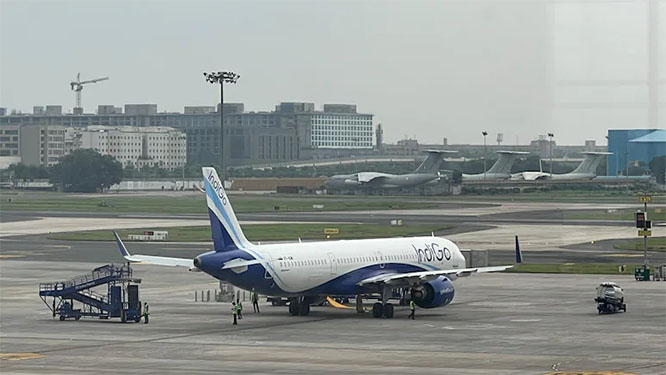
IndiGo, India’s largest airline, is battling one of its worst operational disruptions in recent years, with hundreds of delays and cancellations throwing domestic travel into chaos.

Government data on Tuesday showed its on-time performance plunging to 35%, an unusual dip for a carrier long associated with punctuality.

By Wednesday afternoon, airports in Delhi, Mumbai, Bengaluru and Hyderabad had collectively reported close to 200 cancellations, stranding travellers across the country.

Crew Shortage After New Duty Norms

A major trigger behind the meltdown is a severe crew shortage, especially among pilots, following the rollout of revised Flight Duty Time Limitation (FDTL) norms last month.

The rules mandate longer rest hours and more humane rosters — a shift IndiGo has struggled to incorporate across its vast network.

Sources said several flights were grounded due to lack of cabin crew, while some delays stretched upwards of eight hours.

With IndiGo controlling over 60% of India’s domestic aviation market, the ripple effect has impacted airports nationwide.

IndiGo Issues Apology, Lists “Compounding Factors”

In a statement, IndiGo acknowledged the large-scale disruption:

“We sincerely apologise to customers. A series of unforeseen operational challenges — technology glitches, winter schedule changes, adverse weather, system congestion and updated FDTL norms — created a compounding impact that could not have been anticipated.”

To stabilise operations, the airline has begun calibrated schedule adjustments for the next 48 hours, aiming to restore punctuality. Affected passengers are being offered refunds or alternate travel arrangements, IndiGo said.

What the FDTL Rules Require

The FDTL norms, designed to reduce pilot fatigue, cap duty and flying hours as follows:
•    Maximum 8 hours of flying per day
•    35 hours per week
•    125 hours per month
•    1,000 hours per year

Crew must also receive rest equalling twice the flight duration, with a minimum 10-hour rest period in any 24-hour window.

The DGCA introduced these limits to enhance flight safety.

Hyderabad: 33 Flights Cancelled, Long Queues Reported

Hyderabad’s Rajiv Gandhi International Airport saw heavy early-morning crowds as 33 IndiGo flights (arrivals and departures) were cancelled.

The airport clarified on X that operations were normal, advising passengers to contact IndiGo directly for latest flight status.

Cancellations included flights to and from Visakhapatnam, Goa, Ahmedabad, Delhi, Bengaluru, Chennai, Madurai, Hubli, Bhopal and Bhubaneswar.

Bengaluru: 42 Flights Disrupted

Bengaluru’s Kempegowda International Airport recorded 42 cancellations — 22 arrivals and 20 departures — affecting routes to Delhi, Mumbai, Chennai, Hyderabad, Goa, Kolkata and Lucknow.

Passengers Vent on Social Media

Irate travellers took to X to share their experiences. One passenger stranded in Hyderabad wrote: “I have been here since 3 a.m. and missed an important meeting.”

Another said: “My flight was pushed from 1:55 PM to 2:55 PM and now 4:35 PM. I was informed only three minutes before entering the airport.”

Delhi Airport Hit by Tech Glitch

At Delhi Airport, the disruption deepened due to a slowdown in the Amadeus system — used for reservations, check-ins and departure control.

The technical issue led to longer queues and sluggish processing, adding to delays already worsened by staff shortages.

Comments

Add new comment

  • Coastaldigest.com reserves the right to delete or block any comments.
  • Coastaldigset.com is not responsible for its readers’ comments.
  • Comments that are abusive, incendiary or irrelevant are strictly prohibited.
  • Please use a genuine email ID and provide your name to avoid reject.
News Network
November 26,2025

Mangaluru, Nov 26: Assembly Speaker and local MLA U.T. Khader has initiated a high-level push to resolve one of Mangaluru’s longest-standing traffic headaches: the narrow, high-density stretch of National Highway-66 between Nanthoor and Talapady.

He announced on Tuesday that a formal proposal has been submitted to the Union Ministry of Road Transport and Highways (MoRTH) seeking approval to prepare a Detailed Project Report (DPR) for the widening of this crucial corridor.

The plan specifically aims to expand the existing 45-meter road width to a full 60 meters, coupled with the construction of dedicated service roads. Khader highlighted that land for a 60-meter highway was originally acquired during the initial four-laning project, but only 45 meters were developed, leading to a perpetual bottleneck.

"With vehicle density rising sharply, the expansion has become unavoidable," Khader stated, stressing that the upgrade is essential for ensuring smoother traffic flow and improving safety at the city's main entry and exit points.

The stretch between Nanthoor and Talapady is a vital link on the busy Kochi-Panvel coastal highway and connects to major city junctions. The move to utilize the previously acquired land for the full 60-meter width is seen as a necessary measure to catch up with the region's rapid vehicular growth and prevent further traffic gridlocks.

Comments

Add new comment

  • Coastaldigest.com reserves the right to delete or block any comments.
  • Coastaldigset.com is not responsible for its readers’ comments.
  • Comments that are abusive, incendiary or irrelevant are strictly prohibited.
  • Please use a genuine email ID and provide your name to avoid reject.
News Network
December 4,2025

indigoflight.jpg

Domestic carrier IndiGo has cancelled over 180 flights from three major airports — Mumbai, Delhi and Bengaluru — on Thursday, December 4, as the airline struggles to secure the required crew to operate its flights in the wake of new flight-duty and rest-period norms for pilots.

While the number of cancellations at Mumbai airport stands at 86 (41 arrivals and 45 departures) for the day, at Bengaluru, 73 flights have been cancelled, including 41 arrivals, according to a PTI report that quoted sources.

"IndiGo cancelled over 180 flights on Thursday at three airports-Mumbai, Delhi and Bengaluru," the source told the news agency.

Besides, it had cancelled as many as 33 flights at Delhi airport for Thursday, the source said, adding, "The number of cancellations is expected to be higher by the end of the day."

The Gurugram-based airline's On-Time Performance (OTP) nosedived to 19.7 per cent at six key airports — Delhi, Mumbai, Chennai, Kolkata, Bengaluru and Hyderabad — on December 3, as it struggled to get the required crew to operate its services, down from almost half of December 2, when it was 35 per cent.

"IndiGo has been facing acute crew shortage since the implementation of the second phase of the FDTL (Flight Duty Time Limitations) norms, leading to cancellations and huge delays in its operations across the airports," a source had told PTI on Wednesday.

Chaos continued at several major airports for the third day on Thursday because of the cancellations.

A spokesperson for the Kempegowda International Airport (KIA) in Bengaluru said that 73 IndiGo flights had been cancelled on Thursday.

At least 150 flights were cancelled and dozens of others delayed on Wednesday, airport sources said, leaving thousands of travellers stranded, according to news agency Reuters.

The Directorate General of Civil Aviation (DGCA) has said it is investigating IndiGo flight disruptions and has asked the airline to submit the reasons for the current situation, as well as its plans to reduce flight cancellations and delays.

It may be mentioned here that the pilots' body, Federation of Indian Pilots (FIP), has alleged that IndiGo, despite getting a two-year preparatory window before the full implementation of new flight duty and rest period norms for cockpit crew, "inexplicably" adopted a "hiring freeze".

The FIP said it has urged the safety regulator, the DGCA, not to approve airlines' seasonal flight schedules unless they have adequate staff to operate their services "safely and reliably" in accordance with the New Flight Duty Time Limitations (FDTL) norms.

In a letter to the DGCA late on Wednesday, the FIP urged the DGCA to consider re-evaluating and reallocating slots to other airlines, which have the capacity to operate them without disruption during the peak holiday and fog season if IndiGo continues to "fail in delivering on its commitments to passengers due to its own avoidable staffing shortages."

Comments

Add new comment

  • Coastaldigest.com reserves the right to delete or block any comments.
  • Coastaldigset.com is not responsible for its readers’ comments.
  • Comments that are abusive, incendiary or irrelevant are strictly prohibited.
  • Please use a genuine email ID and provide your name to avoid reject.