



‘Excess deaths could be up to 49 lakh’: Experts reject India’s official coivid death toll

News Network
November 15, 2021

New Delhi, Nov 15: India’s excess deaths during the COVID-19 pandemic could be as high as 49 lakh (4.9 million), according to a new study that provides further evidence that millions more may have died from coronavirus than the official tally.

Experts who have questioned India’s official covid-19 death toll of 4.63 lakh citing Civil Registry Service (CRS) data, seroprevalence studies and other sources, claimed that the country registered anywhere between 27 lakh and 49 lakh excess deaths during the pandemic till June 2021.

Indo-Canadian epidemiologist Dr Prabhat Jha, director of the Centre for Global Health Research, University of Toronto, said various data showed that Covid-19 is the main contributor to excess deaths in the pandemic months in both 2020 and 2021.

“The actual numbers are at least three million or substantially higher than what has been officially reported, and with the adjustments India’s Covid deaths per million are close or similar to Latin America,” he said.

Dr Jha and other experts, who spoke at a specially convened panel by the Indian Academy of Sciences (IASc), said the calculations were made using several sources: CRS data from states, data from the Consumer Payment Household Surveys (CPHS) and surveys by the polling agency CVoter (Since May 2020, the polling agency has been asking households if they have recorded a Covid death).

“In the first wave, there was a modest 1 per cent increase in the number of households reporting deaths but then it abated. Then from April to June, there was a colossal 6% increase in households reporting a death,” said Dr Jha.

According to Dr Arvind Subramaniam, Senior Fellow at the Watson Institute for International and Public Affairs at Brown University, the overall Indian “undercounting was somewhere between a factor of 7 and 10”.

Not all of these deaths were recorded as Covid-19 deaths, said Rukmini S, an independent data expert based in Chennai.

Rukmini said the Indian government's definition of a Covid-19 fatality “covered people who tested positive and then died soon after with a clear progression of the disease”.
Low medical certification

Most deaths in India remain without medical certification, which complicates matters.

Dr Jha, citing the United Nations, said there were about 10 million deaths a year in India out of which 3 million (30%) went unregistered. 

“They are just not counted but this is greater in women where close to 60% of women deaths are not counted. And of those seven million deaths registered, only about 13% have medical certification,” he said.

According to an under-review study on excess mortality in India, Bengaluru suffered an excess death ratio of 2.9 in the second wave.

Many of the excess deaths have since been disclosed in the daily Covid-19 bulletins, with one source in the Bruhat Bengaluru Mahanagara Palike (BBMP) saying that “some deaths were held back during the second wave to avoid magnifying already high numbers and inducing greater panic in the public.”

This is borne out by data. During April and May, 4,033 Covid-19 deaths were made public. However, subsequent releases of backlog deaths, including some cases re-evaluated as Covid-19 fatalities by the death audit committee, show that 9,917 deaths actually happened during those two months.

Professor Dr Satyajith Mayor, Director of the National Centre for Biological Sciences (NCBS), and L S Shashidhara, co-organisers of the panel discussion, demanded data transparency from the government.

"These high numbers must figure in our response to the ongoing pandemic and also caution our citizens of the dire consequences of this disease,” said Mayor and Shashidhara in a joint statement.

Comments

Add new comment

  • Coastaldigest.com reserves the right to delete or block any comments.
  • Coastaldigset.com is not responsible for its readers’ comments.
  • Comments that are abusive, incendiary or irrelevant are strictly prohibited.
  • Please use a genuine email ID and provide your name to avoid reject.
News Network
November 26,2025

Mangaluru, Nov 26: Assembly Speaker and local MLA U.T. Khader has initiated a high-level push to resolve one of Mangaluru’s longest-standing traffic headaches: the narrow, high-density stretch of National Highway-66 between Nanthoor and Talapady.

He announced on Tuesday that a formal proposal has been submitted to the Union Ministry of Road Transport and Highways (MoRTH) seeking approval to prepare a Detailed Project Report (DPR) for the widening of this crucial corridor.

The plan specifically aims to expand the existing 45-meter road width to a full 60 meters, coupled with the construction of dedicated service roads. Khader highlighted that land for a 60-meter highway was originally acquired during the initial four-laning project, but only 45 meters were developed, leading to a perpetual bottleneck.

"With vehicle density rising sharply, the expansion has become unavoidable," Khader stated, stressing that the upgrade is essential for ensuring smoother traffic flow and improving safety at the city's main entry and exit points.

The stretch between Nanthoor and Talapady is a vital link on the busy Kochi-Panvel coastal highway and connects to major city junctions. The move to utilize the previously acquired land for the full 60-meter width is seen as a necessary measure to catch up with the region's rapid vehicular growth and prevent further traffic gridlocks.

Comments

Add new comment

  • Coastaldigest.com reserves the right to delete or block any comments.
  • Coastaldigset.com is not responsible for its readers’ comments.
  • Comments that are abusive, incendiary or irrelevant are strictly prohibited.
  • Please use a genuine email ID and provide your name to avoid reject.
News Network
December 3,2025

indigo.jpg

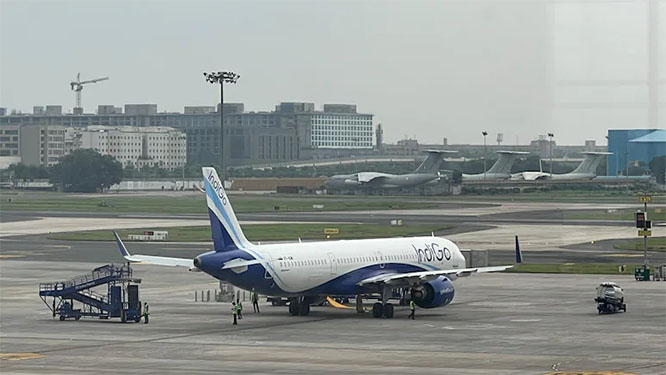
IndiGo, India’s largest airline, is battling one of its worst operational disruptions in recent years, with hundreds of delays and cancellations throwing domestic travel into chaos.

Government data on Tuesday showed its on-time performance plunging to 35%, an unusual dip for a carrier long associated with punctuality.

By Wednesday afternoon, airports in Delhi, Mumbai, Bengaluru and Hyderabad had collectively reported close to 200 cancellations, stranding travellers across the country.

Crew Shortage After New Duty Norms

A major trigger behind the meltdown is a severe crew shortage, especially among pilots, following the rollout of revised Flight Duty Time Limitation (FDTL) norms last month.

The rules mandate longer rest hours and more humane rosters — a shift IndiGo has struggled to incorporate across its vast network.

Sources said several flights were grounded due to lack of cabin crew, while some delays stretched upwards of eight hours.

With IndiGo controlling over 60% of India’s domestic aviation market, the ripple effect has impacted airports nationwide.

IndiGo Issues Apology, Lists “Compounding Factors”

In a statement, IndiGo acknowledged the large-scale disruption:

“We sincerely apologise to customers. A series of unforeseen operational challenges — technology glitches, winter schedule changes, adverse weather, system congestion and updated FDTL norms — created a compounding impact that could not have been anticipated.”

To stabilise operations, the airline has begun calibrated schedule adjustments for the next 48 hours, aiming to restore punctuality. Affected passengers are being offered refunds or alternate travel arrangements, IndiGo said.

What the FDTL Rules Require

The FDTL norms, designed to reduce pilot fatigue, cap duty and flying hours as follows:
•    Maximum 8 hours of flying per day
•    35 hours per week
•    125 hours per month
•    1,000 hours per year

Crew must also receive rest equalling twice the flight duration, with a minimum 10-hour rest period in any 24-hour window.

The DGCA introduced these limits to enhance flight safety.

Hyderabad: 33 Flights Cancelled, Long Queues Reported

Hyderabad’s Rajiv Gandhi International Airport saw heavy early-morning crowds as 33 IndiGo flights (arrivals and departures) were cancelled.

The airport clarified on X that operations were normal, advising passengers to contact IndiGo directly for latest flight status.

Cancellations included flights to and from Visakhapatnam, Goa, Ahmedabad, Delhi, Bengaluru, Chennai, Madurai, Hubli, Bhopal and Bhubaneswar.

Bengaluru: 42 Flights Disrupted

Bengaluru’s Kempegowda International Airport recorded 42 cancellations — 22 arrivals and 20 departures — affecting routes to Delhi, Mumbai, Chennai, Hyderabad, Goa, Kolkata and Lucknow.

Passengers Vent on Social Media

Irate travellers took to X to share their experiences. One passenger stranded in Hyderabad wrote: “I have been here since 3 a.m. and missed an important meeting.”

Another said: “My flight was pushed from 1:55 PM to 2:55 PM and now 4:35 PM. I was informed only three minutes before entering the airport.”

Delhi Airport Hit by Tech Glitch

At Delhi Airport, the disruption deepened due to a slowdown in the Amadeus system — used for reservations, check-ins and departure control.

The technical issue led to longer queues and sluggish processing, adding to delays already worsened by staff shortages.

Comments

Add new comment

  • Coastaldigest.com reserves the right to delete or block any comments.
  • Coastaldigset.com is not responsible for its readers’ comments.
  • Comments that are abusive, incendiary or irrelevant are strictly prohibited.
  • Please use a genuine email ID and provide your name to avoid reject.
News Network
December 6,2025

pilot.jpg

New Delhi: IndiGo, India’s largest airline, faced major operational turbulence this week after failing to prepare for new pilot-fatigue regulations issued by the Directorate General of Civil Aviation (DGCA). The stricter rules—designed to improve flight safety—took effect in phases through 2024, with the latest implementation on November 1. IndiGo has acknowledged that inadequate roster planning led to widespread cancellations and delays.

Below are the key DGCA rules that affected IndiGo’s operations:

1. Longer Mandatory Weekly Rest

Weekly rest for pilots has been increased from 36 hours to 48 hours.

The government says the extended break is essential to curb cumulative fatigue. This rule remains in force despite the current crisis.

2. Cap on Night Landings

Pilots can now perform only two night landings per week—a steep reduction from the earlier limit of six.

Night hours, defined as midnight to early morning, are considered the least alert period for pilots.

Given the disruptions, this rule has been temporarily relaxed for IndiGo until February 10.

3. Reduced Maximum Night Flight Duty

Flight duty that stretches into the night is now capped at 10 hours.

This measure has also been kept on hold for IndiGo until February 10 to stabilize operations.

4. Weekly Rest Cannot Be Replaced With Personal Leave

Airlines can no longer count a pilot’s personal leave as part of the mandatory 48-hour rest.

Pilots say this closes a loophole that previously reduced actual rest time.

Currently, all airlines are exempt from this rule to normalise travel.

5. Mandatory Fatigue Monitoring

Airlines must submit quarterly fatigue reports along with corrective actions to DGCA.

This system aims to create a transparent fatigue-tracking framework across the industry.

The DGCA has stressed that these rules were crafted to strengthen flight safety and align India with global fatigue-management standards. The temporary relaxations are expected to remain until February 2025, giving IndiGo time to stabilise its schedules and restore normal air travel.

Comments

Add new comment

  • Coastaldigest.com reserves the right to delete or block any comments.
  • Coastaldigset.com is not responsible for its readers’ comments.
  • Comments that are abusive, incendiary or irrelevant are strictly prohibited.
  • Please use a genuine email ID and provide your name to avoid reject.
