Farm protests regain momentum as Tikait mobilises support from western UP

Agencies
January 30, 2021

farmers_0.jpg

Ghaziabad/New Delhi, Jan 30: Agitating farmer leaders held a day-long fast at various protest sites on Delhi's borders on Mahatma Gandhi's death anniversary on Saturday as the stir against the agri laws appeared to regain momentum after rallying support from the agricultural community of the crucial western Uttar Pradesh region.

More farmers gathered at Ghazipur, on the Delhi-Meerut highway, that has now become the new focal point of the stir, while union leaders claimed that protesters were also heading back to Singhu and Tikri borders from Punjab and Haryana, days after the crowds had waned following the violence at the tractor rally on January 26.

The administration remained on high alert with Internet services temporarily suspended at the Singhu, Gazipur, and Tikri borders of the national capital, as well as the adjoining areas. Haryana has already suspended the internet in 14 districts.

Security personnel, including from anti-riot police and paramilitary forces, were deployed in strength.Multiple layers of barricades including concrete blocks were being put at the protest sites.

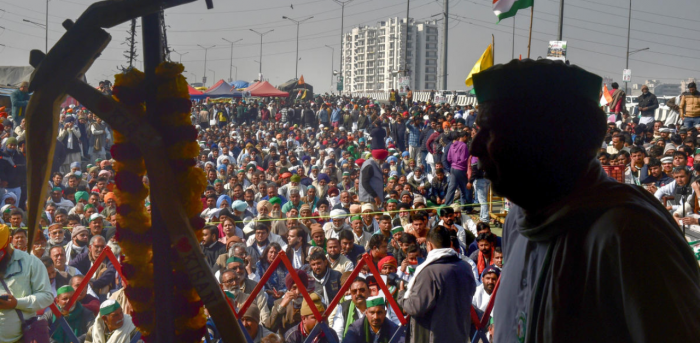
Wearing garlands, the farmer leaders, who had called for observing 'Sadbhavana Diwas' (Harmony Day) on Saturday after the immense outrage over violence by protesters during their Republic Day tractor rally, sat on the dais during the fast, as crowds of supporters swelled, especially in Gazipur where the Bharatiya Kisan Union is leading the protest.

Addressing the protesters in Gazipur, BKU leader Rakesh Tikait, whose emotional appeal had galvanised farmers from Uttar Pradesh and Uttarakhand to flock to the protest site, said they have fought this battle for over two months now, and "they won't relent or retreat". "The movement was and is strong," BKU's Meerut Zone president Pawan Khatana said, a day after tens of thousands of farmers from politically sensitive western Uttar Pradesh had gathered in Muzaffarnagar to participate in a mahapanchayat in a massive outpouring of support for the Bharatiya Kisan Union-led protest.

Till now, the agitation was seen as mainly being led by Punjab-based farmer unions.

A multitude of green-and-white caps, symbolic of the unions spearheading the battle, union flags and the tricolour, planted on tractors, dotted the highway On various tractors and camps, photos of legendary farmer leaders such as Chaudhary Charan Singh and Mahendra Singh Tikait have been put up.

Khatana, who is at the demonstration site with Tikait, said there has been continuous support for the "peaceful protest" against the farmers' demand for removal of the new agri laws. "This is not a political protest. Anybody who shares the ideology of the BKU and Rakesh Tikait is welcome here. But it is our appeal to those who do not wish to support the movement till the end that please do not come only to leave in between," he said.

Several opposition parties including the Congress, TMC AAP, RLD and the Left have openly supported the stir.

Abhimanyu Kohar, a senior member of Samkyukt Kisan Morcha which is an umbrella body of farmer unions, said the ongoing agitation will gain strength as farmers in large numbers will join them in the coming days.

Farmer leader Balbir Singh Rajewal said in Chandigarh that he expects a record gathering by February 2 at the border points of Delhi. "People in large numbers from Punjab, Haryana, Uttar Pradesh, Rajasthan and Uttarakhand are reaching the protest sites," Rajewal claimed.

The president of the Bharatiya Kisan Union (Rajewal) also condemned the violence in Delhi on the Republic Day and said it was unfortunate. "Possibly by February 2, there will again be a record gathering of people at the protest sites," he said, adding that the agitation would remain peaceful. Rajewal also criticised the Haryana government for suspending internet services.

He accused the Centre of instilling a sense of fear among people by showing pictures of the "unfortunate incidents", apparently referring to the January 26 violence in the national capital.

Rajewal appealed to those joining the agitation at Delhi's borders to keep the protest peaceful. "It is our responsibility to keep the agitation peaceful," he stressed. The farmer leader appealed to the Centre to shun its "stubborn attitude" and withdraw the three farm laws. Asked about the next meeting between the protesting farmers and the government, he said, "When they call us, we will certainly go".

To a question on joining the investigation following notices issued by the Delhi Police to farmer leaders in connection with the Republic Day violence, Rajewal said, "We will send them a reply." The Delhi Police has issued the notices to around 20 farmer leaders, including Rajewal, over the violence during the farmers' tractor parade, asking why legal action should not be taken against them.

A team of forensic experts on Saturday visited the Red Fort, where the protesters had indulged in vandalism, hoisted a religious flag and attacked the police personnel, to collect evidence.

Heavy security deployment, including personnel of the Provincial Armed Constabulary (PAC), Rapid Action Force (RAF) in anti-riot gears and civil police, continued at the protest site.

Police had on Friday used tear gas and baton charge to break up a clash between farmers and a large group of men who claimed to be local residents at the Singhu border.

The Delhi Traffic Police said movement on the National Highway 24 (Delhi-Meerut Expressway) has been stopped. Apart from the three borders of Delhi, internet services will remain suspended in their adjoining areas too effective from 11 pm of January 29 to 11 pm of January 31, a Union Home Ministry official said. The decision has been taken to "maintain public safety and averting public emergency" under Temporary Suspension of Telecom Services (Public Emergency or Public Safety) Rules 2017, the official said.

Thousands of farmers have been protesting at Delhi's borders with Haryana and Uttar Pradesh, demanding a rollback of the Farmers' Produce Trade and Commerce (Promotion and Facilitation) Act, 2020, the Farmers (Empowerment and Protection) Agreement on Price Assurance and Farm Services Act, 2020 and the Essential Commodities (Amendment) Act, 2020. 

The protesting farmers have expressed apprehension that these laws would pave the way for the dismantling of the minimum support price (MSP) system, leaving them at the "mercy" of big corporations. However, the government has maintained that the new laws will bring better opportunities to farmers and introduce new technologies in agriculture.  

Comments

Add new comment

  • Coastaldigest.com reserves the right to delete or block any comments.
  • Coastaldigset.com is not responsible for its readers’ comments.
  • Comments that are abusive, incendiary or irrelevant are strictly prohibited.
  • Please use a genuine email ID and provide your name to avoid reject.
News Network
December 7,2025

envoy.jpg

Since 1946, the United States has attempted 93 coups or “regime change” operations across the world — including two in Iran, US Special Envoy for Syria Tom Barrack has admitted.

Speaking to the UAE-based IMI Media Group, in remarks published by The National, Barrack said Washington tried twice to overthrow the Iranian government but failed both times. 

“For (Trump) then to be imputed with regime change — we had two regime changes in Iran already. Neither one worked. So I think wisely leave it to the region to solve,” said Barrack, who also serves as the US ambassador to Turkey.

His comments come six months after the US joined Israel in airstrikes against Iran during ongoing indirect nuclear negotiations between Tehran and Washington.

On June 13, Israel launched an attack on Iran that killed at least 1,064 people and hit civilian infrastructure. Days later, the United States targeted three nuclear facilities — Fordow, Natanz and Isfahan — in what Iran called a clear violation of international law. Iranian retaliation eventually forced a halt to the assault on June 24.

Barrack further claimed that US President Donald Trump and Foreign Secretary Marco Rubio are “not into regime change” and prefer a regional approach driven by Middle Eastern countries themselves. According to him, regional dialogue and non-interference by outside powers offer a more durable path forward.

He added that Washington is still open to an agreement with Tehran if Iranian authorities show “seriousness” and willingness to engage constructively.

However, Iran maintains the US has not shown readiness for meaningful talks. In an interview with Japan’s Kyodo News, Iranian Foreign Minister Abbas Araghchi said negotiations could advance only if Washington acknowledges Iran’s right to peaceful nuclear energy and lifts unilateral sanctions.

Comments

Add new comment

  • Coastaldigest.com reserves the right to delete or block any comments.
  • Coastaldigset.com is not responsible for its readers’ comments.
  • Comments that are abusive, incendiary or irrelevant are strictly prohibited.
  • Please use a genuine email ID and provide your name to avoid reject.
News Network
December 2,2025

Mangaluru, Dec 2: Mangaluru International Airport responded to a medical emergency late on Monday night. Air India Express flight IX 522, travelling from Riyadh to Thiruvananthapuram, was diverted to Mangaluru Airport after a passenger in his late 30s experienced a medical emergency on board.

The Airport’s Operations Control Centre received an alert regarding the passenger’s health condition. The airport activated its emergency response protocol, mobilising the airport medical team and coordinating with stakeholders including CISF, immigration, and customs. 

Upon landing, airport medical personnel attended to the passenger, assessed his condition, and arranged to shift him to a local tertiary-care hospital for further treatment. The passenger’s relatives accompanied the passenger, who incidentally received necessary medical care on board, which helped stabilise the situation.

Following the handling of the emergency, the flight departed for Thiruvananthapuram at 2:05 am on Tuesday.

"We appreciate the cooperation of all parties involved, and this incident reaffirms our ongoing commitment to prioritising passenger safety and readiness to respond to unforeseen emergencies with professionalism and care," the Airport spokesperson said. 

Comments

Add new comment

  • Coastaldigest.com reserves the right to delete or block any comments.
  • Coastaldigset.com is not responsible for its readers’ comments.
  • Comments that are abusive, incendiary or irrelevant are strictly prohibited.
  • Please use a genuine email ID and provide your name to avoid reject.
News Network
December 6,2025

pilot.jpg

New Delhi: IndiGo, India’s largest airline, faced major operational turbulence this week after failing to prepare for new pilot-fatigue regulations issued by the Directorate General of Civil Aviation (DGCA). The stricter rules—designed to improve flight safety—took effect in phases through 2024, with the latest implementation on November 1. IndiGo has acknowledged that inadequate roster planning led to widespread cancellations and delays.

Below are the key DGCA rules that affected IndiGo’s operations:

1. Longer Mandatory Weekly Rest

Weekly rest for pilots has been increased from 36 hours to 48 hours.

The government says the extended break is essential to curb cumulative fatigue. This rule remains in force despite the current crisis.

2. Cap on Night Landings

Pilots can now perform only two night landings per week—a steep reduction from the earlier limit of six.

Night hours, defined as midnight to early morning, are considered the least alert period for pilots.

Given the disruptions, this rule has been temporarily relaxed for IndiGo until February 10.

3. Reduced Maximum Night Flight Duty

Flight duty that stretches into the night is now capped at 10 hours.

This measure has also been kept on hold for IndiGo until February 10 to stabilize operations.

4. Weekly Rest Cannot Be Replaced With Personal Leave

Airlines can no longer count a pilot’s personal leave as part of the mandatory 48-hour rest.

Pilots say this closes a loophole that previously reduced actual rest time.

Currently, all airlines are exempt from this rule to normalise travel.

5. Mandatory Fatigue Monitoring

Airlines must submit quarterly fatigue reports along with corrective actions to DGCA.

This system aims to create a transparent fatigue-tracking framework across the industry.

The DGCA has stressed that these rules were crafted to strengthen flight safety and align India with global fatigue-management standards. The temporary relaxations are expected to remain until February 2025, giving IndiGo time to stabilise its schedules and restore normal air travel.

Comments

Add new comment

  • Coastaldigest.com reserves the right to delete or block any comments.
  • Coastaldigset.com is not responsible for its readers’ comments.
  • Comments that are abusive, incendiary or irrelevant are strictly prohibited.
  • Please use a genuine email ID and provide your name to avoid reject.