



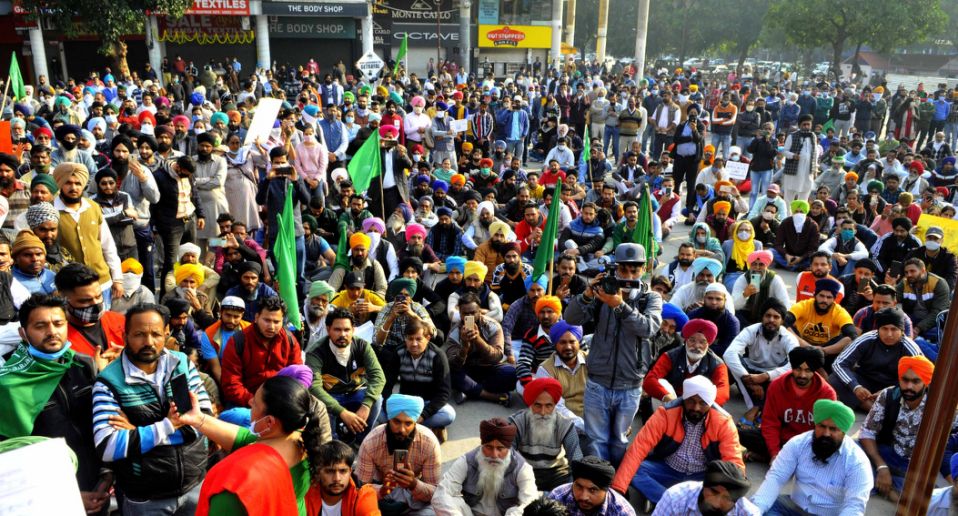
Farmers unanimously reject Modi govt’s proposal, agitation to continue

Agencies
December 9, 2020

c09690.jpg

New Delhi, Dec 9: Protesting farmers on Wednesday unanimously rejected the proposed amendments suggested by the Central government to three controversial farm laws and have sought complete rollback of the laws.

This came after the government agreed to farmers' demands by giving its nod on key issues raised by them, including amendments to the three contentious farms laws that were the first and biggest issue driving the ongoing farmers' protest.

The government communicated its stand through a written draft proposal to the farmers in which it agreed to two main amendments regarding the minimum support price (MSP) and the Agricultural Produce Market Committee (APMC), but rejected their demand to repeal the three farm laws.

"We have rejected the proposal given by the Central government. There was no opposition from anyone. Our future course of action is that we will close all the borders in 1-2 days," said Kulwant Singh Sandhu, one of the farmer leaders.

In the proposal, the Centre agreed to a written minimum support price (MSP) assurance and uniform tax for private market yard and APMC -- a marketing board established by state governments to ensure that farmers are safeguarded from exploitation by large retailers, as well as ensuring that farm to retail price does not touch excessively high levels.

According to the proposal, there would be a provision for registration for private traders dealing in trade. On the issue of scrapping the farm laws, the government said it is ready to consider the provisions of the laws on which the farmers have raised objections.

On the issue of registration of traders, the government had given assurance to frame new rules under which state governments will be given the power to come up with new rules for the welfare of the farmers.

Clearing the apprehension among the farmers that their fields will be attached, the government had also ensured not to take any such action. The government's proposal clarified that the provisions in the new laws are very clear and it will release them and publicise them in a clearer manner if there is any confusion on the issue.

The government had also cleared the misconception on the APMC Act that farmers will be caught in the clutches of private mandis and the mandis established by the mandi samitis will weaken. The government proposed an amendment in which there will be a provision that state governments can impose the registration rule for private mandis. There will also be a provision that the state governments will ensure similar rate of "cess fee" in private as well as APMC mandis.

On the issue that big industrialists will take over farmers' lands and the farmers will be landless, the government's proposal said that it is already clear in the new law that neither can any loan be availed by the buyer on the structure to be built on the farmer's land nor such structure can be held hostage by him.

On the issue that there is no system of registration on agricultural contracts, the government said if the trader is not registered, he has to file a copy within 30 days regarding the deal with the farmers.

The government also said that those approaching the civil courts would now be allowed. Earlier, farmers had sought a rollback of this law.

On the Electricity Amendment Act 2020, the government has assured that the Act would not be implemented and the earlier process would be maintained as status quo.

On the farmers' demand to take back the law on stubble burning, the government said it will come up with a proper arrangement on the subject.

The proposal was sent to the farmers after their meeting with Union Home Minister Amit Shah on Tuesday night remained inconclusive. Five rounds of government-farmer talks have been held so far but they have been inconclusive due to both sides' staying adamant on their issues.

Comments

Add new comment

  • Coastaldigest.com reserves the right to delete or block any comments.
  • Coastaldigset.com is not responsible for its readers’ comments.
  • Comments that are abusive, incendiary or irrelevant are strictly prohibited.
  • Please use a genuine email ID and provide your name to avoid reject.
News Network
December 3,2025

indigo.jpg

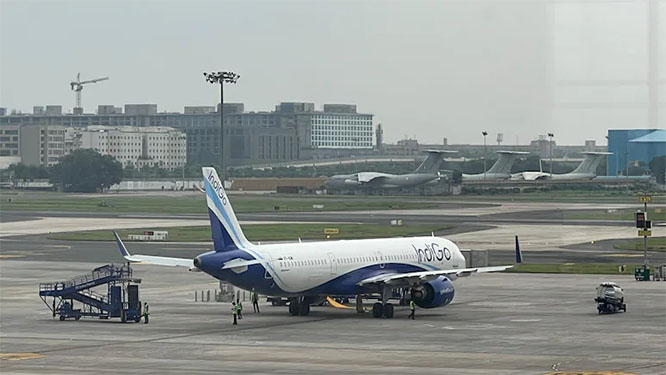
IndiGo, India’s largest airline, is battling one of its worst operational disruptions in recent years, with hundreds of delays and cancellations throwing domestic travel into chaos.

Government data on Tuesday showed its on-time performance plunging to 35%, an unusual dip for a carrier long associated with punctuality.

By Wednesday afternoon, airports in Delhi, Mumbai, Bengaluru and Hyderabad had collectively reported close to 200 cancellations, stranding travellers across the country.

Crew Shortage After New Duty Norms

A major trigger behind the meltdown is a severe crew shortage, especially among pilots, following the rollout of revised Flight Duty Time Limitation (FDTL) norms last month.

The rules mandate longer rest hours and more humane rosters — a shift IndiGo has struggled to incorporate across its vast network.

Sources said several flights were grounded due to lack of cabin crew, while some delays stretched upwards of eight hours.

With IndiGo controlling over 60% of India’s domestic aviation market, the ripple effect has impacted airports nationwide.

IndiGo Issues Apology, Lists “Compounding Factors”

In a statement, IndiGo acknowledged the large-scale disruption:

“We sincerely apologise to customers. A series of unforeseen operational challenges — technology glitches, winter schedule changes, adverse weather, system congestion and updated FDTL norms — created a compounding impact that could not have been anticipated.”

To stabilise operations, the airline has begun calibrated schedule adjustments for the next 48 hours, aiming to restore punctuality. Affected passengers are being offered refunds or alternate travel arrangements, IndiGo said.

What the FDTL Rules Require

The FDTL norms, designed to reduce pilot fatigue, cap duty and flying hours as follows:
•    Maximum 8 hours of flying per day
•    35 hours per week
•    125 hours per month
•    1,000 hours per year

Crew must also receive rest equalling twice the flight duration, with a minimum 10-hour rest period in any 24-hour window.

The DGCA introduced these limits to enhance flight safety.

Hyderabad: 33 Flights Cancelled, Long Queues Reported

Hyderabad’s Rajiv Gandhi International Airport saw heavy early-morning crowds as 33 IndiGo flights (arrivals and departures) were cancelled.

The airport clarified on X that operations were normal, advising passengers to contact IndiGo directly for latest flight status.

Cancellations included flights to and from Visakhapatnam, Goa, Ahmedabad, Delhi, Bengaluru, Chennai, Madurai, Hubli, Bhopal and Bhubaneswar.

Bengaluru: 42 Flights Disrupted

Bengaluru’s Kempegowda International Airport recorded 42 cancellations — 22 arrivals and 20 departures — affecting routes to Delhi, Mumbai, Chennai, Hyderabad, Goa, Kolkata and Lucknow.

Passengers Vent on Social Media

Irate travellers took to X to share their experiences. One passenger stranded in Hyderabad wrote: “I have been here since 3 a.m. and missed an important meeting.”

Another said: “My flight was pushed from 1:55 PM to 2:55 PM and now 4:35 PM. I was informed only three minutes before entering the airport.”

Delhi Airport Hit by Tech Glitch

At Delhi Airport, the disruption deepened due to a slowdown in the Amadeus system — used for reservations, check-ins and departure control.

The technical issue led to longer queues and sluggish processing, adding to delays already worsened by staff shortages.

Comments

Add new comment

  • Coastaldigest.com reserves the right to delete or block any comments.
  • Coastaldigset.com is not responsible for its readers’ comments.
  • Comments that are abusive, incendiary or irrelevant are strictly prohibited.
  • Please use a genuine email ID and provide your name to avoid reject.