



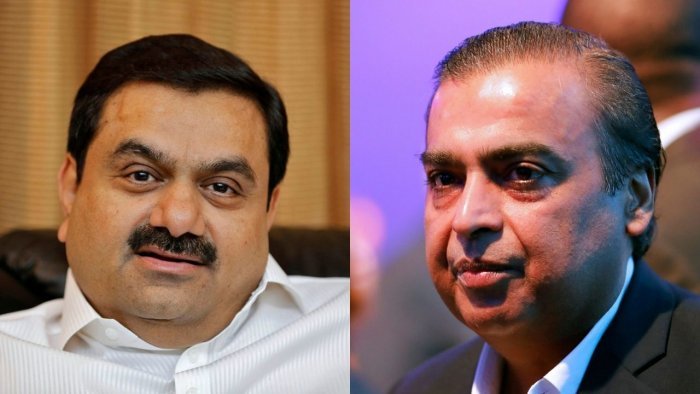
Gautam Adani overtakes Mukesh Ambani to be Asia’s richest person

Agencies
February 8, 2022

ada.jpg

Gautam Adani, the Indian billionaire who turned a small commodities trading business into a conglomerate spanning ports, mines and green energy, is now Asia’s richest person.

The 59-year-old mogul’s net worth reached $88.5 billion on Monday, according to the Bloomberg Billionaires Index, eclipsing fellow countryman Mukesh Ambani’s $87.9 billion. With an almost $12 billion jump in his personal fortune, Adani is the world’s biggest wealth-gainer this year.

The coal magnate -- whose controversial Australian mine project drew flak from climate activists including Greta Thunberg -- has increasingly looked beyond the fossil fuel for expansion. He’s moving into renewable energy, airports, data centers and defense contracting -- priorities Indian Prime Minister Narendra Modi also considers crucial to nation-building and meeting the country’s long-term economic goals.

“The Adani Group has spotted and entered all the happening sectors at the right time, which has appealed to a select band of foreign portfolio investors,” said Deepak Jasani, head of retail research at Mumbai-based brokerage HDFC Securities Ltd. “The sectors are capital-intensive and the company has faced little difficulty in raising funds to expand.”

Some of Adani Group’s listed stocks have soared more than 600 per cent in the past two years on bets his push into green energy and infrastructure will pay off as Modi looks to revive the $2.9 trillion economy and meet the India’s carbon net-zero target by 2070. MSCI Inc’s decision to include more Adani companies in its Indian benchmark index has also meant any fund tracking the gauge will have to buy the shares.

While 2020 was Ambani’s year -- his oil-to-petrochemicals conglomerate Reliance Industries Ltd. created billions of dollars in wealth through a technology pivot that brought in Facebook and Google Inc as investors -- the pendulum has since swung toward Adani. 

Green pledges

Both Indian billionaires -- who have built their empires on fossil fuels or coal -- are now pushing ahead with green energy projects. Ambani has committed $10 billion over the next three years as part of a larger $76 billion spend plan in renewables. Adani has pledged to invest a total of $70 billion by 2030 to help his group become the world’s largest renewable-energy producer.

Firms including Total SE and Warburg Pincus LLC have invested in Adani’s companies in 2021. The French oil giant agreed in January 2021 to buy 20 per cent of Adani Green Energy Ltd. and a 50 per cent stake in the Indian partner’s portfolio of operating solar assets, though at a steep discount. The deal value was just $2.5 billion, compared with Adani Green’s market capitalisation of $20 billion at the time.

In March of 2021, Warburg said it would invest $110 million in exchange for about half-a-percent of Adani Ports and Special Economic Zone Ltd.

As part of his green push, Adani has unveiled plans to boost his renewable-energy capacity almost eightfold by 2025. In May, Adani Green agreed to buy SoftBank Group Corp’s local renewable-power business in a deal that gave SB Energy India an enterprise value of $3.5 billion.

Scaling up

In barely three years, Adani has gained control of seven airports and almost a quarter of India’s air traffic. His group now owns the country’s largest airport operator, power generator and city gas retailer in the non-state sector.

Shares of Adani Green and Adani Total Gas Ltd, a Mumbai-listed joint venture with the French firm, have rallied more than 1,000 per cent since the beginning of 2020. Flagship Adani Enterprises Ltd has advanced more than 730 per cent, Adani Transmission Ltd. more than 500 per cent and Adani Ports 95 per cent over this period. The benchmark S&P BSE Sensex Index has gained 40 per cent by comparison.

Scant analyst coverage hasn’t deterred MSCI from adding some of the Adani stocks to its India gauge. Three of the tycoon’s listed companies were included in May, taking the group’s total footprint to five. The addition has led to a more mandated buying by investors who track the gauge, HDFC’s Jasani said.

A college dropout, Adani first tried his luck in Mumbai’s diamond industry in the early 1980s before returning to his home state of Gujarat to help run his brother’s plastics business. In 1988, he set up Adani Enterprises.

Ransom demand

The businessman is a survivor of crises. More than two decades ago, he was kidnapped and held for ransom. In 2008, he was among the hostages at Mumbai’s Taj Mahal Palace hotel during the terror attacks that killed at least 166 people.

Adani’s sustainability claims and green ambitions are criticised by climate campaigners who point to the group’s Carmichael coal mining project in Australia, which will expand supplies of the highly-polluting fossil fuel. The Adani Group opted to use its own money after having trouble in securing external funding and said in December that it was ready to begin the first coal exports from the Australian mine.

The billionaire has also come under attack from Modi’s political opponents for his proximity to the powerful leader, with some even calling it cronyism. Adani has dismissed such criticism as baseless, and thrived with his successful strategy of dovetailing his investments with Modi’s priorities.

Some of the big Adani Group businesses such as ports are “almost monopolies,” said Sanjiv Bhasin, director at local brokerage IIFL Securities Ltd. With many Adani companies being closely linked to India’s industrialisation and infrastructure push, they are “in a sweet spot and they have capitalised on it,” Bhasin said. 

While 2020 was Ambani’s year -- his oil-to-petrochemicals conglomerate Reliance Industries Ltd. created billions of dollars in wealth through a technology pivot that brought in Facebook and Google Inc as investors -- the pendulum has since swung toward Adani. 

Green pledges

Both Indian billionaires -- who have built their empires on fossil fuels or coal -- are now pushing ahead with green energy projects. Ambani has committed $10 billion over the next three years as part of a larger $76 billion spend plan in renewables. Adani has pledged to invest a total of $70 billion by 2030 to help his group become the world’s largest renewable-energy producer.

Firms including Total SE and Warburg Pincus LLC have invested in Adani’s companies in 2021. The French oil giant agreed in January 2021 to buy 20 per cent of Adani Green Energy Ltd. and a 50 per cent stake in the Indian partner’s portfolio of operating solar assets, though at a steep discount. The deal value was just $2.5 billion, compared with Adani Green’s market capitalisation of $20 billion at the time.

In March of 2021, Warburg said it would invest $110 million in exchange for about half-a-percent of Adani Ports and Special Economic Zone Ltd.

As part of his green push, Adani has unveiled plans to boost his renewable-energy capacity almost eightfold by 2025. In May, Adani Green agreed to buy SoftBank Group Corp’s local renewable-power business in a deal that gave SB Energy India an enterprise value of $3.5 billion.

Scaling up

In barely three years, Adani has gained control of seven airports and almost a quarter of India’s air traffic. His group now owns the country’s largest airport operator, power generator and city gas retailer in the non-state sector.

Shares of Adani Green and Adani Total Gas Ltd, a Mumbai-listed joint venture with the French firm, have rallied more than 1,000 per cent since the beginning of 2020. Flagship Adani Enterprises Ltd has advanced more than 730 per cent, Adani Transmission Ltd. more than 500 per cent and Adani Ports 95 per cent over this period. The benchmark S&P BSE Sensex Index has gained 40 per cent by comparison.

Scant analyst coverage hasn’t deterred MSCI from adding some of the Adani stocks to its India gauge. Three of the tycoon’s listed companies were included in May, taking the group’s total footprint to five. The addition has led to a more mandated buying by investors who track the gauge, HDFC’s Jasani said.

A college dropout, Adani first tried his luck in Mumbai’s diamond industry in the early 1980s before returning to his home state of Gujarat to help run his brother’s plastics business. In 1988, he set up Adani Enterprises.

Ransom demand

The businessman is a survivor of crises. More than two decades ago, he was kidnapped and held for ransom. In 2008, he was among the hostages at Mumbai’s Taj Mahal Palace hotel during the terror attacks that killed at least 166 people.

Adani’s sustainability claims and green ambitions are criticised by climate campaigners who point to the group’s Carmichael coal mining project in Australia, which will expand supplies of the highly-polluting fossil fuel. The Adani Group opted to use its own money after having trouble in securing external funding and said in December that it was ready to begin the first coal exports from the Australian mine.

The billionaire has also come under attack from Modi’s political opponents for his proximity to the powerful leader, with some even calling it cronyism. Adani has dismissed such criticism as baseless, and thrived with his successful strategy of dovetailing his investments with Modi’s priorities.

Some of the big Adani Group businesses such as ports are “almost monopolies,” said Sanjiv Bhasin, director at local brokerage IIFL Securities Ltd. With many Adani companies being closely linked to India’s industrialisation and infrastructure push, they are “in a sweet spot and they have capitalised on it,” Bhasin said.


Comments

Add new comment

  • Coastaldigest.com reserves the right to delete or block any comments.
  • Coastaldigset.com is not responsible for its readers’ comments.
  • Comments that are abusive, incendiary or irrelevant are strictly prohibited.
  • Please use a genuine email ID and provide your name to avoid reject.
News Network
February 4,2026

gaming.jpg

Ghaziabad: In a tragic incident, three sisters aged 12, 14 and 16 died after jumping from the ninth floor of their apartment in Uttar Pradesh’s Ghaziabad in the early hours of Wednesday. The girls allegedly took the extreme step after becoming deeply obsessed with an online Korean task-based game.

The incident occurred around 2.15 am at a high-rise apartment complex in Bharat City. Before jumping, the sisters — Pakhi (12), Prachi (14) and Vishika (16) — left behind a handwritten note that read, “Sorry, Papa.”

According to police, the girls went to the balcony, bolted the door from inside and jumped one after another. Their screams and the sound alerted their parents, neighbours and security guards. By the time the parents broke open the balcony door, all three had died.

“When we reached the spot, we confirmed that three minor girls, daughters of Chetan Kumar, had died after jumping from the building,” said Assistant Commissioner of Police Atul Kumar Singh.

Visuals from the scene on Wednesday morning showed the bodies lying on the ground, their mother wailing in grief, and stunned neighbours gathering at the complex.

Police said the sisters were heavily influenced by Korean culture and were addicted to an online “Korean love game”, though no specific game has been identified so far. Investigators are examining an eight-page suicide note written in a pocket diary, detailing the girls’ mobile and gaming activities.

“Read everything written in this diary because all of it is true. I’m really sorry. Sorry, Papa,” the note said, accompanied by a hand-drawn crying emoji.

Their father, Chetan Kumar, told police that the girls had even adopted Korean names and had gradually withdrawn from school and daily activities. “They used to say, ‘Korea is our life, Korea is our biggest love. We cannot give it up,’” he said, breaking down.

Police said the parents had recently restricted the girls’ mobile phone usage, which may have triggered distress. “The investigation has not revealed the name of any particular game, but it is evident that the girls were deeply influenced by Korean culture, as mentioned in the suicide note,” said senior police officer Nimish Patel.

The sisters reportedly did everything together, including eating and bathing. Their gaming addiction is believed to have begun during the COVID-19 pandemic, after which they became irregular at school and eventually stopped attending altogether.

Police also revealed that Chetan Kumar is married to two sisters and lives with both wives and their children, all daughters. Two of the deceased girls were daughters of one wife, while the third was their half-sister.

Further investigation is underway.

Comments

Add new comment

  • Coastaldigest.com reserves the right to delete or block any comments.
  • Coastaldigset.com is not responsible for its readers’ comments.
  • Comments that are abusive, incendiary or irrelevant are strictly prohibited.
  • Please use a genuine email ID and provide your name to avoid reject.
News Network
January 28,2026

ajit.jpg

Mumbai: The sudden death of Maharashtra Deputy Chief Minister Ajit Pawar in a plane crash in his hometown of Baramati has plunged the state into political uncertainty, raising a pressing question for both the Nationalist Congress Party (NCP) and its rival faction, the Nationalist Congress Party (Sharadchandra Pawar): what next?

For the two factions that emerged after the dramatic split of June–July 2023, the moment marks their gravest challenge yet. Many believe the answer now rests with party founder Sharad Pawar.

Sharad Pawar, who founded the NCP in 1999 after parting ways with the Congress over Sonia Gandhi’s foreign origin, has already indicated his intention to step away from electoral politics once his Rajya Sabha term ends in April 2026.

Speaking at a public event in Baramati ahead of his 85th birthday on December 12, 2025, Pawar said he would not contest any further elections. “I have contested 14 elections. The younger generation needs to be given an opportunity,” he said, adding that he would decide later whether to seek another Rajya Sabha term.

Often described as the Bhishma Pitamah of Indian politics, Pawar also spoke of his gradual withdrawal from active leadership. “For the first 30 years, I handled everything. For the next 25–30 years, Ajit Dada handled responsibilities. Now, arrangements must be made for new leadership,” he said.

Ajit Pawar’s death has dramatically altered that transition, especially as he was working towards reunifying the two NCP factions.

“After the developments of June–July 2023 and the 2024 Lok Sabha and Vidhan Sabha elections, there were deep changes within the family and the party. In the last six months, serious efforts were made to reunite. Even workers from both sides wanted unity. This is a massive blow,” a Pawar family insider told DH over phone from Baramati.

Electoral outcomes over the past year reflected the split. In the 2024 Lok Sabha elections, NCP (SP) recorded the best strike rate in Maharashtra, winning eight of the 10 seats it contested. The NCP, by contrast, won just one seat out of four.

However, the trend reversed in the subsequent Vidhan Sabha elections, where the NCP emerged stronger, securing 41 of the 288 seats, while NCP (SP) managed only 10.

Within NCP (SP), Sharad Pawar’s daughter Supriya Sule serves as Working President, followed by leaders such as Rohit Pawar, state president Shashikant Shinde and former state chief Jayant Patil.

In the NCP, Praful Patel is the Working President and Raigad MP Sunil Tatkare heads the state unit. Ajit Pawar’s wife, Sunetra Pawar, is a Rajya Sabha MP, while their sons Parth and Jay are not actively involved in day-to-day politics. Parth Pawar briefly entered electoral politics in 2019 but lost the Lok Sabha election from Maval. Jay Pawar’s political debut was under consideration.

With Ajit Pawar gone, speculation has intensified that a member of the family may be asked to assume a larger role. For now, Sunetra Pawar is expected to play a key coordinating role in party affairs, alongside Patel and Tatkare.

The NCP continues to have several heavyweight leaders, including Chhagan Bhujbal, Hasan Mushrif, Dattatreya Bharne, Manikrao Kokate and Dhananjay Munde.

Ajit Pawar had already begun steps towards reconciliation between the two factions. While they contested the Pune and Pimpri-Chinchwad municipal elections separately, they later decided to fight the zilla parishad elections together under the ‘clock’ symbol—seen as the first formal step towards reunification.

Nagpur meet and party roadmap

Both NCP factions claim adherence to the ideology of ‘Shiv–Shahu–Phule–Ambedkar’. At the Rashtravadi Chintan Shivir held in Nagpur on September 19, 2025, the NCP reaffirmed its commitment to sarva dharma sambhav and discussed strengthening ties with the BJP “for the welfare and development of Maharashtra”.

In recent days, reports had suggested Ajit Pawar might return to the Maha Vikas Aghadi following the party’s poor performance in Pune municipal elections, but these claims were denied.

Big question for Maha Yuti

Ajit Pawar’s death also presents an immediate challenge for the Devendra Fadnavis-led Maha Yuti government. Pawar held crucial portfolios, including Finance, Planning and Excise. With the Budget Session approaching, appointing a new Finance Minister has become urgent.

Beyond numbers and portfolios, Maha Yuti has lost a swift decision-maker known for his administrative grip and political finesse—leaving a vacuum that will not be easy to fill.

Comments

Add new comment

  • Coastaldigest.com reserves the right to delete or block any comments.
  • Coastaldigset.com is not responsible for its readers’ comments.
  • Comments that are abusive, incendiary or irrelevant are strictly prohibited.
  • Please use a genuine email ID and provide your name to avoid reject.
News Network
February 1,2026

Bengaluru: The Karnataka High Court has refused to quash an investigation against a WhatsApp group administrator accused of allowing the circulation of obscene and offensive images depicting Hindutva politicians and idols in 2021.

Justice M Nagaprasanna observed that, prima facie, the ingredients of the offence under Section 295A of the Indian Penal Code were made out. “The offence under Section 295A of the IPC is met to every word of its ingredient, albeit prima facie,” the judge said.

The petitioner, Sirajuddin, a resident of Belthangady taluk in Dakshina Kannada district, had challenged the FIR registered against him at the CEN (Cyber, Economics and Narcotics) police station, Mangaluru, for offences under Section 295A of the IPC and Section 67 of the Information Technology Act. Section 295A relates to punishment for deliberate and malicious acts intended to outrage the religious feelings of any class of citizens.

According to the complaint filed by K Jayaraj Salian, also a resident of Belthangady taluk, he received a WhatsApp group link from an unknown source and was added to the group after accessing it. The group reportedly had six administrators and around 250 participants, where obscene and offensive images depicting Hindu deities and certain political figures were allegedly circulated repeatedly.

Sirajuddin was arrested in connection with the case and later released on bail on February 16, 2021. He argued before the court that he was being selectively targeted, while other administrators—including the creator of the group—were neither arrested nor investigated. He also contended that the Magistrate could not have taken cognisance of the offence under Section 295A without prior sanction under Section 196(1) of the CrPC.

Rejecting the argument, Justice Nagaprasanna held that prior sanction is required only at the stage of taking cognisance, and not at the stage of registration of the crime or during investigation.

The judge noted that the State had produced the entire investigation material before the court. “A perusal of the material reveals depictions of Hindu deities in an extraordinarily obscene, demeaning and profane manner. The content is such that its reproduction in a judicial order would itself be inappropriate,” the court said, adding that the material, on its face, had the tendency to outrage religious feelings and disturb communal harmony.

Observing that the case was still at the investigation stage, the court said it could not interdict the probe at this juncture. However, it expressed concern that the investigating officer appeared to have not proceeded uniformly against all administrators. The court clarified that if the investigation revealed the active involvement of any member in permitting the circulation of such content, they must also be proceeded against.

“At this investigative stage, any further observation by this Court would be unnecessary,” the order concluded.

Comments

Add new comment

  • Coastaldigest.com reserves the right to delete or block any comments.
  • Coastaldigset.com is not responsible for its readers’ comments.
  • Comments that are abusive, incendiary or irrelevant are strictly prohibited.
  • Please use a genuine email ID and provide your name to avoid reject.
