How internet shutdowns doubled violence against women in Manipur

News Network
July 27, 2023

amanipur.jpg

When videos of two women being paraded naked and assaulted in Manipur went viral last week on social media, the remote northeastern state had been cut off from internet access for nearly three months.

The attack took place on May 4, but the videos of the women being dragged and groped by armed men before what onlookers say was a gang rape, surfaced last week. Authorities said they are investigating the incident and have arrested several men.

Officials imposed a statewide internet shutdown on May 3, saying it was needed to curb rumours and disinformation, and quell violent ethnic clashes that have killed at least 125 people and displaced tens of thousands.

But the internet ban in the state - among the longest in India to date - has made it difficult to alert authorities and journalists to rights violations, many of them directed at women, activists say.

"If there was no internet shutdown, those videos would have surfaced over two months ago and the horror could have been addressed speedily, and other similar offences could have been curbed," said Patricia Mukhim, an activist and editor of the Shillong Times daily in Meghalaya.

"The internet shutdown is a violation of human rights - it curtails people's freedom, and it shuts out news of violent incidents and allows perpetrators to carry on undeterred," she told the Thomson Reuters Foundation.

The shutdowns also have an "adverse impact on women's ability to feel safe and restrict their freedom of movement," said Jayshree Bajoria, an associate director at Human Rights Watch in Asia.

"It took a horrific video of violence against women in Manipur to emerge on social media for the authorities to take action. This shows how necessary the internet is for the flow of information, and reporting and documenting abuses," she said.

After the Manipur high court directed the state government to restore the internet in a "limited fashion", authorities on Tuesday said they had "conditionally" lifted the ban on broadband services.

Social media websites, WiFi hotspots, virtual private networks (VPNs) and mobile internet - used by a majority of people - still remain blocked in Manipur.

Adverse impact

India had the most number of shutdowns in the world for the fifth successive year in 2022, according to Access Now, a digital rights group.

The shutdowns - including during protests, elections and examinations - were often imposed for indefinite periods and without the publication of shutdown orders, in violation of a 2020 judgment by the nation's top court.

"Authorities have cited violence as part of the rationale for shutting down the internet. However, there is no evidence to show internet shutdowns reduce violence - quite the opposite," Access Now said in a report in May.

The clashes in Manipur, which borders Myanmar, began when members of the Kuki and Naga tribal groups launched a protest on May 3 against the possible sharing of their benefits with the ethnic majority Meiteis in the state.

The federal government rushed thousands of paramilitary and army troops to the state of 3.2 million people, but the state has remained tense since, with killings and other incidents of sporadic violence.

The restive northeast region is among the least developed in the country, with patchy internet access and among the most shutdowns in India, according to data compiled by the Software Freedom Law Center, a digital rights group.

As more services are digitised under the Digital India programme, internet shutdowns disproportionately hurt rural communities and other vulnerable groups such as those who depend on social welfare benefits, a recent report by Human Rights Watch and the Internet Freedom Foundation showed.

Toll on women

In addition to shutdowns, authorities also frequently block websites and issue takedown orders to social media platforms. The government issued nearly 7,000 takedown orders of social media posts and accounts last year compared to 6,000 in 2021, according to Access Now.

Most shutdowns involve blocking the internet on mobile phones, which is how most of the population, particularly in rural areas, access the internet.

This severely impacts access to education and livelihoods, particularly for rural women, the report by Human Rights Watch and IFF showed.

In the western state of Rajasthan, which has had the most internet shutdowns after Kashmir, the majority of workers in the government's rural employment guarantee programme are women.

As attendance checks and wage payments for workers have been digitised, frequent internet shutdowns in the state mean that many women don't get to work, or that they don't get paid, said Bajoria.

"Most of the women come from socially and economically marginalised households ... shutdowns that cut off internet access make their situation worse," she said.

In Manipur, the shutdown means that women cannot communicate as easily with their families via WhatsApp, check the news, make and receive payments on the phone, or even recharge their mobile SIMs, said Ninglun Hangal, who works with development non-profits.

Unable to work from home because of the internet ban, Hangal travelled 13 hours to relocate to neighbouring Assam state. But for women forced to stay back, conditions are tough, she said.

"There are more rumours and misinformation circulating, and there's no way to check or clarify what is true" she said.

"Women feel isolated and scared for their safety, and it's taking a terrible toll. More cases of assault and abuse are bound to come to light when the internet is restored."


Comments

Add new comment

  • Coastaldigest.com reserves the right to delete or block any comments.
  • Coastaldigset.com is not responsible for its readers’ comments.
  • Comments that are abusive, incendiary or irrelevant are strictly prohibited.
  • Please use a genuine email ID and provide your name to avoid reject.
News Network
December 3,2025

indigo.jpg

IndiGo, India’s largest airline, is battling one of its worst operational disruptions in recent years, with hundreds of delays and cancellations throwing domestic travel into chaos.

Government data on Tuesday showed its on-time performance plunging to 35%, an unusual dip for a carrier long associated with punctuality.

By Wednesday afternoon, airports in Delhi, Mumbai, Bengaluru and Hyderabad had collectively reported close to 200 cancellations, stranding travellers across the country.

Crew Shortage After New Duty Norms

A major trigger behind the meltdown is a severe crew shortage, especially among pilots, following the rollout of revised Flight Duty Time Limitation (FDTL) norms last month.

The rules mandate longer rest hours and more humane rosters — a shift IndiGo has struggled to incorporate across its vast network.

Sources said several flights were grounded due to lack of cabin crew, while some delays stretched upwards of eight hours.

With IndiGo controlling over 60% of India’s domestic aviation market, the ripple effect has impacted airports nationwide.

IndiGo Issues Apology, Lists “Compounding Factors”

In a statement, IndiGo acknowledged the large-scale disruption:

“We sincerely apologise to customers. A series of unforeseen operational challenges — technology glitches, winter schedule changes, adverse weather, system congestion and updated FDTL norms — created a compounding impact that could not have been anticipated.”

To stabilise operations, the airline has begun calibrated schedule adjustments for the next 48 hours, aiming to restore punctuality. Affected passengers are being offered refunds or alternate travel arrangements, IndiGo said.

What the FDTL Rules Require

The FDTL norms, designed to reduce pilot fatigue, cap duty and flying hours as follows:
•    Maximum 8 hours of flying per day
•    35 hours per week
•    125 hours per month
•    1,000 hours per year

Crew must also receive rest equalling twice the flight duration, with a minimum 10-hour rest period in any 24-hour window.

The DGCA introduced these limits to enhance flight safety.

Hyderabad: 33 Flights Cancelled, Long Queues Reported

Hyderabad’s Rajiv Gandhi International Airport saw heavy early-morning crowds as 33 IndiGo flights (arrivals and departures) were cancelled.

The airport clarified on X that operations were normal, advising passengers to contact IndiGo directly for latest flight status.

Cancellations included flights to and from Visakhapatnam, Goa, Ahmedabad, Delhi, Bengaluru, Chennai, Madurai, Hubli, Bhopal and Bhubaneswar.

Bengaluru: 42 Flights Disrupted

Bengaluru’s Kempegowda International Airport recorded 42 cancellations — 22 arrivals and 20 departures — affecting routes to Delhi, Mumbai, Chennai, Hyderabad, Goa, Kolkata and Lucknow.

Passengers Vent on Social Media

Irate travellers took to X to share their experiences. One passenger stranded in Hyderabad wrote: “I have been here since 3 a.m. and missed an important meeting.”

Another said: “My flight was pushed from 1:55 PM to 2:55 PM and now 4:35 PM. I was informed only three minutes before entering the airport.”

Delhi Airport Hit by Tech Glitch

At Delhi Airport, the disruption deepened due to a slowdown in the Amadeus system — used for reservations, check-ins and departure control.

The technical issue led to longer queues and sluggish processing, adding to delays already worsened by staff shortages.

Comments

Add new comment

  • Coastaldigest.com reserves the right to delete or block any comments.
  • Coastaldigset.com is not responsible for its readers’ comments.
  • Comments that are abusive, incendiary or irrelevant are strictly prohibited.
  • Please use a genuine email ID and provide your name to avoid reject.
News Network
December 2,2025

Puttur: The long-cherished dream of a government medical college in Puttur has moved a decisive step closer to reality, with the Karnataka State Finance Department granting its official approval for the construction of a new 300-bed hospital.

Puttur MLA Ashok Kumar Rai announced the crucial development to reporters on Monday, confirming that the official communication from the finance department was issued on November 27. This 300-bed facility is intended to be the cornerstone for the establishment of the government medical college, a project announced in the state budget.

Fast-Track Implementation

The MLA outlined an aggressive timeline for the project:

•    A Detailed Project Report (DPR) for the hospital is expected to be ready within 45 days.

•    The tender process for the construction will be completed within two months.

Following the completion of the tender process, Chief Minister Siddaramaiah is scheduled to lay the foundation stone for the project.

"Setting up a medical college in Puttur is a historical decision by the Congress government in Karnataka," Rai stated. The project has an estimated budget allocation of Rs 1,000 crore for the medical college.

Focus on Medical Education Department

The MLA highlighted a key strategic move: requesting the government to implement the hospital construction through the Medical Education Department instead of the Health and Family Welfare Department. This is intended to streamline the entire process of establishing the full medical college, ensuring the facilities—including labs, operation theatres, and other necessary infrastructure—adhere to the strict guidelines set by the Medical Council of India (MCI). The proposed site for the project is in Bannur.

Rai also took the opportunity to address political criticism, stating that the government has fulfilled its promise despite "apprehensions" and "mocking and criticising" from opposition parties who had failed to take similar initiatives when they were in power. "Chief Minister Siddaramaiah has kept his word," he added.

Comments

Add new comment

  • Coastaldigest.com reserves the right to delete or block any comments.
  • Coastaldigset.com is not responsible for its readers’ comments.
  • Comments that are abusive, incendiary or irrelevant are strictly prohibited.
  • Please use a genuine email ID and provide your name to avoid reject.
P A Hameed Padubidri
November 26,2025

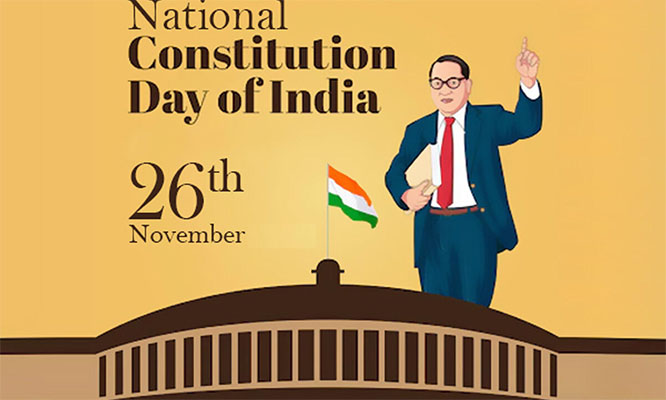
CD.jpg

Constitution Day, also known as Samvidhan Divas, is observed every year on November 26 to honor the adoption of the Constitution of India and to recognize the visionary effort that shaped the world’s largest democracy.

Historical Background

It’s on November 26, 1949, the Constituent Assembly of India formally adopted the Constitution.This date is commemorated to acknowledge the completion of nearly three years of drafting, debate, and refinement.

On January 26, 1950, the Constitution came into force, marking India’s transition from a dominion to a sovereign republic.

The date 26 January was chosen to honor the “Purna Swaraj” declaration made in 1930 that marked the relentless efforts & sacrifices of the many. 

Why Constitution Day is Celebrated

* To honor & remember the framers of the Constitution, especially Dr. B. R. Ambedkar, the Chairman of the Drafting Committee, & many others. 

* To remind the citizens of the values, responsibilities, and rights enshrined in the Constitution.

* To promote constitutional values & literacy among students, institutions, and the general public.

* To reaffirm the nation’s commitment to justice, equality, liberty, fraternity and secular values. 

Vision and Significance of the Constitution

It establishes the fundamental political and legal framework for the nation.

Defines the structure, powers and functions of:
    •    The Executive
    •    The Legislature
    •    The Judiciary
    •    Guarantees a comprehensive set of Fundamental Rights, including:

-Equality before law
-Freedom of speech & expression
-Protection of life and personal liberty
-Freedom of religion
-Embeds Directive Principles of State Policy, guiding governance toward social justice and welfare.
-Introduces Fundamental Duties to ensure civic responsibility among citizens.

Key Features Celebrated on Constitution Day

-The Indian constitution is considered one of the longest written constitutions of the world. It’s systematically drafted considering almost all aspects that properly fits to the country. 

-Blend of multiple global constitutional principles while staying rooted in Indian values and realities.

-Framework that balances Federalism, Secularism, Democracy and Rule of Law. This makes everyone-from President to common man-below the law & are equal in the sight of law. 

-Another feature is that it’s based on built-in mechanisms for amendments, ensuring the Constitution grows with changing needs.

Message of the Day

The core ethos of this  Constitution Day is not merely about looking back at history-it’s a reminder of the continuous duty to protect democratic values, respect diversity and uphold the principles that define India as a sovereign, socialist, secular and democratic republic.

Happy Constitution Day to all my compatriots

Comments

Add new comment

  • Coastaldigest.com reserves the right to delete or block any comments.
  • Coastaldigset.com is not responsible for its readers’ comments.
  • Comments that are abusive, incendiary or irrelevant are strictly prohibited.
  • Please use a genuine email ID and provide your name to avoid reject.