



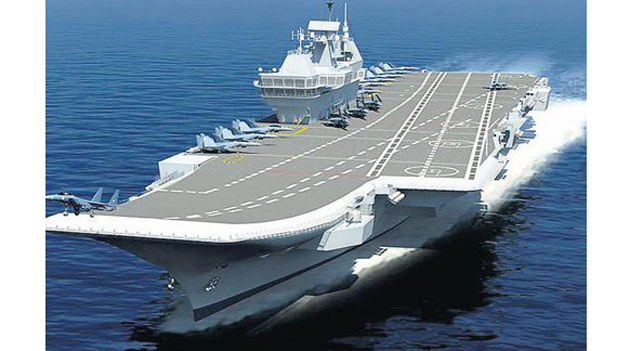
India gets first indigenous aircraft carrier as Prime Minister commissions INS Vikrant 

News Network
September 2, 2022

insvikrant.jpg

Kochi, Sept 2: Prime Minister Narendra Modi on Friday commissioned the first indigenously designed and built aircraft carrier INS Vikrant at Cochin Shipyard Limited in Kochi. PM Modi Modi received the Guard of Honour as he arrived for the Commissioning ceremony of INS Vikrant in Kerala.

He then unveiled the new Naval Ensign (Nishaan), doing away with the colonial past on the occasion. Naval Ensigns are flags that naval ships or formations bear to denote nationality. The current Indian Naval Ensign consists of a St. George's Cross -- a red cross with white background.

In one corner of the cross, the Indian flag was put when the country attained freedom, replacing the Union Jack in that place.

Modi has described September 2 as a "landmark day for India's efforts to become Aatmanirbhar in the defence sector" as the first indigenously designed and built aircraft carrier has been commissioned.

A host of dignitaries including Defence Minister Rajnath, Shipping Minister Sarbananda Sonowal, Governor Arif Mohamad Khan, Chief Minister Pinarayi Vijayan, Ernakulam MP Hibi Eden, Navy Chief Admiral R Hari Kumar and top officials of Navy and Cochin Shipyard Limited (CSL) attended the event.

Designed by the Indian Navy's in-house Warship Design Bureau (WDB) and built by Cochin Shipyard Limited, Vikrant has been built with state-of-the-art automation features.

It has a large amount of indigenous equipment and machinery, involving major industrial houses in the country- BEL, BHEL, GRSE, Keltron, Kirloskar, Larsen & Toubro, Wartsila India etc. as well as over 100 MSMEs. With the commissioning of Vikrant, India will have two operational aircraft carriers, which will bolster the maritime security of the nation.

The Indigenous Aircraft Carrier (IAC) is named after her illustrious predecessor, India's first aircraft carrier, which had played a vital role in the 1971 war.

As per the Indian Navy, the 262-meter-long carrier has a full displacement of close to 45,000 tonnes which is much larger and more advanced than her predecessor.

With Vikrant, India has joined a select group of nations (the US, Russia, France, the UK and China) having the niche capability to indigenously design and build an aircraft carrier.

IAC Vikrant consists of 14 decks with 2,300 compartments that can carry around 1,500 sea warriors and to cater to the food requirements, around 10,000 chapatis or rotis are made in the ship's kitchen, which is called the ship's galley.

The ship is powered by four Gas Turbines totalling 88 MW power and has a maximum speed of 28 Knots. Built at an overall cost of close to ₹20,000 crores, the project has been progressed in three Phases of the contract between MoD and CSL, concluded in May 2007, December 2014 and October 2019 respectively. The ship's keel was laid in Feb 2009, followed by launching in August 2013.

The ship would be capable of operating an air wing consisting of 30 aircraft comprising of MIG-29K fighter jets, Kamov-31, MH-60R multi-role helicopters, in addition to indigenously manufactured Advanced Light Helicopters (ALH) and Light Combat Aircraft (LCA) (Navy).

INS Vikrant history

INS Vikrant began her journey as the HMS Hercules, an aircraft carrier in the (British) Royal Navy in 1943 during the second world war. But it remained incomplete as the war ended, and in 1946, the work on the ship was suspended.

After the war, the UK and US navies wanted to sell the ships they no longer needed. So, in 1957, the Indian government purchased HMS Hercules. It became INS Vikrant when it was commissioned into the Indian Navy on 4 March 1961 in Belfast. The name Vikrant was derived from the Sanskrit word 'Vikranta', meaning 'Very powerful' and 'brave'. The ship formally joined Indian Navy in the Bombay harbour on 3 November 1961 and was received by then PM Jawaharlal Nehru at Ballar Pier.

The ship played an active role during the liberation of the Bangladesh war, in 1971. The aircraft carrier remained in service for another 26 years, till she was decommissioned on 31 January 1997. The Vikrant was then converted into a museum ship and remained berthed in Bombay harbour, open to the public to marvel at her glorious past. Due to rising maintenance costs and poor conditions, the Vikran ship was finally scrapped in November 2014.

Comments

Add new comment

  • Coastaldigest.com reserves the right to delete or block any comments.
  • Coastaldigset.com is not responsible for its readers’ comments.
  • Comments that are abusive, incendiary or irrelevant are strictly prohibited.
  • Please use a genuine email ID and provide your name to avoid reject.
News Network
December 2,2025

A major upgrade in safety and monitoring is planned for Haj 2026, with every Indian pilgrim set to receive a Haj Suvidha smart wristband linked to the official Haj Suvidha mobile app. The initiative aims to support pilgrims—especially senior citizens—who may struggle with smartphones during the 45-day journey.

What the Smart Wristband Will Do

Officials said the device will come with:
•    Location tracking
•    Pedometer
•    SOS emergency button
•    Qibla compass
•    Prayer timings
•    Basic health monitoring

SP Tiwari, secretary of the UP State Haj Committee, said the goal is to make the pilgrimage safer and more comfortable.

“Most Hajis are elderly and not comfortable with mobile apps,” he said. “The smartwatch will help locate pilgrims who forget their way or cannot communicate their location.”

The wristbands will be monitored by the Consulate General of India in Saudi Arabia, similar to mobile tracking via the Haj Suvidha App.

Free Distribution and Training

•    Smart wristbands will be given free of cost.
•    Training for pilgrims will be conducted between January and February 2026.
•    Sample units will reach state Haj committees soon.
•    Final devices will be distributed as pilgrims begin their journey.

New Rules for Accommodation

Two major decisions have also been finalised for Haj 2026:
1.    Separate rooms for men and women – including married couples. They may stay on the same floor but must occupy different rooms, following stricter Saudi guidelines.
2.    Cooking banned – gas cylinders will not be allowed; all meals will be provided through official catering services arranged by the Haj Committee of India.

These decisions were finalised during a meeting of the Haj Committee of India and state representatives in Mumbai.

Haj Suvidha App Launched Earlier

The government launched the Haj Suvidha App in 2024, offering:

•    Training modules
•    Accommodation and flight details
•    Baggage information
•    SOS and translation tools
•    Grievance redressal

Haj 2026 Quota and Key States

•    India’s total Haj quota for 2026: 1,75,025 pilgrims
•    70% (1,25,000) allotted to the Haj Committee of India
•    30% (around 50,000) reserved for Haj Group Organisers

Uttar Pradesh has the largest allocation (around 30,000 seats), though approximately 18,000 pilgrims are expected to go this year. States with high pilgrim numbers include Kerala, Maharashtra and Gujarat.

Dates of Haj 2026

The pilgrimage is scheduled to take place from 24 May to 29 May, 2026 (tentative).
Haj is one of the five pillars of Islam and is mandatory for Muslims who meet the required conditions.

Comments

Add new comment

  • Coastaldigest.com reserves the right to delete or block any comments.
  • Coastaldigset.com is not responsible for its readers’ comments.
  • Comments that are abusive, incendiary or irrelevant are strictly prohibited.
  • Please use a genuine email ID and provide your name to avoid reject.
News Network
November 28,2025

ministerPM.jpg

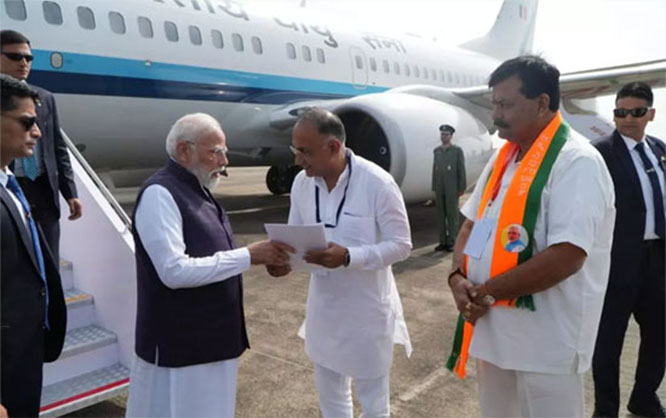
Mangaluru, Nov 28: Karnataka Health Minister and Dakshina Kannada district in-charge minister Dinesh Gundu Rao on Friday handed over Chief Minister Siddaramaiah’s letter to Prime Minister Narendra Modi, highlighting the severe distress faced by farmers due to crashing crop prices.

PM Modi arrived at the Mangaluru International Airport en route to Udupi, where Gundu Rao welcomed him and submitted the letter. The chief minister’s message stressed that farmers are suffering heavy losses because maize and green gram are being bought far below the Minimum Support Price (MSP). The state urged the Centre to immediately begin procurement at MSP.

According to the letter, Karnataka has a bumper harvest this year—over 54.74 lakh metric tons of maize and 1.98 lakh metric tons of green gram—yet farmers are unable to secure fair prices. Against the MSP of ₹2,400/MT for maize and ₹8,768/MT for green gram, market rates have plunged to ₹1,600–₹1,800 and ₹5,400 respectively.

The chief minister has requested the Centre to:

• Direct NAFED, FCI and NCCF to start MSP procurement immediately.
• Ensure ethanol units purchase maize directly from farmers or FPOs.
• Increase Karnataka’s ethanol allocation, citing high production capacity.
• Stop maize imports, which have depressed domestic prices.
• Relax quality norms for green gram, allowing up to 10% discoloration due to rains.

The letter stresses that MSP is crucial for farmer dignity and income stability and calls for swift central intervention to prevent a deepening crisis.

Comments

Add new comment

  • Coastaldigest.com reserves the right to delete or block any comments.
  • Coastaldigset.com is not responsible for its readers’ comments.
  • Comments that are abusive, incendiary or irrelevant are strictly prohibited.
  • Please use a genuine email ID and provide your name to avoid reject.
News Network
December 4,2025

Mangaluru: Chaos erupted at Mangaluru International Airport (MIA) after IndiGo flight 6E 5150, bound for Mumbai, was repeatedly delayed and ultimately cancelled, leaving around 100 passengers stranded overnight. The incident highlights the ongoing country-wide operational disruptions affecting the airline, largely due to the implementation of new Flight Duty Time Limitations (FDTL) norms for crew.

The flight was initially scheduled for 9:25 PM on Tuesday but was first postponed to 11:40 PM, then midnight, before being cancelled around 3:00 AM. Passengers expressed frustration over last-minute communication and the lack of clarity, with elderly and ailing travellers particularly affected. “Though the airline arranged food, there was no proper communication, leaving us confused,” said one family member.

An IndiGo executive at MIA cited the FDTL rules, designed to prevent pilot fatigue by limiting crew working hours, as the cause of the cancellation. While alternative arrangements, including hotel stays, were offered, about 100 passengers chose to remain at the airport, creating tension. A replacement flight was arranged but also faced delays due to the same constraints, finally departing for Mumbai around 1:45 PM on Wednesday. Passengers either flew, requested refunds, or postponed their travel.

The Mangaluru delay is part of a broader crisis for IndiGo. The airline has been forced to make “calibrated schedule adjustments”—a euphemism for widespread cancellations and delays—after stricter FDTL norms came into effect on November 1.

While an IndiGo spokesperson acknowledged unavoidable flight disruptions due to technology issues, operational requirements, and the updated crew rostering rules, the DGCA has intervened, summoning senior airline officials to explain the chaos and outline corrective measures.

The ripple effect has been felt across the country, with major hubs like Bengaluru and Mumbai reporting numerous cancellations. The Mangaluru incident underscores the systemic operational strain currently confronting India’s largest carrier, leaving passengers nationwide grappling with uncertainty and delays.

Comments

Add new comment

  • Coastaldigest.com reserves the right to delete or block any comments.
  • Coastaldigset.com is not responsible for its readers’ comments.
  • Comments that are abusive, incendiary or irrelevant are strictly prohibited.
  • Please use a genuine email ID and provide your name to avoid reject.