India ranks 94 out of 107 nations in Hunger Index; Lanka, Nepal, Bangla, Pak better than India

News Network
October 17, 2020

hunger.JPG

New Delhi, Oct 17: India ranked 94 among 107 nations in the Global Hunger Index 2020 and is in the 'serious' hunger category with experts blaming poor implementation processes, lack of effective monitoring, siloed approach in tackling malnutrition and poor performance by large states behind the low ranking.

Last year, India's rank was 102 out of 117 countries.

The neighbouring Bangladesh, Myanmar and Pakistan too are in the 'serious' category but ranked higher than India in this year's hunger index. While Bangladesh ranked 75, Myanmar and Pakistan are in the 78th and 88th position.

Nepal in 73rd and Sri Lanka in 64th position are in 'moderate' hunger category, the report showed.

Seventeen nations, including China, Belarus, Ukraine, Turkey, Cuba and Kuwait, shared the top rank with GHI scores of less than five, the website of the Global Hunger Index, that tracks hunger and malnutrition, said on Friday.

According to the report, 14 per cent of India's population is undernourished.

It also showed the country recorded a 37.4 per cent stunting rate among children under five and a wasting rate of 17.3 per cent. The under-five mortality rate stood at 3.7 per cent.

Wasting is children who have low weight for their height, reflecting acute undernutrition. Stunting is children under the age of five who have low height for their age, reflecting chronic undernutrition.

Data from 1991 through 2014 for Bangladesh, India, Nepal, and Pakistan showed that stunting is concentrated among children from households facing multiple forms of deprivation, including poor dietary diversity, low levels of maternal education, and household poverty.

During this period, India experienced a decline in under-five mortality, driven largely by a decrease in deaths from birth asphyxia or trauma, neonatal infections, pneumonia, and diarrhoea, the report stated.

"However, child mortality, caused by prematurity and low birth weight, increased particularly in poorer states and rural areas. Prevention of prematurity and low birthweight is identified as a key factor with the potential to reduce under-five mortality in India, through actions such as better antenatal care, education, and nutrition as well as reductions in anaemia and oral tobacco use," it said.

Experts think that poor implementation processes, lack of effective monitoring and siloed approaches to tackling malnutrition often result in poor nutrition indices.

Purnima Menon, a senior research fellow at the International Food Policy Research Institute, New Delhi, said the performance of large states like Uttar Pradesh, Bihar and Madhya Pradesh need to be improved to see an overall change of India's ranking.

"The national average is affected a lot by the states like UP and Bihar... the states which actually have a combination of high levels of malnutrition and they contribute a lot to the population of the country.

"Every fifth child born in India is in Uttar Pradesh. So if you have a high level of malnutrition in a state that has a high population, it contributes a lot to India's average. Obviously, then, India's average will be slow to move," she said.

Ms Menon said big states with large population and a high burden of malnutrition are those which are actually affecting India's average.

"So, if we want a change in India then we would also need a change in Uttar Pradesh, Jharkhand, Madhya Pradesh and Bihar," she said.

Shweta Khandelwal, the head of Nutrition Research and Additional Professor at Public Health Foundation of India, said the country has one of the most impressive portfolios of programmes and policies in nutrition in the books.

"However, the ground realities are quite dismal."

"Research shows that our top-down approach, poor implementation processes, lack of effective monitoring and siloed approaches in tackling malnutrition (missing convergence) often result in poor nutrition indices. We must integrate actions to make public health and nutrition a priority across each sector," she said.

Ms Khandelwal suggested five measures to prevent exacerbation of hunger because of the pandemic.

"Safeguard and promote access to nutritious, safe and affordable diets; invest in improving maternal and child nutrition through pregnancy, infancy, and early childhood; re-activate and scale-up services for the early detection and treatment of child wasting; maintain the provision of nutritious and safe school meals for vulnerable children and expand social protection to safeguard access to nutritious diets and essential service," she said.

She said it is important to aim at curbing multiple forms of malnutrition holistically in a concerted manner rather than single short-sighted fixes.

"Hunger and undernutrition cannot and should not be fixed by mere calorie provision. All stakeholders steered by robust leadership must pay attention to making balanced healthy diets which are climate-friendly, affordable and accessible to all," she added.

GHI score is calculated on four indicators - undernourishment; child wasting, the share of children under the age of five who are wasted-- who have low weight for their height reflecting acute undernutrition); child stunting, children under the age of five who have low height for their age reflecting chronic undernutrition; and child mortality - the mortality rate of children under the age of five.

Comments

Add new comment

  • Coastaldigest.com reserves the right to delete or block any comments.
  • Coastaldigset.com is not responsible for its readers’ comments.
  • Comments that are abusive, incendiary or irrelevant are strictly prohibited.
  • Please use a genuine email ID and provide your name to avoid reject.
News Network
November 29,2025

DKSsiddu.jpg

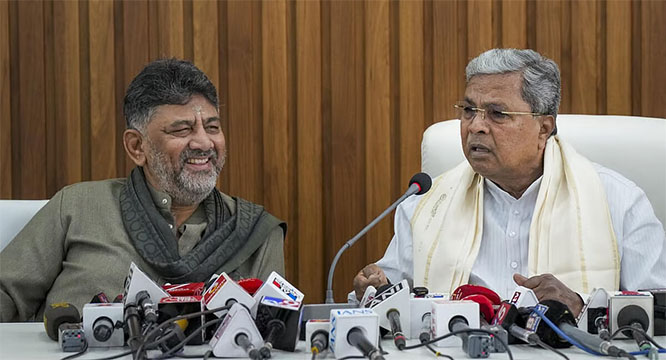
New Delhi: Karnataka chief minister Siddaramaiah and deputy CM DK Shivakumar on Saturday put up a dramatic display of unity at a closely watched joint press briefing, firmly dismissing weeks of speculation about a power-sharing tussle within the Congress. With the high command nudging both leaders to sit together and settle the dust, the meeting became a political spectacle, ending with the duo declaring that there was “no confusion, no differences.”

Calling the reports of a rift “manufactured confusion,” Siddaramaiah said the talks had gone smoothly, even joking about their breakfast. “Breakfast was very good. All three of us enjoyed it,” he said. “We want to end this confusion once and for all. For local elections and for 2028, our mission is clear — Congress must return to power. There is no difference between me and DKS, not now, not before.”

He blamed the media for fuelling rumours and reiterated absolute adherence to the party leadership. “From tomorrow, let there be no confusion. What the high command says, we will follow.”

Siddaramaiah also assured that the Assembly session starting December 8 would run smoothly and vowed that Congress would take on the BJP and JD(S) “together.”

Shivakumar echoed the chief minister word for word, stressing loyalty and discipline. “People have given us a massive mandate. It is our duty to deliver,” he said. “This government was formed under Siddaramaiah’s leadership. We both have complete trust in the high command. If they tell me to wait, I will wait.”

He added that the two leaders had discussed strategy for the 2028 Assembly elections. “Whatever the CM says, I agree. We are loyal soldiers of the party. The party may be facing challenges nationally, but we will keep it strong in Karnataka.”

Shivakumar also said Siddaramaiah would soon visit his home for lunch or dinner — another symbolic gesture meant to underline their unity.

Both leaders later posted on social media describing the breakfast meeting as “productive” and focused on “Karnataka’s priorities.”

The BJP, however, rejected the show of camaraderie as “pure bunkum,” accusing Congress of trying to paper over an internal power struggle. But Siddaramaiah and Shivakumar insisted their united front would continue — and that there was “no confusion” within the state leadership.

Comments

Add new comment

  • Coastaldigest.com reserves the right to delete or block any comments.
  • Coastaldigset.com is not responsible for its readers’ comments.
  • Comments that are abusive, incendiary or irrelevant are strictly prohibited.
  • Please use a genuine email ID and provide your name to avoid reject.
News Network
December 3,2025

indigo.jpg

IndiGo, India’s largest airline, is battling one of its worst operational disruptions in recent years, with hundreds of delays and cancellations throwing domestic travel into chaos.

Government data on Tuesday showed its on-time performance plunging to 35%, an unusual dip for a carrier long associated with punctuality.

By Wednesday afternoon, airports in Delhi, Mumbai, Bengaluru and Hyderabad had collectively reported close to 200 cancellations, stranding travellers across the country.

Crew Shortage After New Duty Norms

A major trigger behind the meltdown is a severe crew shortage, especially among pilots, following the rollout of revised Flight Duty Time Limitation (FDTL) norms last month.

The rules mandate longer rest hours and more humane rosters — a shift IndiGo has struggled to incorporate across its vast network.

Sources said several flights were grounded due to lack of cabin crew, while some delays stretched upwards of eight hours.

With IndiGo controlling over 60% of India’s domestic aviation market, the ripple effect has impacted airports nationwide.

IndiGo Issues Apology, Lists “Compounding Factors”

In a statement, IndiGo acknowledged the large-scale disruption:

“We sincerely apologise to customers. A series of unforeseen operational challenges — technology glitches, winter schedule changes, adverse weather, system congestion and updated FDTL norms — created a compounding impact that could not have been anticipated.”

To stabilise operations, the airline has begun calibrated schedule adjustments for the next 48 hours, aiming to restore punctuality. Affected passengers are being offered refunds or alternate travel arrangements, IndiGo said.

What the FDTL Rules Require

The FDTL norms, designed to reduce pilot fatigue, cap duty and flying hours as follows:
•    Maximum 8 hours of flying per day
•    35 hours per week
•    125 hours per month
•    1,000 hours per year

Crew must also receive rest equalling twice the flight duration, with a minimum 10-hour rest period in any 24-hour window.

The DGCA introduced these limits to enhance flight safety.

Hyderabad: 33 Flights Cancelled, Long Queues Reported

Hyderabad’s Rajiv Gandhi International Airport saw heavy early-morning crowds as 33 IndiGo flights (arrivals and departures) were cancelled.

The airport clarified on X that operations were normal, advising passengers to contact IndiGo directly for latest flight status.

Cancellations included flights to and from Visakhapatnam, Goa, Ahmedabad, Delhi, Bengaluru, Chennai, Madurai, Hubli, Bhopal and Bhubaneswar.

Bengaluru: 42 Flights Disrupted

Bengaluru’s Kempegowda International Airport recorded 42 cancellations — 22 arrivals and 20 departures — affecting routes to Delhi, Mumbai, Chennai, Hyderabad, Goa, Kolkata and Lucknow.

Passengers Vent on Social Media

Irate travellers took to X to share their experiences. One passenger stranded in Hyderabad wrote: “I have been here since 3 a.m. and missed an important meeting.”

Another said: “My flight was pushed from 1:55 PM to 2:55 PM and now 4:35 PM. I was informed only three minutes before entering the airport.”

Delhi Airport Hit by Tech Glitch

At Delhi Airport, the disruption deepened due to a slowdown in the Amadeus system — used for reservations, check-ins and departure control.

The technical issue led to longer queues and sluggish processing, adding to delays already worsened by staff shortages.

Comments

Add new comment

  • Coastaldigest.com reserves the right to delete or block any comments.
  • Coastaldigset.com is not responsible for its readers’ comments.
  • Comments that are abusive, incendiary or irrelevant are strictly prohibited.
  • Please use a genuine email ID and provide your name to avoid reject.
News Network
December 2,2025

Mangaluru, Dec 2: Mangaluru International Airport responded to a medical emergency late on Monday night. Air India Express flight IX 522, travelling from Riyadh to Thiruvananthapuram, was diverted to Mangaluru Airport after a passenger in his late 30s experienced a medical emergency on board.

The Airport’s Operations Control Centre received an alert regarding the passenger’s health condition. The airport activated its emergency response protocol, mobilising the airport medical team and coordinating with stakeholders including CISF, immigration, and customs. 

Upon landing, airport medical personnel attended to the passenger, assessed his condition, and arranged to shift him to a local tertiary-care hospital for further treatment. The passenger’s relatives accompanied the passenger, who incidentally received necessary medical care on board, which helped stabilise the situation.

Following the handling of the emergency, the flight departed for Thiruvananthapuram at 2:05 am on Tuesday.

"We appreciate the cooperation of all parties involved, and this incident reaffirms our ongoing commitment to prioritising passenger safety and readiness to respond to unforeseen emergencies with professionalism and care," the Airport spokesperson said. 

Comments

Add new comment

  • Coastaldigest.com reserves the right to delete or block any comments.
  • Coastaldigset.com is not responsible for its readers’ comments.
  • Comments that are abusive, incendiary or irrelevant are strictly prohibited.
  • Please use a genuine email ID and provide your name to avoid reject.