Indian economy, battered by covid-19, needs its lost growth

News Network
September 1, 2021

The coronavirus continues to batter India’s damaged economy, putting growing pressure on Prime Minister Narendra Modi to nurture a nascent recovery and get the country back to work.

The coronavirus, which has struck in two waves, has killed hundreds of thousands of people and at times has brought cities to a halt. Infections and deaths have eased, and the country is returning to work. Economists predict that growth could surge in the second half of the year on paper.

Still, the damage could take years to undo. Economic output was 9.2% lower for the April-through-June period this year than what it was for the same period in 2019, according to India Ratings, a credit ratings agency.

The coronavirus has essentially robbed India of much of the momentum it needed to provide jobs for its young and fast-growing workforce. It has also exacerbated longer-term problems that were already dragging down growth, such as high debt, a lack of competitiveness with other countries and policy missteps.

Economists are particularly concerned about the slow rate of vaccinations and the possibility of a third wave of the coronavirus, which could prove to be disastrous for any economic recovery.

“Vaccination progress remains slow,” with just 11% of the population fully inoculated so far, Priyanka Kishore, the head of India and Southeast Asia at Oxford Economics, said in a research briefing last week. The firm lowered its growth rate for 2021 to 8.8%, from 9.1%.

Even growth of 8.8% would be a strong number in better times. Compared with the previous year, India’s economy grew 20.1% April through June, according to estimates released by the Ministry of Statistics and Program Implementation.

But those comparisons benefit from comparison with India’s dismal performance last year. The economy shrank 7.3% last year, when the government shut down the economy to stop a first wave of the coronavirus. That led to big job losses, now among the biggest hurdles holding back growth, experts say.

Real household incomes have fallen further this year, said Mahesh Vyas, chief executive of the Center for Monitoring Indian Economy. “Till this is not repaired,” he said, “the Indian economy can’t bounce back.”

At least 3.2 million Indians lost stable, well-paying salaried jobs in July alone, Vyas estimated. Small traders and daily wage labourers had bigger job losses during the lockdowns than others, though they were able to go back to work once the restrictions were lifted, Vyas said in a report in August. “Salaried jobs are not similarly elastic,” he said. “It is difficult to retrieve a lost salaried job.”

About 10 million people have lost such jobs since the beginning of the pandemic, Vyas said.

In August, Modi’s government moved to rekindle the economy by selling stakes worth close to $81 billion in state-owned assets like airports, railway stations and stadiums. But economists largely see the policy as a move to generate cash in the short term. It remains to be seen if it will lead to more investment, they say.

“The whole idea is that the government will borrow this money from the domestic market,” said Devendra Kumar Pant, chief economist at India Ratings. “But what happens if this project goes to a domestic player and he is having to borrow in the domestic market? Your credit demand domestically won’t change.”

Pant added that questions remained about how willing private players would be to maintain those assets long term and how the monetization policy would ultimately affect consumer prices.

 “In India, things will decay for the worse rather than improve,” he said, adding that the costs to users of highways and other infrastructure could go up.

During the second wave in May, Modi resisted calls by many public health researchers, including Dr Anthony Fauci, director of the US National Institute of Allergy and Infectious Diseases, to reinstitute a nationwide lockdown.

The lockdowns in 2021 were nowhere near as severe as the nationwide curbs last year, which pushed millions of people out of cities and into rural areas, often on foot because rail and other transportation had been suspended.

Throughout the second wave, core infrastructure projects across the country, which employ millions of domestic migrant workers, were exempted from restrictions. More than 15,000 miles of Indian highway projects, along with rail and city metro improvements, continued.

On Tuesday, Pant said that India’s growth estimates of 20.1% for the April through June period were nothing but an “illusion.” Growth contracted so sharply around the same period last year, by a record 24%, that even double-digit gains this year would leave the economy behind where it was two years ago.

Economists say that India needs to spend, even splurge, to unlock the full potential of its huge low-skilled workforce. “There is a need for very simple primary health facilities, primary services to deliver nutrition to children,” Vyas said. “All these are highly labour intensive jobs and these are government services largely.”

One of the reasons Indian governments typically have not spent in those areas, Vyas said, is that it has been considered “not a sexy thing to do.” Another is the government's “dogmatic fixation” with keeping fiscal deficits in control, he said. The government simply can’t rely on the private sector alone for creating jobs, Vyas said.

The “only solution,” he said, is for the government to spend and spur private investment. “You have a de-motivated private sector because there isn’t enough demand. That’s what’s holding India back.”

Comments

Ramesh Mishra
 - 
Monday, 13 Sep 2021

INDIAN ECONOMY
Due to the malfeasance in the Judiciary, Politicians and Executives, the economy is gone back 75,years behind. The malfeasance into the three vital branches can not be corrected and consolidated because all the three vital organs of the government have completely collapsed. Modi, PM of India has pilloried, tortured, traumatised, harassed, humiliated, degraded and destroyed his opposition, critics. India is now a " total loss". The internal conflict has ruined the trade commerce and the mutual trust. Hindu, Muslim, Christian and Sikh are divided due to the lack of leadership. The division of India can't be prevented its too late to rebuild the public trust. The public is cheated at every step in India which is a country of crooks.
Ramesh Mishra, Victoria, British Columbia, CANADA

Add new comment

  • Coastaldigest.com reserves the right to delete or block any comments.
  • Coastaldigset.com is not responsible for its readers’ comments.
  • Comments that are abusive, incendiary or irrelevant are strictly prohibited.
  • Please use a genuine email ID and provide your name to avoid reject.
coastaldigest.com news network
November 29,2025

health1.jpg

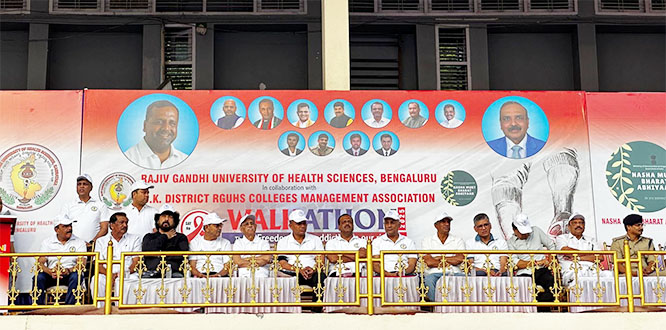
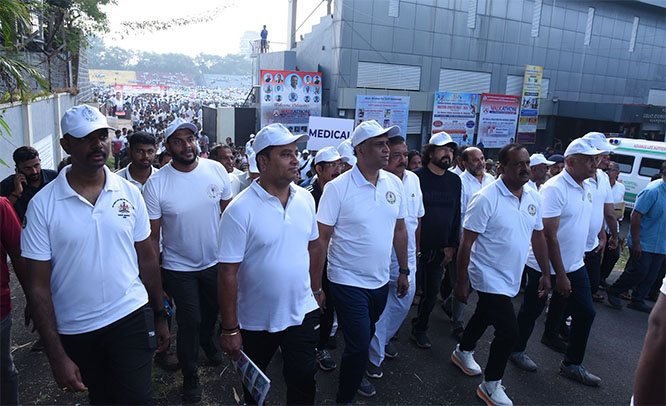
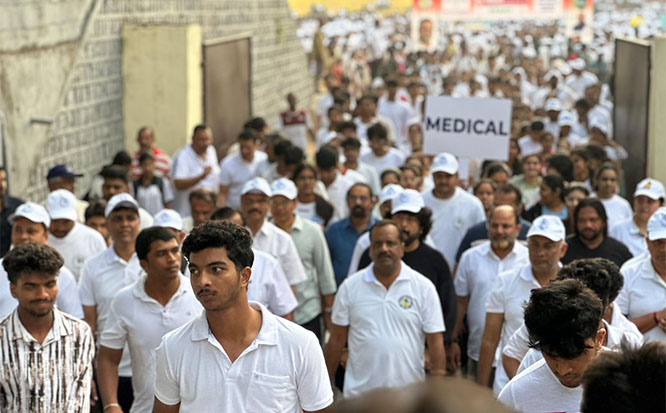
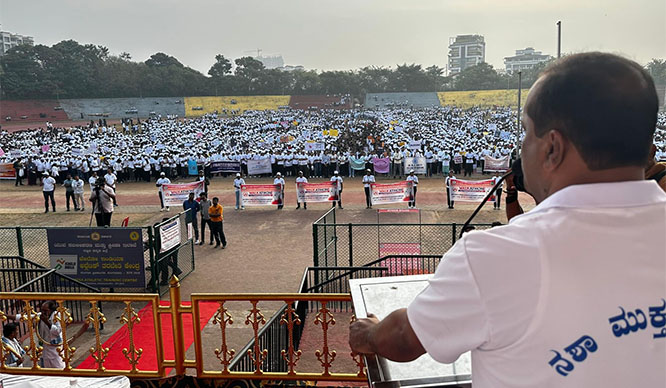
Mangaluru, Nov 29: Around 12,500 healthcare students from Medical, Dental, AYUSH, Pharmacy, Nursing, Physiotherapy and Allied Health Sciences colleges of Dakshina Kannada, affiliated to Rajiv Gandhi University of Health Sciences (RGUHS), took part in a massive walkathon to promote awareness on Organ Donation and Nasha Mukth Bharat.

The inaugural ceremony was held at Mangala Stadium. Dr Bhagavan B C, Hon’ble Vice-Chancellor of RGUHS, delivered the welcome address. The walkathon was flagged off by Shri U T Khader, Hon’ble Speaker of the Karnataka Legislative Assembly, and presided over by Shri Dinesh Gundu Rao, Hon’ble Minister for Health, Family Welfare and Dakshina Kannada District In-charge. Dakshina Kannada MP Shri Brijesh Chowta also addressed the students.

Music director Guru Kiran, MLA Dr Bharat Shetty (Mangalore North), Police Commissioner Shri Sudheer Kumar Reddy, Shri Manjunath Bhandary and Shri Harish Kumar were among those present.

Institution heads including Dr Haji U K Monu (Kanachur Colleges), Dr Shantharam Shetty (Tejaswini College), Dr Bhaskar Shetty (City Group of Colleges), Mr Abdul Rahiman (Kanachur Institute of Medical Sciences), and the District Health Officer, Mangalore, also participated.

The vote of thanks was delivered by Prof U T Ifthikar Fareed, Syndicate Member, RGUHS.

The event was organised by Dr U T Ifthikar Ali and Dr Shiva Sharan (Syndicate Members), Prof Vaishali (Senate Member), Prof Mohammad Suhail (Chairman, BOS Physiotherapy), Dr Sharan Shetty (Former Senate Member), along with principals and faculty of various colleges.

Students marched from Mangala Stadium to Karavali Grounds via MCC and Lalbagh signal. The event set a record as one of the largest gatherings of healthcare students for a social cause in the RGUHS Dakshina Kannada Zone.

health7.jpg

health6.jpg

health5.jpg

health4.jpg

health3.jpg

health2.jpg

Comments

Add new comment

  • Coastaldigest.com reserves the right to delete or block any comments.
  • Coastaldigset.com is not responsible for its readers’ comments.
  • Comments that are abusive, incendiary or irrelevant are strictly prohibited.
  • Please use a genuine email ID and provide your name to avoid reject.
News Network
November 30,2025

The United Nations Committee against Torture (CAT) has condemned the Israeli regime for enforcing a policy of “organized torture” against Palestinians.

In a report published on Friday, CAT stated that the occupying regime enforces a deliberate policy of “organized and widespread torture and ill-treatment” against Palestinian abductees, particularly since October 7, 2023, when Israel launched its genocidal war on Gaza.

The committee expressed “deep concern over repeated severe beatings, dog attacks, electrocution, water-boarding, use of prolonged stress positions [and] sexual violence” inflicted on Palestinians.

Palestinian prisoners were degraded by “being made to act like animals or being urinated on,” systematically denied medical care, and subjected to excessive restraints, “in some cases resulting in amputation,” the report added.

CAT also condemned the routine application of “unlawful combatants law” to justify the prolonged detention without trial of thousands of Palestinian men, women, and children.

More than 10,000 Palestinians, including women and children, are currently held in Israeli prisons, according to Palestinian and international human rights groups, with 3,474 Palestinians in “administrative detention,” meaning they are imprisoned without trial for indefinite periods.

The report highlighted the “high proportion of children who are currently detained without charge or on remand,” noting that while Israel sets the age of criminal responsibility at 12, even younger children have been abducted.

Children designated as security prisoners face severe restrictions on family contact, may be subjected to solitary confinement, and are denied access to education, in clear violation of international law.

The committee further suggested that Israel’s policies across the Occupied Territories constitute collective torture against the Palestinian population.

“A range of policies adopted by Israel in the course of its continued unlawful presence in the Occupied Palestinian Territory amounts to cruel, inhuman or degrading living conditions for the Palestinian population,” the report said.

On Thursday, the Palestinian resistance movement Hamas condemned the systematic killing and torture of Palestinian abductees in Israeli prisons, urging international action to halt these abuses.

Citing human rights data, Hamas stated that 94 Palestinians have been killed in Israeli prisons since the start of Tel Aviv’s genocidal war on Gaza.

“This reflects an organized criminal approach that has turned these prisons into direct killing grounds to eliminate our people,” the resistance movement said.

Hamas called on the international community, the UN, and human rights organizations to immediately pressure Israel to end crimes against prisoners and uphold their rights as guaranteed by all international conventions and norms.

Comments

Add new comment

  • Coastaldigest.com reserves the right to delete or block any comments.
  • Coastaldigset.com is not responsible for its readers’ comments.
  • Comments that are abusive, incendiary or irrelevant are strictly prohibited.
  • Please use a genuine email ID and provide your name to avoid reject.
News Network
December 4,2025

indigoflight.jpg

Domestic carrier IndiGo has cancelled over 180 flights from three major airports — Mumbai, Delhi and Bengaluru — on Thursday, December 4, as the airline struggles to secure the required crew to operate its flights in the wake of new flight-duty and rest-period norms for pilots.

While the number of cancellations at Mumbai airport stands at 86 (41 arrivals and 45 departures) for the day, at Bengaluru, 73 flights have been cancelled, including 41 arrivals, according to a PTI report that quoted sources.

"IndiGo cancelled over 180 flights on Thursday at three airports-Mumbai, Delhi and Bengaluru," the source told the news agency.

Besides, it had cancelled as many as 33 flights at Delhi airport for Thursday, the source said, adding, "The number of cancellations is expected to be higher by the end of the day."

The Gurugram-based airline's On-Time Performance (OTP) nosedived to 19.7 per cent at six key airports — Delhi, Mumbai, Chennai, Kolkata, Bengaluru and Hyderabad — on December 3, as it struggled to get the required crew to operate its services, down from almost half of December 2, when it was 35 per cent.

"IndiGo has been facing acute crew shortage since the implementation of the second phase of the FDTL (Flight Duty Time Limitations) norms, leading to cancellations and huge delays in its operations across the airports," a source had told PTI on Wednesday.

Chaos continued at several major airports for the third day on Thursday because of the cancellations.

A spokesperson for the Kempegowda International Airport (KIA) in Bengaluru said that 73 IndiGo flights had been cancelled on Thursday.

At least 150 flights were cancelled and dozens of others delayed on Wednesday, airport sources said, leaving thousands of travellers stranded, according to news agency Reuters.

The Directorate General of Civil Aviation (DGCA) has said it is investigating IndiGo flight disruptions and has asked the airline to submit the reasons for the current situation, as well as its plans to reduce flight cancellations and delays.

It may be mentioned here that the pilots' body, Federation of Indian Pilots (FIP), has alleged that IndiGo, despite getting a two-year preparatory window before the full implementation of new flight duty and rest period norms for cockpit crew, "inexplicably" adopted a "hiring freeze".

The FIP said it has urged the safety regulator, the DGCA, not to approve airlines' seasonal flight schedules unless they have adequate staff to operate their services "safely and reliably" in accordance with the New Flight Duty Time Limitations (FDTL) norms.

In a letter to the DGCA late on Wednesday, the FIP urged the DGCA to consider re-evaluating and reallocating slots to other airlines, which have the capacity to operate them without disruption during the peak holiday and fog season if IndiGo continues to "fail in delivering on its commitments to passengers due to its own avoidable staffing shortages."

Comments

Add new comment

  • Coastaldigest.com reserves the right to delete or block any comments.
  • Coastaldigset.com is not responsible for its readers’ comments.
  • Comments that are abusive, incendiary or irrelevant are strictly prohibited.
  • Please use a genuine email ID and provide your name to avoid reject.