India’s GDP expected to contract by 9.6% this fiscal: World Bank

News Network
October 8, 2020

gdp.JPG

The World Bank on Thursday said that India’s GDP is expected to contract by 9.6 per cent this fiscal which is reflective of the national lockdown and the income shock experienced by households and firms due to the Covid-19 pandemic, noting that the country's economic situation is “much worse” than ever seen before.

The Washington-based global lender, in its latest South Asia Economic Focus report ahead of the annual meeting of the World bank and International Monetary Fund, forecasts a sharper than expected economic slump across the region, with regional growth expected to contract by 7.7 per cent in 2020, after topping six per cent annually in the past five years.

“India’s GDP is expected to contract by 9.6 per cent in the fiscal year that started in March,” the World Bank said in the report released here.

Regional growth is projected to rebound to 4.5 per cent in 2021, it said.

Factoring in population growth, however, income-per-capita in the region will remain 6 per cent below 2019 estimates, indicating that the expected rebound will not offset the lasting economic damage caused by the pandemic, it said.

“The situation is much worse in India than we have ever seen before,” Hans Timmer, World Bank Chief Economist for South Asia told reporters during a conference call.

“It is an exceptional situation in India. A very dire outlook,” he said.

There was a 25 per cent decline in GDP in the second quarter of the year, which is the first quarter of the current fiscal year in India.

In the report, the World bank said that the spread of the coronavirus and containment measures have severely disrupted supply and demand conditions in India.

With the intent to contain the spread of COVID-19, Prime Minister Narendra Modi, with effect from March 25, announced a nationwide complete lockdown that brought as much as 70 per cent of economic activity, investment, exports and discretionary consumption to a standstill. Only essential goods and services such as agriculture, mining, utility services, some financial and IT services and public services were allowed to operate.

Dubbed as the world's biggest lockdown, it shut a majority of the factories and businesses, suspended flights, stopped trains and restricted movement of vehicles and people.

According to the World Bank, monetary policy has been deployed aggressively and fiscal resources have been channeled to public health and social protection, but additional counter-cyclical measures will be needed, within a revised medium-term fiscal framework.

Despite measures to shield vulnerable households and firms, the trajectory of poverty reduction has slowed, if not reversed, it said.

“We have seen from the rapid survey that many people have lost their jobs,” Timmer said, adding that this is happening against a background when India's economy was already slowing down before the pandemic.

“We had seen a rise in non-performing loans. Those are all vulnerabilities that India has to deal with,” he said.

Responding to a question, Timmer said what the Indian government has done with limited resources and limited fiscal space is very impressive.

“We have seen a loosening of monetary policy. You have seen attempts to increase credit to the private sector to help a company survive,” he said, adding that there have been big efforts in the health sector and expansion of a social safety net.

“But with every big crisis, I think, we have to realise that this will not go over anytime soon. And it will actually change the longer-term future also. What this reveals is really as good as federal policies, especially the policies related to the informal sector.

“There's a big problem that the informal sector has no coverage in social insurance. What we see now is that especially the informal workers in the middle of the income distribution have lost their jobs. There are no systems in place to support those people,” Timmer said.

Responding to another question, Timmer said that as a result of Covid-19, the World Bank estimates that in one year, the number of people living below the poverty line has increased by 33 per cent.

In its report, the World Bank said that the response of the government of India to the COVID-19 outbreak was swift and comprehensive. A strict lockdown was implemented to contain the health emergency.

To mitigate its impact on the poorest, it was complemented by social protection measures; to ensure that businesses could maintain their operations, the Reserve Bank of India and the government also provided liquidity and other regulatory support, it said.

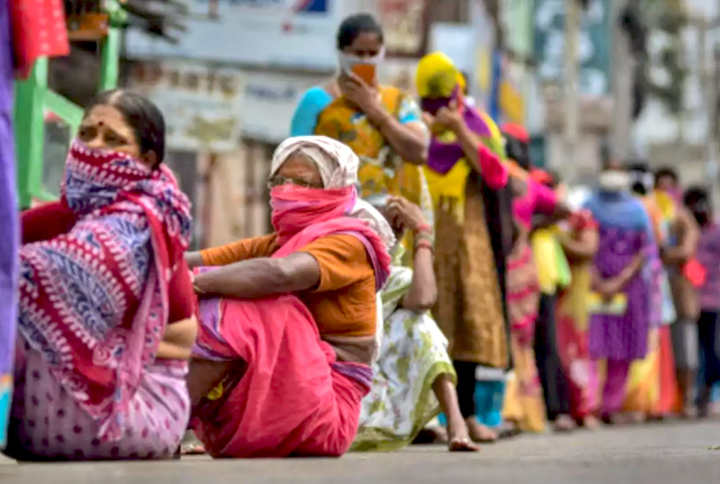
“Nonetheless, there was a massive contraction in output and poor and vulnerable households experienced significant social hardships – specifically urban migrants and workers in the informal economy,” the bank said.

After fiscal 2017, during which the economy grew at 8.3 per cent, growth decelerated in each subsequent year to 7.0, 6.1 and 4.2 per cent.

This was on account of two mutually reinforcing dynamics: emerging weaknesses in non-bank financial companies (a major source of credit growth, making up for risk aversion from banks) and slowing private consumption growth, the bank added.

Comments

Add new comment

  • Coastaldigest.com reserves the right to delete or block any comments.
  • Coastaldigset.com is not responsible for its readers’ comments.
  • Comments that are abusive, incendiary or irrelevant are strictly prohibited.
  • Please use a genuine email ID and provide your name to avoid reject.
News Network
December 5,2025

indigoCEO.jpg

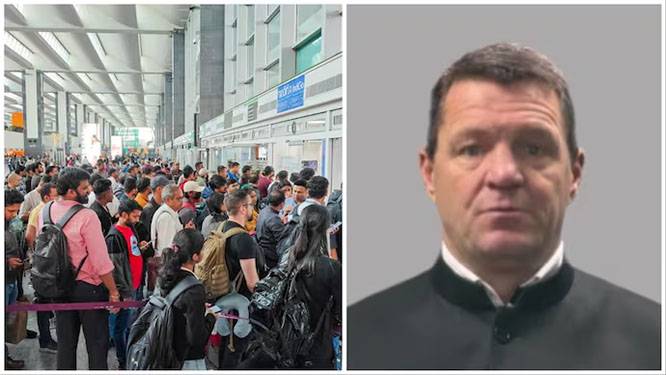
New Delhi, Dec 5: IndiGo CEO Pieter Elbers issued a public apology this evening after more than a thousand flights were cancelled today, making it the "most severely impacted day" in terms of cancellations. The biggest airline of the country cancelled "more than half" of its daily number of flights on Friday, said Elbers. He also said that even though the crisis will persist on Saturday, the airline anticipates fewer than 1,000 flight cancellations.

"Full normalisation is expected between December 10 and 15, though IndiGo cautions that recovery will take time due to the scale of operations," the IndiGo CEO said. 

IndiGo operates around 2,300 domestic and international flights daily.

Pieter Elbers, while apologising for the major inconvenience due to delays and cancellations, said the situation is a result of various causes.

The crisis at IndiGo stems from new regulations that boost pilots' weekly rest requirements by 12 hours to 48 and allow only two night-time landings per week, down from six. IndiGo has attributed the mass cancellations to "misjudgment and planning gaps".

Elbers also listed three lines of action that the airline will adopt to address the issue.

"Firstly, customer communication and addressing your needs, for this, messages have been sent on social media. And just now, a more detailed communication with information, refunds, cancellations and other customer support measures was sent," he said.

The airline has also stepped up its call centre capacity.

"Secondly, due to yesterday's situation, we had customers stranded mostly at the nation's largest airports. Our focus was for all of them to be able to travel today itself, which will be achieved. For this, we also ask customers whose flights are cancelled not to come to the airports as notifications are sent," the CEO said.

"Thirdly, cancellations were made for today to align our crew and planes to be where they need to start tomorrow morning afresh. Earlier measures of the last few days, regrettable, have proven not to be enough, but we have decided today to reboot all our systems and schedules, resulting in the highest numbers of cancellations so far, but imperative for progressive improvements starting from tomorrow," he added.

As airports witnessed chaotic scenes, the Directorate General of Civil Aviation (DGCA) stepped in to grant IndiGo a temporary exemption from stricter night duty rules for pilots. It also allowed substitution of leaves with a weekly rest period. 

Civil Aviation Minister Ram Mohan Naidu has said a high-level inquiry will be ordered and accountability will be fixed.

Comments

Add new comment

  • Coastaldigest.com reserves the right to delete or block any comments.
  • Coastaldigset.com is not responsible for its readers’ comments.
  • Comments that are abusive, incendiary or irrelevant are strictly prohibited.
  • Please use a genuine email ID and provide your name to avoid reject.
coastaldigest.com news network
December 2,2025

karkala.jpg

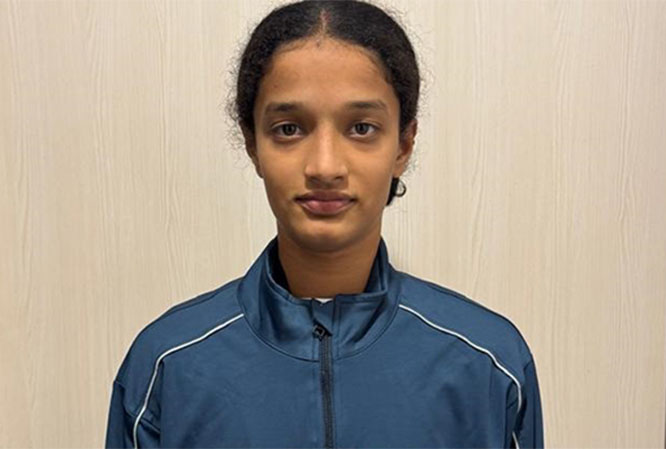
Udupi, Dec 2: A wave of regional pride is sweeping through Udupi district as Shagun S Verma Hegde, a talented Class 9 student from Christ King English Medium High School, Karkala, has been named the captain of the Indian National Team for the Under-15 Girls’ Volleyball Championship.

Shagun holds the unique distinction of being the sole player from Karnataka selected to represent the country in the prestigious international tournament. The championship, organized by the School Games Federation, is scheduled to take place in Shangluo, China, from December 3 to 13, where Shagun will lead the national squad.

A Remarkable Journey to the Top

Shagun’s selection is a testament to her dedication and exceptional skill on the court. Her journey included several rigorous rounds of selection:

•    She was the only player from Udupi district to qualify for the state-level selection camp.

•    Out of eight players from Karnataka who advanced to the national selection camp in Pune, Maharashtra, Shagun was the only one to secure a place in the final national squad.

•    The national camp saw participation from approximately 200 players, which was shortlisted to 23. Shagun not only made the final cut but was also ranked as the second-best player overall, solidifying her leadership role.

Shagun, who is the daughter of Sandesh Verma and Shruthiraj of Kallotte, Karkala, has trained under experienced coaches Santosh D’Souza, Jeevan D’Silva, Jairaj Poojary, and Ramesh. Her selection as the team captain has brought profound honour to her family, school, the Udupi district, and the entire state of Karnataka.

Comments

Add new comment

  • Coastaldigest.com reserves the right to delete or block any comments.
  • Coastaldigset.com is not responsible for its readers’ comments.
  • Comments that are abusive, incendiary or irrelevant are strictly prohibited.
  • Please use a genuine email ID and provide your name to avoid reject.
News Network
December 2,2025

DKSsiddu.jpg

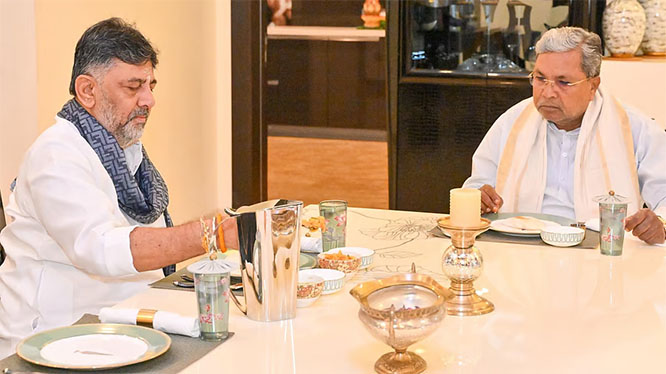
Bengaluru: 'Nati koli saaru' (country chicken curry) considered one of Chief Minister Siddaramaiah’s favourites along with steaming hot idlis was on the breakfast menu at Deputy CM D K Shivakumar’s residence on Tuesday, according to official sources.

The spread also included 'nati koli' fry, vada and pongal, among other items, they said.

In an apparent show of unity, Siddaramaiah visited Shivakumar’s residence for breakfast, just days after the two leaders shared a meal amid a simmering power tussle in the state Congress.

Siddaramaiah drove to the Deputy CM’s residence in Sadashivanagar, where he was received by Shivakumar and his brother D K Suresh, who is a former Congress MP.

Suresh and Kunigal MLA H D Ranganath, a relative of Shivakumar, joined them for breakfast, which featured a mix of vegetarian and non-vegetarian dishes.

Speaking to reporters later, Siddaramaiah said Shivakumar had invited him during his visit to the CM’s residence for breakfast on Saturday.

Asked about the difference between the two meals, the chief minister said, "At his (Shivakumar’s) house it was non-veg, while at my house it was veg. He is a vegetarian, I am a non-vegetarian. I had not prepared non-veg. I told DK to get chicken from the village as you won’t get the original in Bengaluru."

Shivakumar said he had initially invited Siddaramaiah to his residence, but the CM had suggested visiting his place first and reciprocating later. "It was a vegetarian breakfast at the CM’s house on Saturday," he noted.

"Today, I invited him (the CM) to my house. He enjoyed the breakfast, which had his Mysuru taste," Shivakumar added. At this point, Siddaramaiah remarked that Shivakumar’s wife is also from Mysuru.

Saturday’s breakfast at Siddaramaiah’s official residence, held as part of efforts by the Congress high command to ease tensions in the leadership dispute between the two, reportedly included idlis and sambar, according to official sources.

Comments

Add new comment

  • Coastaldigest.com reserves the right to delete or block any comments.
  • Coastaldigset.com is not responsible for its readers’ comments.
  • Comments that are abusive, incendiary or irrelevant are strictly prohibited.
  • Please use a genuine email ID and provide your name to avoid reject.