‘Jammu & Kashmir to become state again 'at right time’: PM Modi’s new promise and other points

News Network
June 25, 2021

New Delhi: Prime Minister Narendra Modi, in a 3-hour meeting with political leaders of Jammu and Kashmir on Thursday, spoke about removing "Dilli ki Doori as well as Dil Ki Doori" and assured his commitment to restoring full statehood at the right time.

Here's are 10-point

1.    Fourteen mainstream Jammu and Kashmir leaders from eight political parties, including four Chief Ministers, attended the three-hour meeting aimed at getting the political process back on course in the region after it lost its special status under Article 370 of the Constitution in 2019 and was downgraded from a state to two Union Territories - Jammu and Kashmir and Ladakh.

2.    PM Modi, say sources, said statehood would be restored "at an appropriate time" but urged the parties to get on board with delimitation or the redrawing of assembly constituencies to enable elections. Elections can happen soon after delimitation, it was said, and "most participants expressed willingness for it", said sources.

3.    "The main focus of the meeting was to strengthen the democratic process. PM said that we are fully committed to the democratic process in J&K. He stressed that the holding assembly elections just like the successful District Development Council elections is a priority," government sources said.

4.    Former Chief Ministers Farooq Abdullah and his son Omar Abdullah of the National Conference met with PM Modi last on August 1, 2019. They were stunned when three days later on August 4, they were detained and hours later, the abrogation of Article 370 was announced in parliament.

5.    Union Home Minister Amit Shah, while announcing the colossal move in parliament, had said that full statehood would be "restored at an appropriate time". After today's meeting, Mr Shah tweeted: "The future of Jammu and Kashmir was discussed and the delimitation exercise and peaceful elections are important milestones in restoring statehood as promised in parliament."

6.    Omar Abdullah, however, told reporters that "almost all leaders" were unhappy with delimitation only in Jammu and Kashmir. "In other states, delimitation will be taken up in 2026, why has been Jammu and Kashmir been singled out? We told the PM delimitation is not needed," said the former Chief Minister, adding that "trust has broken between the Centre and Kashmir".

7.    The seven-party Gupkar alliance led by Farooq Abdullah and former Chief Minister Mehbooba Mufti, accorded front row status with the PM in photos of the meet, pressed for restoration of full statehood and special status. "We will struggle for 370, be it months or years. We didn't get this (special status) from Pakistan, but from India, Nehru. There can be no compromise on this," Ms Mufti said after the meeting.

8.    The Prime Minister, said sources, "patiently heard suggestions and inputs from all participants" and expressed happiness that all participants shared their frank and honest views. "It was an open discussion which revolved around building a better future for Kashmir," they said.

9.    This was the Centre's first major outreach since August 2019 towards political leaders who have been severely critical of the Article 370 decision. Many of the leaders attending the meeting had been detained as part of security measures to prevent any protests over the sweeping changes.

10.    At the meeting, it was also decided that the Jammu and Kashmir Lieutenant Governor Manoj Sinha would set up a committee to review cases of political prisoners, be it those released - like the Abdullahs and Ms Mufti - and those still in detention.

Comments

Add new comment

  • Coastaldigest.com reserves the right to delete or block any comments.
  • Coastaldigset.com is not responsible for its readers’ comments.
  • Comments that are abusive, incendiary or irrelevant are strictly prohibited.
  • Please use a genuine email ID and provide your name to avoid reject.
News Network
December 3,2025

arrival.jpg

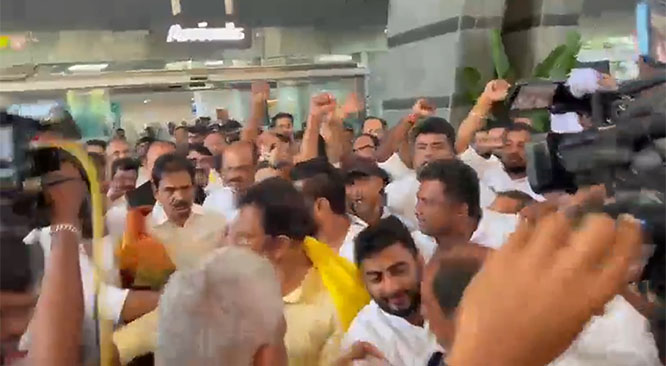
Mangaluru, Dec 3: A group of Congress workers gathered at the Mangaluru International Airport on Wednesday to welcome AICC general secretary K C Venugopal, but the reception quickly turned into a display of support for Deputy Chief Minister D K Shivakumar.

Venugopal arrived in the city to participate in the centenary commemoration of the historic dialogue between Mahatma Gandhi and Narayana Guru. The event, organised by the Sivagiri Mutt, Varkala, in association with the Mangalore University Sri Narayana Guru Study Chair, is being held on the university’s Konaje campus.

KPCC general secretary Mithun Rai and several party workers had assembled at the airport to receive Venugopal. However, the moment he stepped out, workers began raising slogans backing Shivakumar.

The university programme will be inaugurated by Chief Minister Siddaramaiah.

This show of support comes just a day after Siddaramaiah remarked that Shivakumar would lead the government “when the high command decides.” The chief minister made the comment after a breakfast meeting at Shivakumar’s residence—another public display of camaraderie between the two leaders amid ongoing attempts by the party high command to downplay their leadership rivalry.

Comments

Add new comment

  • Coastaldigest.com reserves the right to delete or block any comments.
  • Coastaldigset.com is not responsible for its readers’ comments.
  • Comments that are abusive, incendiary or irrelevant are strictly prohibited.
  • Please use a genuine email ID and provide your name to avoid reject.
News Network
December 13,2025

New Delhi: School-going children are picking up drug and smoking habits and engaging in consumption of alcohol, with the average age of introduction to such harmful substances found to be around 13 years, suggesting a need for earlier interventions as early as primary school, a multi-city survey by AIIMS-Delhi said.

The findings also showed substance use increased in higher grades, with grade XI/XII students two times more likely to report use of substances when compared with grade VIII students. This emphasised the importance of continued prevention and intervention through middle and high school.

The study led by Dr Anju Dhawan of AIIMS's National Drug Dependence Treatment Centre, published in the National Medical Journal of India this month, looks at adolescent substance use across diverse regions.

The survey included 5,920 students from classes 8, 9, 11 and 12 in urban government, private and rural schools across 10 cities -- Bengaluru, Chandigarh, Delhi, Dibrugarh, Hyderabad, Imphal, Jammu, Lucknow, Mumbai, and Ranchi. The data were collected between May 2018 and June 2019.

The average age of initiation for any substance was 12.9 (2.8) years. It was lowest for inhalants (11.3 years) followed by heroin (12.3 years) and opioid pharmaceuticals (without prescription; 12.5 years).

Overall, 15.1 per cent of participants reported lifetime use, 10.3 per cent reported past year use, and 7.2 per cent reported use in the past month of any substance, the study found.

The most common substances used in the past year, after tobacco (4 per cent) and alcohol (3.8 per cent), were opioids (2.8 per cent), followed by cannabis (2 per cent) and inhalants (1.9 per cent). Use of non-prescribed pharmaceutical opioids was most common among opioid users (90.2 per cent).

On being asked, 'Do you think this substance is easily available for a person of your age' separately for each substance category, nearly half the students (46.3 per cent) endorsed that tobacco products and more than one-third of the students (36.5 per cent) agreed that a person of their age can easily procure alcohol products.

Similarly, for Bhang (21.9 per cent), ganja/charas (16.1 per cent), inhalants (15.2 per cent), sedatives (13.7 per cent), opium and heroin (10 per cent each), the students endorsed that these can be easily procured.

About 95 per cent of the children, irrespective of their grade, agreed with the statement that 'drug use is harmful'.

The rates of substance use (any) among boys were significantly higher than those of girls for substance use (ever), use in the past year and use in the past 30 days. Compared to grade VIII students, grade IX students were more likely, and grade XI/XII students were twice as likely to have used any substance (ever).

The likelihood of past-year use of any substance was also higher for grade IX students and for grade XI/XII students as compared to grade VIII students.

About 40 per cent of students mentioned that they had a family member who used tobacco or alcohol each. The use of cannabis (any product) and opioid (any product) by a family member was reported by 8.2 per cent and 3.9 per cent of students, respectively, while the use of other substances, such as inhalants/sedatives by family was 2-3 per cent, the study found.

A relatively smaller percentage of students reported use of tobacco or alcohol among peers as compared to among family members, while a higher percentage reported inhalants, sedatives, cannabis or opioid use among peers.

Children using substances (past year) compared to non-users reported significantly higher any substance use by their family members and peers.

There were 25.7 per cent students who replied 'yes' to the question 'conflicts/fights often occur in your family'. Most students also replied affirmatively to 'family members are aware of how their time is being spent' and 'damily members are aware of with whom they spend their time'.

Comments

Add new comment

  • Coastaldigest.com reserves the right to delete or block any comments.
  • Coastaldigset.com is not responsible for its readers’ comments.
  • Comments that are abusive, incendiary or irrelevant are strictly prohibited.
  • Please use a genuine email ID and provide your name to avoid reject.
News Network
December 7,2025

envoy.jpg

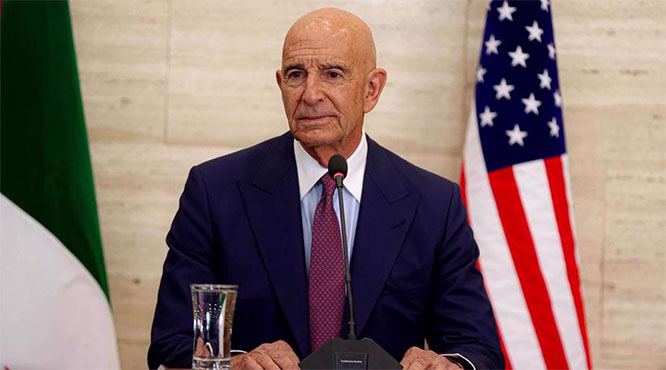
Since 1946, the United States has attempted 93 coups or “regime change” operations across the world — including two in Iran, US Special Envoy for Syria Tom Barrack has admitted.

Speaking to the UAE-based IMI Media Group, in remarks published by The National, Barrack said Washington tried twice to overthrow the Iranian government but failed both times. 

“For (Trump) then to be imputed with regime change — we had two regime changes in Iran already. Neither one worked. So I think wisely leave it to the region to solve,” said Barrack, who also serves as the US ambassador to Turkey.

His comments come six months after the US joined Israel in airstrikes against Iran during ongoing indirect nuclear negotiations between Tehran and Washington.

On June 13, Israel launched an attack on Iran that killed at least 1,064 people and hit civilian infrastructure. Days later, the United States targeted three nuclear facilities — Fordow, Natanz and Isfahan — in what Iran called a clear violation of international law. Iranian retaliation eventually forced a halt to the assault on June 24.

Barrack further claimed that US President Donald Trump and Foreign Secretary Marco Rubio are “not into regime change” and prefer a regional approach driven by Middle Eastern countries themselves. According to him, regional dialogue and non-interference by outside powers offer a more durable path forward.

He added that Washington is still open to an agreement with Tehran if Iranian authorities show “seriousness” and willingness to engage constructively.

However, Iran maintains the US has not shown readiness for meaningful talks. In an interview with Japan’s Kyodo News, Iranian Foreign Minister Abbas Araghchi said negotiations could advance only if Washington acknowledges Iran’s right to peaceful nuclear energy and lifts unilateral sanctions.

Comments

Add new comment

  • Coastaldigest.com reserves the right to delete or block any comments.
  • Coastaldigset.com is not responsible for its readers’ comments.
  • Comments that are abusive, incendiary or irrelevant are strictly prohibited.
  • Please use a genuine email ID and provide your name to avoid reject.