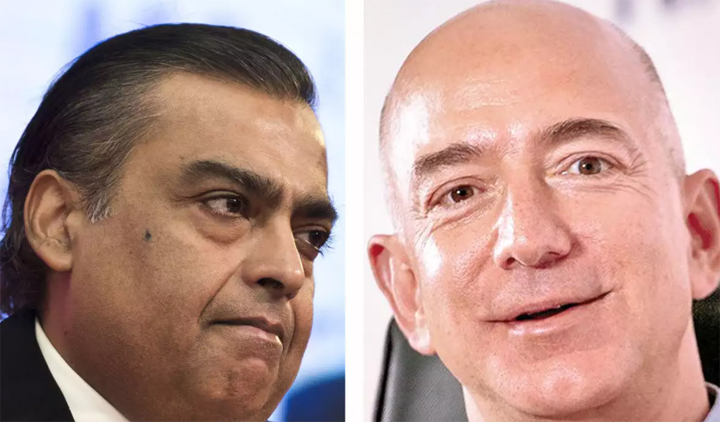
Mukesh Ambani vs Jeff Bezos: A fight or a waiting game?

News Network
November 3, 2020

JIOvsAMAZON.JPG

A vanilla commercial dispute is setting the stage for a clash between the world’s No. 1 and No. 6 richest men. But the legal wrangling is a sideshow. What Jeff Bezos and Mukesh Ambani are really fighting over is pole position in the only billion-plus-people consumer market available to both of them: India.

The ostensible battleground is a $3.4 billion deal Indian tycoon Ambani’s Reliance Industries Ltd. stitched up in August to acquire assets of debt-laden local retailer Future Group. Bezos’s Amazon.com Inc. is trying to block the transaction.

That, in itself, is a bit of a dampener. Expectations were building for the two billionaires to work together. In September, Bloomberg News reported that Ambani had given Amazon an option to buy as much as 40% of Reliance Retail Ventures Ltd., seeking to repeat the success he had earlier this year in bringing in Facebook Inc. and Alphabet Inc. as partners to his digital platform.

By seeking to stall Ambani’s purchase of Future, Bezos may be signaling that he would rather remain a rival. Or, that he’s buying time to sweeten the offer currently on the table.

The actual quarrel is only interesting when you read between the lines of the claims and counterclaims.

Amazon bought a 49% stake last year in a private firm controlled by Kishore Biyani, a pioneer of modern-format retailing in the country. The investment gave the U.S. e-commerce giant the right to acquire Biyani’s shares in the publicly traded Future Retail Ltd. from the third year. Another of Bezos’s conditions was that Biyani wouldn’t sell his assets — about 1,500 stores nationwide — to restricted persons, including Reliance, which operates India’s largest retail chain.

After the Future-Reliance deal was announced, Amazon alleged breach of contract and obtained an interim stay against the sale from an arbitrator in Singapore, a preferred neutral venue in Asia for settling disputes in cross-border agreements. The U.S. company then wrote a letter to Indian stock exchanges and the regulator, asking them to not approve the transaction.

Future Retail has challenged Amazon’s position by saying that the Singapore ruling has no legal basis in India, and that anyway, it wasn’t a party to the founder’s agreement. Given the debilitating impact of the Covid-19 pandemic on operations, the retailer says it’s doing the right thing by all stakeholders in selling assets to Reliance. As for Amazon’s claim of $193 million in damages plus interest, that liability, if awarded by the arbitrator, should fall on Biyani’s private firm that did the deal, Future Retail argues.

Biyani is just a pawn in a much bigger power play. Future's cash crunch didn't emerge suddenly. Amazon had ample opportunity to tiptoe around India’s legal restrictions on foreign ownership of retail chains to act as a white knight. But it didn’t.

Amazon may still be interested in partnering with Ambani — at the right price. Other investors, such as Silver Lake Partners and KKR & Co., have written him checks worth $5 billion in total. They may have feared losing out on what could become India’s most successful mix of physical and digital shopping, a strategy that leverages Reliance Retail’s own outlets together with independently owned neighbourhood stores connected to Ambani’s 4G phone network of 400 million users. However, the portion offered to Amazon would mean a $20 billion commitment. Bezos could afford to see how well Ambani executes his plan.

Amazon’s India website kicked off its annual festival season last month to record sales in the first couple of days. Reliance Retail’s revenue also jumped 30% in the September quarter from the previous three months. But although India’s nationwide lockdown has ended, not all stores have reopened fully. Footfall has yet to recover, especially in fashion and lifestyle and at stores inside malls. In Macquarie’s estimates, the next fiscal year’s earnings per share for Reliance Industries, the holding company, may be 23% below the consensus street forecast. A reason, the brokerage says, is stiff competition, high investment and low margins in retail. Reliance Industries shares fell 8.6% in Mumbai on Monday.

Amazon’s letter to the Securities and Exchange Board of India makes a reference to India’s “ease of doing business,” which has been a sore point with foreign investors from Vodafone Group Plc to Cairn Energy Plc. The regulator needs to hold listed firms accountable for their dealings, Amazon said in the letter, according to Reuters, which has seen a copy.

The last thing India wants is more of a bad rap. The Seattle-based firm already has to operate with one hand tied behind its back: As a foreign e-commerce player, it can’t own inventory or openly discount merchandise. Even harsher rules — covering data and algorithms — may be on their way. It’s important for regulators to not give Amazon the chance to paint a commercial feud as another sign of India’s unfair treatment of global investors.

In more ways than one, a waiting game by Bezos may not be a bad idea.

Comments

Add new comment

  • Coastaldigest.com reserves the right to delete or block any comments.
  • Coastaldigset.com is not responsible for its readers’ comments.
  • Comments that are abusive, incendiary or irrelevant are strictly prohibited.
  • Please use a genuine email ID and provide your name to avoid reject.
News Network
December 2,2025

Puttur: The long-cherished dream of a government medical college in Puttur has moved a decisive step closer to reality, with the Karnataka State Finance Department granting its official approval for the construction of a new 300-bed hospital.

Puttur MLA Ashok Kumar Rai announced the crucial development to reporters on Monday, confirming that the official communication from the finance department was issued on November 27. This 300-bed facility is intended to be the cornerstone for the establishment of the government medical college, a project announced in the state budget.

Fast-Track Implementation

The MLA outlined an aggressive timeline for the project:

•    A Detailed Project Report (DPR) for the hospital is expected to be ready within 45 days.

•    The tender process for the construction will be completed within two months.

Following the completion of the tender process, Chief Minister Siddaramaiah is scheduled to lay the foundation stone for the project.

"Setting up a medical college in Puttur is a historical decision by the Congress government in Karnataka," Rai stated. The project has an estimated budget allocation of Rs 1,000 crore for the medical college.

Focus on Medical Education Department

The MLA highlighted a key strategic move: requesting the government to implement the hospital construction through the Medical Education Department instead of the Health and Family Welfare Department. This is intended to streamline the entire process of establishing the full medical college, ensuring the facilities—including labs, operation theatres, and other necessary infrastructure—adhere to the strict guidelines set by the Medical Council of India (MCI). The proposed site for the project is in Bannur.

Rai also took the opportunity to address political criticism, stating that the government has fulfilled its promise despite "apprehensions" and "mocking and criticising" from opposition parties who had failed to take similar initiatives when they were in power. "Chief Minister Siddaramaiah has kept his word," he added.

Comments

Add new comment

  • Coastaldigest.com reserves the right to delete or block any comments.
  • Coastaldigset.com is not responsible for its readers’ comments.
  • Comments that are abusive, incendiary or irrelevant are strictly prohibited.
  • Please use a genuine email ID and provide your name to avoid reject.
News Network
December 4,2025

indigoflight.jpg

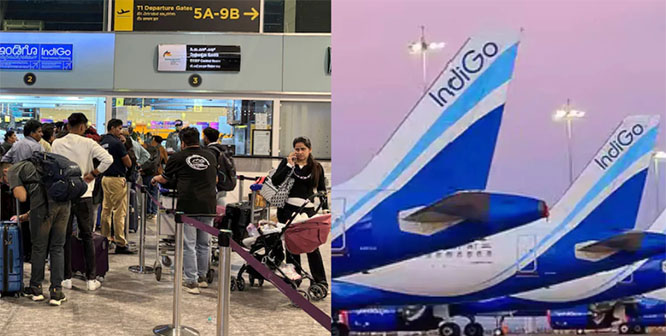
Domestic carrier IndiGo has cancelled over 180 flights from three major airports — Mumbai, Delhi and Bengaluru — on Thursday, December 4, as the airline struggles to secure the required crew to operate its flights in the wake of new flight-duty and rest-period norms for pilots.

While the number of cancellations at Mumbai airport stands at 86 (41 arrivals and 45 departures) for the day, at Bengaluru, 73 flights have been cancelled, including 41 arrivals, according to a PTI report that quoted sources.

"IndiGo cancelled over 180 flights on Thursday at three airports-Mumbai, Delhi and Bengaluru," the source told the news agency.

Besides, it had cancelled as many as 33 flights at Delhi airport for Thursday, the source said, adding, "The number of cancellations is expected to be higher by the end of the day."

The Gurugram-based airline's On-Time Performance (OTP) nosedived to 19.7 per cent at six key airports — Delhi, Mumbai, Chennai, Kolkata, Bengaluru and Hyderabad — on December 3, as it struggled to get the required crew to operate its services, down from almost half of December 2, when it was 35 per cent.

"IndiGo has been facing acute crew shortage since the implementation of the second phase of the FDTL (Flight Duty Time Limitations) norms, leading to cancellations and huge delays in its operations across the airports," a source had told PTI on Wednesday.

Chaos continued at several major airports for the third day on Thursday because of the cancellations.

A spokesperson for the Kempegowda International Airport (KIA) in Bengaluru said that 73 IndiGo flights had been cancelled on Thursday.

At least 150 flights were cancelled and dozens of others delayed on Wednesday, airport sources said, leaving thousands of travellers stranded, according to news agency Reuters.

The Directorate General of Civil Aviation (DGCA) has said it is investigating IndiGo flight disruptions and has asked the airline to submit the reasons for the current situation, as well as its plans to reduce flight cancellations and delays.

It may be mentioned here that the pilots' body, Federation of Indian Pilots (FIP), has alleged that IndiGo, despite getting a two-year preparatory window before the full implementation of new flight duty and rest period norms for cockpit crew, "inexplicably" adopted a "hiring freeze".

The FIP said it has urged the safety regulator, the DGCA, not to approve airlines' seasonal flight schedules unless they have adequate staff to operate their services "safely and reliably" in accordance with the New Flight Duty Time Limitations (FDTL) norms.

In a letter to the DGCA late on Wednesday, the FIP urged the DGCA to consider re-evaluating and reallocating slots to other airlines, which have the capacity to operate them without disruption during the peak holiday and fog season if IndiGo continues to "fail in delivering on its commitments to passengers due to its own avoidable staffing shortages."

Comments

Add new comment

  • Coastaldigest.com reserves the right to delete or block any comments.
  • Coastaldigset.com is not responsible for its readers’ comments.
  • Comments that are abusive, incendiary or irrelevant are strictly prohibited.
  • Please use a genuine email ID and provide your name to avoid reject.
News Network
December 3,2025

indigo.jpg

IndiGo, India’s largest airline, is battling one of its worst operational disruptions in recent years, with hundreds of delays and cancellations throwing domestic travel into chaos.

Government data on Tuesday showed its on-time performance plunging to 35%, an unusual dip for a carrier long associated with punctuality.

By Wednesday afternoon, airports in Delhi, Mumbai, Bengaluru and Hyderabad had collectively reported close to 200 cancellations, stranding travellers across the country.

Crew Shortage After New Duty Norms

A major trigger behind the meltdown is a severe crew shortage, especially among pilots, following the rollout of revised Flight Duty Time Limitation (FDTL) norms last month.

The rules mandate longer rest hours and more humane rosters — a shift IndiGo has struggled to incorporate across its vast network.

Sources said several flights were grounded due to lack of cabin crew, while some delays stretched upwards of eight hours.

With IndiGo controlling over 60% of India’s domestic aviation market, the ripple effect has impacted airports nationwide.

IndiGo Issues Apology, Lists “Compounding Factors”

In a statement, IndiGo acknowledged the large-scale disruption:

“We sincerely apologise to customers. A series of unforeseen operational challenges — technology glitches, winter schedule changes, adverse weather, system congestion and updated FDTL norms — created a compounding impact that could not have been anticipated.”

To stabilise operations, the airline has begun calibrated schedule adjustments for the next 48 hours, aiming to restore punctuality. Affected passengers are being offered refunds or alternate travel arrangements, IndiGo said.

What the FDTL Rules Require

The FDTL norms, designed to reduce pilot fatigue, cap duty and flying hours as follows:
•    Maximum 8 hours of flying per day
•    35 hours per week
•    125 hours per month
•    1,000 hours per year

Crew must also receive rest equalling twice the flight duration, with a minimum 10-hour rest period in any 24-hour window.

The DGCA introduced these limits to enhance flight safety.

Hyderabad: 33 Flights Cancelled, Long Queues Reported

Hyderabad’s Rajiv Gandhi International Airport saw heavy early-morning crowds as 33 IndiGo flights (arrivals and departures) were cancelled.

The airport clarified on X that operations were normal, advising passengers to contact IndiGo directly for latest flight status.

Cancellations included flights to and from Visakhapatnam, Goa, Ahmedabad, Delhi, Bengaluru, Chennai, Madurai, Hubli, Bhopal and Bhubaneswar.

Bengaluru: 42 Flights Disrupted

Bengaluru’s Kempegowda International Airport recorded 42 cancellations — 22 arrivals and 20 departures — affecting routes to Delhi, Mumbai, Chennai, Hyderabad, Goa, Kolkata and Lucknow.

Passengers Vent on Social Media

Irate travellers took to X to share their experiences. One passenger stranded in Hyderabad wrote: “I have been here since 3 a.m. and missed an important meeting.”

Another said: “My flight was pushed from 1:55 PM to 2:55 PM and now 4:35 PM. I was informed only three minutes before entering the airport.”

Delhi Airport Hit by Tech Glitch

At Delhi Airport, the disruption deepened due to a slowdown in the Amadeus system — used for reservations, check-ins and departure control.

The technical issue led to longer queues and sluggish processing, adding to delays already worsened by staff shortages.

Comments

Add new comment

  • Coastaldigest.com reserves the right to delete or block any comments.
  • Coastaldigset.com is not responsible for its readers’ comments.
  • Comments that are abusive, incendiary or irrelevant are strictly prohibited.
  • Please use a genuine email ID and provide your name to avoid reject.