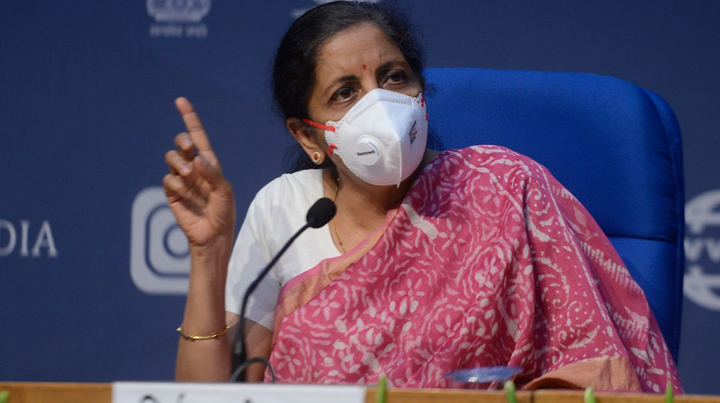
Nirmala Sitharaman says covid-19 an 'act of god’, may result in contraction of economy

News Network
August 27, 2020
Image
Nirmala Sitharaman

New Delhi, Aug 27: Amid a chorus by non-NDA ruled states for compensation of GST revenue shortfall, the Centre on Thursday presented two options to states under which they can borrow from the market to make up for the estimated deficit of Rs 2.35 lakh crore this fiscal.

At the end of a five-hour long meeting of the GST Council, Finance Minister Nirmala Sitharaman said there was no proposal to raise tax rates to make up for the shortfall that has been compounded by the COVID-19 pandemic.

Citing a legal opinion from the Attorney General, she ruled out the Centre making good the shortfall from either its coffers or borrowing against its balance sheet.

The deficit can be made good by states borrowing using a special window, she said, adding this loan can be repaid after five years from the collection of GST cess.

If states agree to either of the options, it would effectively mean that cess would continue beyond five years of the GST rollout.

In 2017, all states agreed to subsume their local taxes such as VAT into the new, nationwide Goods and Services Tax (GST) in return for the Centre promising to make good any loss of revenue in the first five years.

But with the economy slowing down, Rs 70,000 crore shortfall was seen in the last fiscal and this year it is estimated to widen to Rs 2.35 lakh crore.

Revenue Secretary Ajay Bhushan Pandey said out of this amount, only about Rs 97,000 crore is attributable to the implementation of GST, while the rest in on account of the coronavirus pandemic hitting the economy.

Pandey, who is also the finance secretary, said while GST collections have been impacted by the pandemic this year, there was a shortfall of Rs 70,000 crore in 2019-20 (April 2019 to March 2020) which was made good from the surplus of previous two years.

When GST was implemented in 2017, the Centre had promised to compensate states for any revenue loss for five years from a pool created by levying cess over and above the GST on luxury and sin goods.

This cess pool generated a surplus in the first two years but witnessed a deficit in FY20 as well as the current fiscal.

Detailing the options presented to the states, Sitharaman said the Centre, in consultation with the RBI, will provide a special window to states to borrow Rs 97,000 crore at a reasonable rate of interest. This money can be repaid after five years from the collection of cess.

The other option is that the states borrow the entire GST compensation gap of Rs 2,35,000 crore through the special window.

The states have seven working days to decide which option they want, she added.

Sitharaman said “the interest from borrowing would be repaid from the cess collected in the years beyond the first five years of GST implementation.”

“There will be no additional burden on the states,” she said, adding the states have been asked to borrow through the RBI to ensure they do not rush for the borrowing and there is no hardening of bond yields.

The minister said the GST Council decided that the borrowing arrangement would be for the current fiscal and a review would be done at the beginning of the next financial year.

“We very clearly said in both the options... that we shall facilitate talking to the Reserve Bank and getting it at a G-Sec proportionate number of years linked rate for all the states so that each state does not have to go running for the loan and face different situations and in the process the bond yields (turn) higher.

“So we said we will facilitate it, but the borrowing can be done in the name of the states and all states roughly can get the same rate of interest,” Sitharaman said.

A detailed note on the two options would be shared with the states and they would give their views on it in seven working days.

The minister said as soon as an arrangement is agreed upon by the GST Council, the Centre will clear the pending bi-monthly compensation. The compensation amount due for April-July period stands at Rs 1.50 lakh crore.

“This year we are facing an extraordinary situation... we are facing an act of God which might even result in a contraction of the economy, to what percent I am not getting into that.

“Therefore, we said that portion (of compensation) which strictly is hardwired in the (GST) Act, we will arrange, give it to you...,” Sitharaman said.

She said both the options hinge upon the fact that borrowing will be done by the states.

“We explained why it would be preferable for the states to borrow and not the Centre and also we said if states are going to borrow, instead of crowding out people, we will facilitate the process through central bank,” she said.

The Centre had released over Rs 1.65 lakh crore in 2019-20 as GST compensation. However, the amount of cess collected during 2019-20 was Rs 95,444 crore. The balance of about Rs 70,000 crore was paid from the excess cess collected in 2017-18 and 2018-19.

The compensation payout amount was Rs 69,275 crore in 2018-19 and Rs 41,146 crore in 2017-18.

Comments

Add new comment

  • Coastaldigest.com reserves the right to delete or block any comments.
  • Coastaldigset.com is not responsible for its readers’ comments.
  • Comments that are abusive, incendiary or irrelevant are strictly prohibited.
  • Please use a genuine email ID and provide your name to avoid reject.
News Network
December 2,2025

A major upgrade in safety and monitoring is planned for Haj 2026, with every Indian pilgrim set to receive a Haj Suvidha smart wristband linked to the official Haj Suvidha mobile app. The initiative aims to support pilgrims—especially senior citizens—who may struggle with smartphones during the 45-day journey.

What the Smart Wristband Will Do

Officials said the device will come with:
•    Location tracking
•    Pedometer
•    SOS emergency button
•    Qibla compass
•    Prayer timings
•    Basic health monitoring

SP Tiwari, secretary of the UP State Haj Committee, said the goal is to make the pilgrimage safer and more comfortable.

“Most Hajis are elderly and not comfortable with mobile apps,” he said. “The smartwatch will help locate pilgrims who forget their way or cannot communicate their location.”

The wristbands will be monitored by the Consulate General of India in Saudi Arabia, similar to mobile tracking via the Haj Suvidha App.

Free Distribution and Training

•    Smart wristbands will be given free of cost.
•    Training for pilgrims will be conducted between January and February 2026.
•    Sample units will reach state Haj committees soon.
•    Final devices will be distributed as pilgrims begin their journey.

New Rules for Accommodation

Two major decisions have also been finalised for Haj 2026:
1.    Separate rooms for men and women – including married couples. They may stay on the same floor but must occupy different rooms, following stricter Saudi guidelines.
2.    Cooking banned – gas cylinders will not be allowed; all meals will be provided through official catering services arranged by the Haj Committee of India.

These decisions were finalised during a meeting of the Haj Committee of India and state representatives in Mumbai.

Haj Suvidha App Launched Earlier

The government launched the Haj Suvidha App in 2024, offering:

•    Training modules
•    Accommodation and flight details
•    Baggage information
•    SOS and translation tools
•    Grievance redressal

Haj 2026 Quota and Key States

•    India’s total Haj quota for 2026: 1,75,025 pilgrims
•    70% (1,25,000) allotted to the Haj Committee of India
•    30% (around 50,000) reserved for Haj Group Organisers

Uttar Pradesh has the largest allocation (around 30,000 seats), though approximately 18,000 pilgrims are expected to go this year. States with high pilgrim numbers include Kerala, Maharashtra and Gujarat.

Dates of Haj 2026

The pilgrimage is scheduled to take place from 24 May to 29 May, 2026 (tentative).
Haj is one of the five pillars of Islam and is mandatory for Muslims who meet the required conditions.

Comments

Add new comment

  • Coastaldigest.com reserves the right to delete or block any comments.
  • Coastaldigset.com is not responsible for its readers’ comments.
  • Comments that are abusive, incendiary or irrelevant are strictly prohibited.
  • Please use a genuine email ID and provide your name to avoid reject.
News Network
November 30,2025

The United Nations Committee against Torture (CAT) has condemned the Israeli regime for enforcing a policy of “organized torture” against Palestinians.

In a report published on Friday, CAT stated that the occupying regime enforces a deliberate policy of “organized and widespread torture and ill-treatment” against Palestinian abductees, particularly since October 7, 2023, when Israel launched its genocidal war on Gaza.

The committee expressed “deep concern over repeated severe beatings, dog attacks, electrocution, water-boarding, use of prolonged stress positions [and] sexual violence” inflicted on Palestinians.

Palestinian prisoners were degraded by “being made to act like animals or being urinated on,” systematically denied medical care, and subjected to excessive restraints, “in some cases resulting in amputation,” the report added.

CAT also condemned the routine application of “unlawful combatants law” to justify the prolonged detention without trial of thousands of Palestinian men, women, and children.

More than 10,000 Palestinians, including women and children, are currently held in Israeli prisons, according to Palestinian and international human rights groups, with 3,474 Palestinians in “administrative detention,” meaning they are imprisoned without trial for indefinite periods.

The report highlighted the “high proportion of children who are currently detained without charge or on remand,” noting that while Israel sets the age of criminal responsibility at 12, even younger children have been abducted.

Children designated as security prisoners face severe restrictions on family contact, may be subjected to solitary confinement, and are denied access to education, in clear violation of international law.

The committee further suggested that Israel’s policies across the Occupied Territories constitute collective torture against the Palestinian population.

“A range of policies adopted by Israel in the course of its continued unlawful presence in the Occupied Palestinian Territory amounts to cruel, inhuman or degrading living conditions for the Palestinian population,” the report said.

On Thursday, the Palestinian resistance movement Hamas condemned the systematic killing and torture of Palestinian abductees in Israeli prisons, urging international action to halt these abuses.

Citing human rights data, Hamas stated that 94 Palestinians have been killed in Israeli prisons since the start of Tel Aviv’s genocidal war on Gaza.

“This reflects an organized criminal approach that has turned these prisons into direct killing grounds to eliminate our people,” the resistance movement said.

Hamas called on the international community, the UN, and human rights organizations to immediately pressure Israel to end crimes against prisoners and uphold their rights as guaranteed by all international conventions and norms.

Comments

Add new comment

  • Coastaldigest.com reserves the right to delete or block any comments.
  • Coastaldigset.com is not responsible for its readers’ comments.
  • Comments that are abusive, incendiary or irrelevant are strictly prohibited.
  • Please use a genuine email ID and provide your name to avoid reject.
News Network
December 3,2025

indigo.jpg

IndiGo, India’s largest airline, is battling one of its worst operational disruptions in recent years, with hundreds of delays and cancellations throwing domestic travel into chaos.

Government data on Tuesday showed its on-time performance plunging to 35%, an unusual dip for a carrier long associated with punctuality.

By Wednesday afternoon, airports in Delhi, Mumbai, Bengaluru and Hyderabad had collectively reported close to 200 cancellations, stranding travellers across the country.

Crew Shortage After New Duty Norms

A major trigger behind the meltdown is a severe crew shortage, especially among pilots, following the rollout of revised Flight Duty Time Limitation (FDTL) norms last month.

The rules mandate longer rest hours and more humane rosters — a shift IndiGo has struggled to incorporate across its vast network.

Sources said several flights were grounded due to lack of cabin crew, while some delays stretched upwards of eight hours.

With IndiGo controlling over 60% of India’s domestic aviation market, the ripple effect has impacted airports nationwide.

IndiGo Issues Apology, Lists “Compounding Factors”

In a statement, IndiGo acknowledged the large-scale disruption:

“We sincerely apologise to customers. A series of unforeseen operational challenges — technology glitches, winter schedule changes, adverse weather, system congestion and updated FDTL norms — created a compounding impact that could not have been anticipated.”

To stabilise operations, the airline has begun calibrated schedule adjustments for the next 48 hours, aiming to restore punctuality. Affected passengers are being offered refunds or alternate travel arrangements, IndiGo said.

What the FDTL Rules Require

The FDTL norms, designed to reduce pilot fatigue, cap duty and flying hours as follows:
•    Maximum 8 hours of flying per day
•    35 hours per week
•    125 hours per month
•    1,000 hours per year

Crew must also receive rest equalling twice the flight duration, with a minimum 10-hour rest period in any 24-hour window.

The DGCA introduced these limits to enhance flight safety.

Hyderabad: 33 Flights Cancelled, Long Queues Reported

Hyderabad’s Rajiv Gandhi International Airport saw heavy early-morning crowds as 33 IndiGo flights (arrivals and departures) were cancelled.

The airport clarified on X that operations were normal, advising passengers to contact IndiGo directly for latest flight status.

Cancellations included flights to and from Visakhapatnam, Goa, Ahmedabad, Delhi, Bengaluru, Chennai, Madurai, Hubli, Bhopal and Bhubaneswar.

Bengaluru: 42 Flights Disrupted

Bengaluru’s Kempegowda International Airport recorded 42 cancellations — 22 arrivals and 20 departures — affecting routes to Delhi, Mumbai, Chennai, Hyderabad, Goa, Kolkata and Lucknow.

Passengers Vent on Social Media

Irate travellers took to X to share their experiences. One passenger stranded in Hyderabad wrote: “I have been here since 3 a.m. and missed an important meeting.”

Another said: “My flight was pushed from 1:55 PM to 2:55 PM and now 4:35 PM. I was informed only three minutes before entering the airport.”

Delhi Airport Hit by Tech Glitch

At Delhi Airport, the disruption deepened due to a slowdown in the Amadeus system — used for reservations, check-ins and departure control.

The technical issue led to longer queues and sluggish processing, adding to delays already worsened by staff shortages.

Comments

Add new comment

  • Coastaldigest.com reserves the right to delete or block any comments.
  • Coastaldigset.com is not responsible for its readers’ comments.
  • Comments that are abusive, incendiary or irrelevant are strictly prohibited.
  • Please use a genuine email ID and provide your name to avoid reject.