



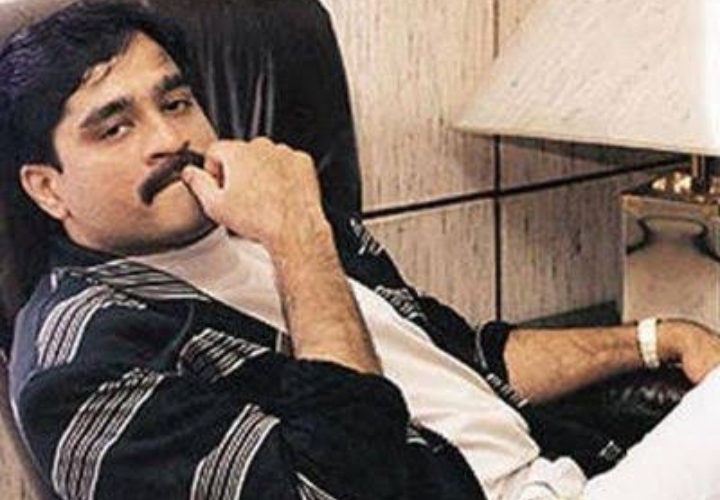
Islamabad, Aug 23: Pakistan has for the first time acknowledged the presence of Dawood Ibrahim on its soil after the government imposed sweeping sanctions on 88 banned terror groups and their leaders which also included the name of the underworld don wanted by India.
There was no official confirmation on Pakistan government including Ibrahim's name in the list of terror groups and its leaders on whom fresh restrictions have been imposed. But if Pakistani media reports are true, this could be the first time Islamabad has acknowledged the presence of Ibrahim on its soil.
Seeking to wriggle out of the FATF's grey list, Pakistan on Friday imposed tough financial sanctions on 88 banned terror groups and their leaders, including Hafiz Saeed, Masood Azhar and Ibrahim, by ordering the seizure of all of their properties and freezing of bank accounts, Pakistani newspaper 'The News' reported on Saturday.
Ibrahim, who heads a vast and multifaceted illegal business, has emerged as India's most wanted terrorist after the 1993 Mumbai bombings.
It is for the first time that Pakistan has admitted the presence of the underworld don in the country.
In 2003, the US declared Ibrahim as a Specially Designated Global Terrorist.
India has repeatedly asked the Government of Pakistan to hand over Ibrahim to India so that he can be prosecuted for the crimes committed by him. It is reported that Ibrahim is based in the southern port city of Karachi.
The Paris-based Financial Action Task Force (FATF) put Pakistan on the grey list in June 2018 and asked Islamabad to implement a plan of action by the end of 2019, but the deadline was extended later due to Covid-19 pandemic.
The government issued two notifications on August 18 announcing sanctions on key figures of terror outfits such as 26/11 Mumbai attack mastermind and Jamaat-ud-Dawa (JuD) chief Saeed, Jaish-e-Mohammed (JeM) chief Azhar, and underworld don Ibrahim.
The Pakistan government has proscribed 88 leaders and members of terrorist groups, in compliance with the new list issued by the United Nations Security Council (UNSC) recently, The News reported.
The notifications announced sanctions on key figures of terror outfits such as the Jamaat-ud-Dawa (JuD), JeM, Taliban, Daesh, Haqqani Group, al-Qaeda, and others.
The government ordered the seizure of all movable and immovable properties of these outfits and individuals, and freezing of their bank accounts, the report said.
These terrorists have been barred from transferring money through financial institutions, purchasing of arms and travelling abroad, it said.
The notifications ratified a complete ban on all leaders and members of defunct Tehreek-e-Taliban Pakistan (TTP) hiding in the Pakistan-Afghanistan border areas.
The paper reported that Saeed, Azhar, Mullah Fazlullah (alias Mullah Radio), Zakiur Rehman Lakhvi, Muhammad Yahya Mujahid, Abdul Hakeem Murad, wanted by Interpol, Noor Wali Mehsud, Fazal Raheem Shah of Uzbekistan Liberation Movement, Taliban leaders Jalaluddin Haqqani, Khalil Ahmad Haqqani, Yahya Haqqani, and Ibrahim and his associates were on the list.
The notifications said that leadership of the defunct TTP, and other organisations including Lashkar-e-Taiba, JeM, Lashkar-e-Jhangvi, Tariq Geedar group of TTP, Harkatul Mujahideen, Al Rasheed Trust, Al Akhtar Trust, Tanzim Jaish-al Mohajireen Ansar, Jamaat-ul Ahrar, Tanzim Khutba Imam Bukhari, Rabita Trust Lahore, Revival of Islamic Heritage Society of Pakistan, Al-Haramain Foundation Islamabad, Harkat Jihad Al Islami, Islami Jihad Group, Uzbekistan Islami Tehreek, Daesh of Iraq, Emirates of Tanzim Qafqaz working against Russia, and Abdul Haq of Uyghurs of Islamic Freedom Movement of China have been banned.
Though various sanctions were in place against almost all of those listed by the UNSC, the government through the new notifications consolidated and documented the previously announced measures, the report said.
The UNSC Sanctions Committee deals with sanctions on entities and individuals declared as terrorists. All states, including Pakistan, are bound to implement the sanctions which include assets freeze, an arms embargo, and travel ban.
It is believed that the latest move by the Pakistan government is part of its efforts to wriggle out of the grey list of the global money laundering and terrorist financing watchdog FATF.
On August 12, Pakistan Parliament's lower house passed four bills related to the tough conditions set by the FATF after the government and the Opposition reached a consensus.
The legislation was part of the efforts by Pakistan to move from the FATF's grey list to the white list.
In its third and final plenary held virtually due to the Covid-19 pandemic in June, the FATF decided to keep Pakistan in the "grey list" as Islamabad failed to check the flow of money to terror groups like Lashkar-e-Taiba (LeT) and Jaish-e-Mohammed (JeM). The plenary was held under the Chinese Presidency of Xiangmin Liu.
With Pakistan's continuation in the 'grey list', it will be difficult for the country to get financial aid from the IMF, World Bank, ADB, and the European Union, thus further enhancing problems for the nation which is in a precarious financial situation.
If Pakistan fails to comply with the FATF directive by October, there is every possibility that the global body may put the country in the 'Black List' along with North Korea and Iran.
The FATF is an inter-governmental body established in 1989 to combat money laundering, terrorist financing, and other related threats to the integrity of the international financial system.
The FATF currently has 39 members including two regional organisations - the European Commission and Gulf Cooperation Council.


Comments
Add new comment