PM Modi's plan to make a Singapore in Gujarat falls flat

Agencies
February 21, 2021

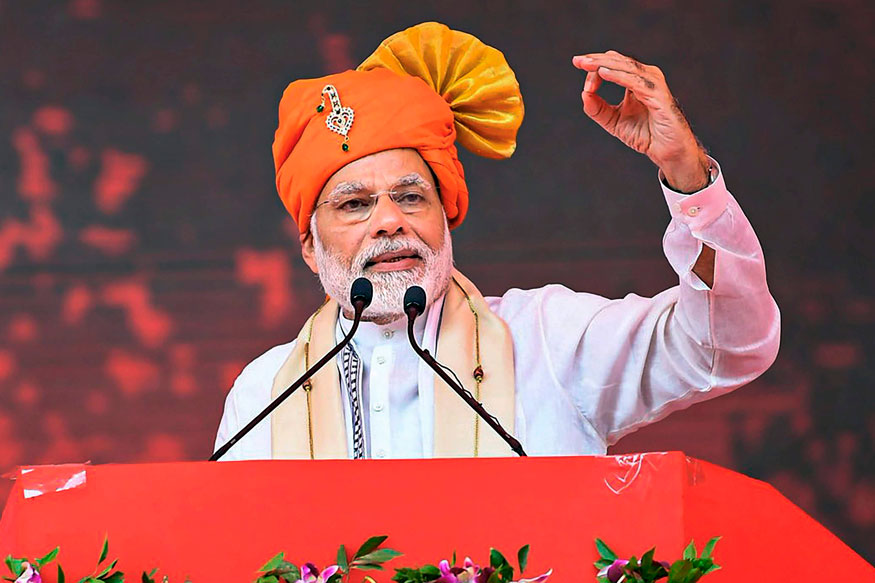
Image result for PM Narendra Modi

When Singapore set up an international financial hub in the late 1960s, the city-state was thinking both fast and slow — seizing an immediate opportunity and opening a path to long-term economic development. Half a century later, India is attempting something similar in Prime Minister Narendra Modi’s home state of Gujarat. But without much thought going into what exactly it’s building, for whom and for what purpose, all it may get is a casino for the local rich. 

For Singapore, the British pound’s 1967 devaluation was the moment of reckoning. For one thing, it raised the profile of Dick van Oenen, a Dutch trader who had made a “significant windfall” for both his employer — Bank of America — and for the newly independent city-state from that abrupt 14% change. But beyond the immediate cash, Singapore saw a broader canvas.

The pound’s tumble had made countries in the Sterling Area, mostly former British colonies, painfully aware that the sun had finally set on the empire’s currency: They needed to switch to the dollar to lend and borrow. The kind of rapid growth East Asia then imagined for itself could be more easily financed by inviting the rich overseas Chinese in Hong Kong, Taiwan, Manila and Jakarta to deposit their funds in dollars. Many of them had become extremely wealthy on assured cash flows from post-colonial monopolies and cartels in everything from gaming and racetrack-betting to flour-making and coconut-milling. 

Channelling these regional savings into local investments and diversifying the Singapore economy was the longer-term impetus for starting a dollar-denominated banking hub, according to Oxford University historian Catherine Schenk. Bank of America’s local branch was the first to get permission to open a separate set of books purely for international business.

India embarked on the project in 2007 with the ambitious goal of turning Mumbai, the country’s domestic financial capital, into an international hub after making the rupee fully convertible “by no later than the end of calendar 2008.” However, after a 14-year interlude that encompassed both the 2008 subprime crisis and a pandemic, there’s little enthusiasm left for financial globalization. Even trade liberalization, which looked irreversible in 2007, is being undermined by a misguided yearning for self-sufficiency. The venture was yanked away from Mumbai and taken to a patch of wilderness in Gujarat. Somewhere along the way, the original purpose was also lost.

All new stores need their early patrons. Had India pursued Singapore’s strategy, it would have begun by targeting nonresident Indians to keep some of their wealth with their banks’ branches in the Gujarat International Finance Tec-City — more popularly known as Gift City — luring them with simple products not available commercially in global markets, such as dollar-denominated sovereign Indian bonds. Corporate issuers would have followed. But banks are run by bankers, who need good schools and better pubs. Three high-rise buildings situated 10 kilometers (6.2 miles) from Gandhinagar — the capital of a state where alcohol is prohibited — offer neither.

Since a bank-led approach wasn’t feasible, minders of Modi’s favourite project turned toward capital markets, in the hope that with sufficient inducement brokers would book trades in Gift City without having to set foot there. As a result, the joyless place has spent years trying to become a marketplace for foreign currency-denominated contracts, hoping to capture some of the financial intermediation that now takes place in London, Singapore, Hong Kong or Dubai, but where the ultimate risk resides in India.

The Gujarat market offers a slew of tax breaks, but has very little customer liquidity. India’s two domestic exchanges — the National Stock Exchange of India Ltd. and BSE Ltd. — are providing costly incentives to intermediaries to trade with one another there. At least 85%-90% of trades at Gift exchanges are proprietary trades, the news website Morning Context recently reported.

Hedge funds aren’t coming. Everything they want for risk mitigation or speculation is available within a one-mile radius in Singapore. To arm-twist investors to come, India’s No. 1 stock exchange even picked a hissy fight with its long-term partner, the Singapore Exchange Ltd. The conflict has since died down, and there’s an agreement on setting up a pipe connecting NSE in Gift City with SGX after ensuring “member readiness.” Meanwhile, the city-state is still trading derivatives linked to Indian indexes and stocks with gusto.

Now comes another strategic wrong turn. Just last week, the central bank allowed resident individuals to open foreign-currency accounts in Gift City to invest in securities issued by overseas firms. This isn’t a step toward the original goal of capital-account convertibility. India already permits all adults and minors an annual $250,000 quota for overseas remittances. Worse, if the money placed in Gift isn’t invested in 15 days, it returns home to a rupee account. Loose change of retail Indian cash parked temporarily in Gujarat is hardly going to entice a pedigreed global issuer to hawk equities or bonds there.

So who’s this for? Gift allows brokers to pool foreign customers’ money under omnibus accounts. Investors don’t need to register, only the brokers need to be satisfied that they’re legitimate. Even the US Securities and Exchange Commission recently ticked off broker-dealers for not doing enough due diligence on omnibus-account customers to prevent money laundering. The project’s regulator, which isn’t even one year old yet, will have to be on a serious watch against  “round-tripping,” or local money escaping to evade taxes and then reentering as overseas investment.

Another plan is to bring trading in non-deliverable forwards — bets on the rupee that aren’t constrained by India’s capital controls because they’re settled in dollars — to Gift by luring overseas investors with tax breaks. This, too, puts the cart before the horse. Among emerging-market NDFs, rupee contracts are the second-most-popular after the South Korean won, with a 19% share of the $250 billion-a-day market, according to a 2019 Bank for International Settlements survey.

The price signals these offshore derivatives emit tend to become a headache for a central bank trying to manage a controlled home currency in times of balance-of-payment stress, like during the 2013 taper tantrum. Rather than wanting these potentially destabilizing flows to come closer home, India ought to be deepening the onshore rupee market in Mumbai instead. It should also be paying more attention to interest-rate derivatives, like Mexico and South Africa have.

In hosting an international financial center, Singapore stole a march over rival Hong Kong, where the bankers were initially against more competition. But it wasn’t tall buildings that made the experiment a success. A freely convertible currency, pragmatic regulation, a stable tax regime, rule of law and speedy dispute resolution played a huge role. (Good schools and pubs helped, too.)

Opening up after the pandemic, the Indian economy is awash in central bank-sponsored liquidity. What it lacks is capital, and the preconditions to establish a truly international financial center. Gujarat was never the right place to build a global mart. Bereft of any economic logic, Gift may only appeal to the local wealthy shopping for a bit of tax-free dollar riches.

Comments

Add new comment

  • Coastaldigest.com reserves the right to delete or block any comments.
  • Coastaldigset.com is not responsible for its readers’ comments.
  • Comments that are abusive, incendiary or irrelevant are strictly prohibited.
  • Please use a genuine email ID and provide your name to avoid reject.
News Network
November 28,2025

ministerPM.jpg

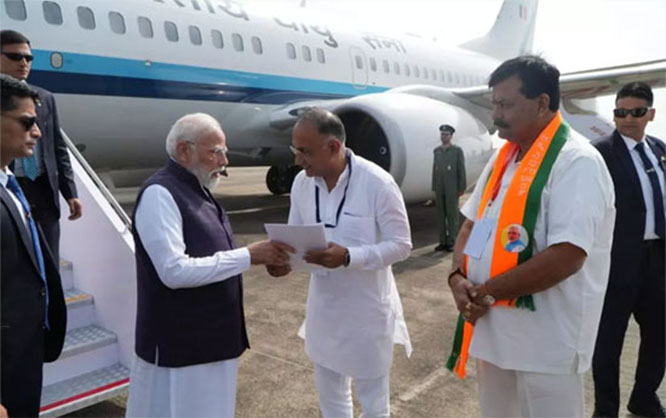
Mangaluru, Nov 28: Karnataka Health Minister and Dakshina Kannada district in-charge minister Dinesh Gundu Rao on Friday handed over Chief Minister Siddaramaiah’s letter to Prime Minister Narendra Modi, highlighting the severe distress faced by farmers due to crashing crop prices.

PM Modi arrived at the Mangaluru International Airport en route to Udupi, where Gundu Rao welcomed him and submitted the letter. The chief minister’s message stressed that farmers are suffering heavy losses because maize and green gram are being bought far below the Minimum Support Price (MSP). The state urged the Centre to immediately begin procurement at MSP.

According to the letter, Karnataka has a bumper harvest this year—over 54.74 lakh metric tons of maize and 1.98 lakh metric tons of green gram—yet farmers are unable to secure fair prices. Against the MSP of ₹2,400/MT for maize and ₹8,768/MT for green gram, market rates have plunged to ₹1,600–₹1,800 and ₹5,400 respectively.

The chief minister has requested the Centre to:

• Direct NAFED, FCI and NCCF to start MSP procurement immediately.
• Ensure ethanol units purchase maize directly from farmers or FPOs.
• Increase Karnataka’s ethanol allocation, citing high production capacity.
• Stop maize imports, which have depressed domestic prices.
• Relax quality norms for green gram, allowing up to 10% discoloration due to rains.

The letter stresses that MSP is crucial for farmer dignity and income stability and calls for swift central intervention to prevent a deepening crisis.

Comments

Add new comment

  • Coastaldigest.com reserves the right to delete or block any comments.
  • Coastaldigset.com is not responsible for its readers’ comments.
  • Comments that are abusive, incendiary or irrelevant are strictly prohibited.
  • Please use a genuine email ID and provide your name to avoid reject.
News Network
November 29,2025

DKSsiddu.jpg

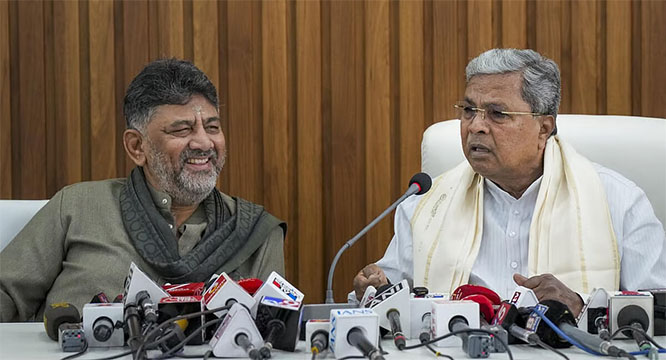
New Delhi: Karnataka chief minister Siddaramaiah and deputy CM DK Shivakumar on Saturday put up a dramatic display of unity at a closely watched joint press briefing, firmly dismissing weeks of speculation about a power-sharing tussle within the Congress. With the high command nudging both leaders to sit together and settle the dust, the meeting became a political spectacle, ending with the duo declaring that there was “no confusion, no differences.”

Calling the reports of a rift “manufactured confusion,” Siddaramaiah said the talks had gone smoothly, even joking about their breakfast. “Breakfast was very good. All three of us enjoyed it,” he said. “We want to end this confusion once and for all. For local elections and for 2028, our mission is clear — Congress must return to power. There is no difference between me and DKS, not now, not before.”

He blamed the media for fuelling rumours and reiterated absolute adherence to the party leadership. “From tomorrow, let there be no confusion. What the high command says, we will follow.”

Siddaramaiah also assured that the Assembly session starting December 8 would run smoothly and vowed that Congress would take on the BJP and JD(S) “together.”

Shivakumar echoed the chief minister word for word, stressing loyalty and discipline. “People have given us a massive mandate. It is our duty to deliver,” he said. “This government was formed under Siddaramaiah’s leadership. We both have complete trust in the high command. If they tell me to wait, I will wait.”

He added that the two leaders had discussed strategy for the 2028 Assembly elections. “Whatever the CM says, I agree. We are loyal soldiers of the party. The party may be facing challenges nationally, but we will keep it strong in Karnataka.”

Shivakumar also said Siddaramaiah would soon visit his home for lunch or dinner — another symbolic gesture meant to underline their unity.

Both leaders later posted on social media describing the breakfast meeting as “productive” and focused on “Karnataka’s priorities.”

The BJP, however, rejected the show of camaraderie as “pure bunkum,” accusing Congress of trying to paper over an internal power struggle. But Siddaramaiah and Shivakumar insisted their united front would continue — and that there was “no confusion” within the state leadership.

Comments

Add new comment

  • Coastaldigest.com reserves the right to delete or block any comments.
  • Coastaldigset.com is not responsible for its readers’ comments.
  • Comments that are abusive, incendiary or irrelevant are strictly prohibited.
  • Please use a genuine email ID and provide your name to avoid reject.
News Network
December 4,2025

indigocrisis.jpg

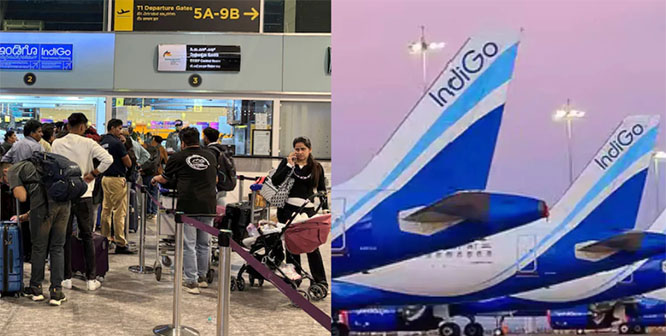
Angry outbursts, long queues, and desperate appeals filled airports across India today as IndiGo grappled with a severe operational breakdown. Hundreds of flights have been cancelled or delayed, leaving thousands of passengers stranded through the night and forcing many to spend long hours at helpdesks.

Social media was flooded with videos of fliers pleading for assistance, accusing the airline of misleading updates, and demanding accommodation after being stuck for 10 to 12 hours at airports such as Hyderabad and Bengaluru.

What Triggered the Meltdown?

IndiGo has attributed the widespread disruption to “a multitude of unforeseen operational challenges.” These include:

•    Minor technology glitches
•    Winter-season schedule adjustments
•    Bad weather
•    Congestion in the aviation network
•    New crew rostering rules (Flight Duty Time Limitations or FDTL)

Among these, the most disruptive has been the implementation of the updated FDTL norms introduced by the Directorate General of Civil Aviation (DGCA) in January 2024.

These rules were designed to reduce pilot fatigue and improve passenger safety. Key changes include:

•    Longer weekly rest periods for flight crew
•    A revised definition of “night,” extending it by an extra hour
•    Tighter caps on flight duty timing and night landings
•    Cutting night shifts for pilots and crew from six per roster cycle to just two

Once these norms became fully enforceable, airlines were required to overhaul rosters well in advance. For IndiGo, this triggered a sudden shortage of crew available for duty, leading to cascading delays and cancellations.

Why IndiGo Was Hit the Hardest

IndiGo is India’s largest airline by a wide margin, operating over 2,200 flights daily. That’s roughly double the number operated by Air India.

When an airline of this size experiences even a 10–20% disruption, it translates to 200–400 flights being delayed or grounded — producing massive spillover effects across the country.

IndiGo also relies heavily on high-frequency overnight operations, a model typical of low-cost carriers that aim to maximise aircraft utilisation and reduce downtime. The stricter FDTL norms clash with these overnight-heavy schedules, forcing the airline to pull back services.

Aviation bodies have also criticised IndiGo’s preparedness. The Airline Pilots' Association of India (ALPA) said airlines were given a two-year window to plan for the new rules but “started preparing rather late.” IndiGo, it said, failed to rebuild crew rosters 15 days in advance as required.

The Federation of Indian Pilots (FIP) went further, calling the crisis the result of IndiGo’s “prolonged and unorthodox lean manpower strategy,” and alleging that the airline adopted a hiring freeze even as it knew the new rules would require more careful staffing.

How Many Flights Are Affected?

In the past 48 hours, over 300 flights have been cancelled. At least 100 more are expected to be cancelled today.

City-wise impact:

•    Hyderabad: 33 expected cancellations; several fliers stranded overnight
•    Bengaluru: over 70 expected cancellations
•    Delhi, Mumbai, Chennai, Kolkata: widespread delays and missed connections

Passengers shared distressing accounts online.

One customer at Hyderabad airport said they waited from 6 PM to 9 AM with “no action taken” regarding their delayed Pune flight. Another said IndiGo repeatedly told them the crew was “arriving soon,” only for the delay to stretch over 12 hours.

IndiGo has apologised for the disruption and promised that operations will stabilise within 48 hours, adding that “calibrated adjustments” are being made to contain the chaos.

What Should Passengers Do Now?

For those flying in the next few days, especially with IndiGo, here are key precautions:

1. Keep Checking Flight Status
Monitor your flight closely before leaving for the airport, as delays may be announced last-minute.

2. Arrive Early
Expect long queues at counters and security due to crowding and rescheduling.

3. Carry Essentials
Pack snacks, water, basic medicines, chargers, and items for children or senior citizens. Extended waiting times should be anticipated.

4. Use Flexible Booking Options
If you booked tickets with a free-date-change or cancellation option, consider using them.
If you haven’t booked yet, prefer refundable or flexible fares, or even consider alternate airlines.

5. Follow IndiGo’s Updates
Keep an eye on IndiGo’s official social media channels and contact customer support for rebooking and refund queries.

What Needs to Change?

Pilot groups have raised concerns not just about staffing but also the planning practices behind it.
The Federation of Indian Pilots accused IndiGo of:

•    Imposing an unexplained hiring freeze despite knowing the FDTL changes were coming
•    Entering non-poaching agreements that limited talent movement
•    Keeping pilot pay frozen
•    Underestimating the need to restructure operations in advance

They have urged DGCA to approve seasonal schedules only after airlines prove they have adequate pilot strength under the new norms.

ALPA also warned that some airlines might be using the delays as an “immature pressure tactic” to push DGCA for relaxations in the new rules — which, if granted, could compromise the very safety standards the norms were meant to protect.

Both pilot bodies stressed that no exemption should dilute safety, and any deviations should be based solely on scientific risk assessment.

Is a Solution in Sight?

While IndiGo says normalcy will return within two days, aviation experts believe that fully stabilising operations could take longer, depending on how quickly the airline can:
•    Re-align rosters
•    Mobilise rested crew
•    Boost staffing
•    Adjust its winter schedule to match regulatory requirements
Passengers are advised to remain prepared for continued delays over the next few days as the airline works through its backlog. 

Comments

Add new comment

  • Coastaldigest.com reserves the right to delete or block any comments.
  • Coastaldigset.com is not responsible for its readers’ comments.
  • Comments that are abusive, incendiary or irrelevant are strictly prohibited.
  • Please use a genuine email ID and provide your name to avoid reject.