Prolonged school closure may cost India over $400 billion: World Bank

News Network
October 13, 2020

school.JPG

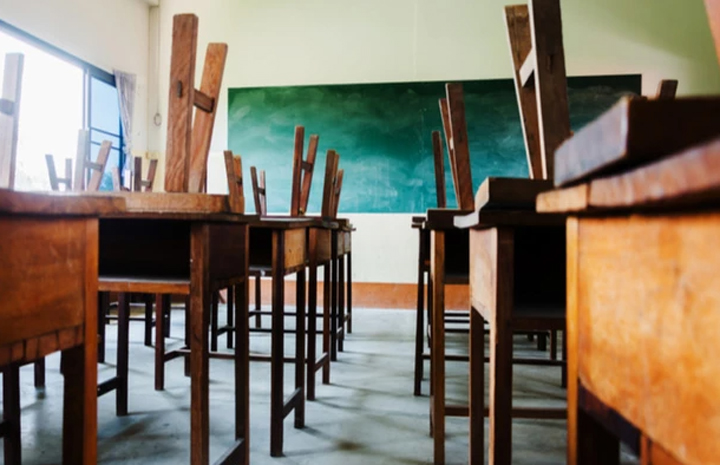
New Delhi, Oct 13: The prolonged closure of schools due to the COVID-19 pandemic in India may cause a loss of over $400 billion in the country’s future earnings, besides substantial learning losses, according to a World Bank report.

South Asia region stands to lose $622 billion from the school closures in the present scenario or up to $880 billion in a more pessimistic scenario, it said, adding while the regional loss is largely driven by India, all countries will lose substantial shares of their GDP.

The report titled “Beaten or Broken? Informality and COVID-19 in South Asia” claims that South Asia is set to plunge into its worst-ever recession in 2020 as the devastating impacts of COVID-19 on the region’s economies linger.

“Temporary school closures in all South Asian countries have had major implications for students. They have kept 391 million students out of school in primary and secondary education, further complicating efforts to resolve the learning crisis, said the report.

While most governments have made enormous efforts to mitigate the impact of school closures, it has been difficult to engage children through remote learning initiatives,” it said.

The report also noted that the pandemic may cause up to 5.5 million students to drop out from the education system and cause substantial learning losses, which will have a lifetime impact on the productivity of a generation of students.

“Most school systems closed in March, and — though there are important exceptions — countries are starting to reopen or have already opened their schools. Children have been out of school for approximately 5 months. Being out of school for that long means that children not only stop learning new things, they also forget some of what they have learned. The projected learning loss for the region is 0.5 years of learning-adjusted years of schooling (LAYS), falling from 6.5 LAYS to 6.0 LAYS, an enormous setback from recent advances in schooling,” it said.

The Learning Adjusted Year of Schooling’ (LAYS) concept, introduced by the World Bank, seeks to combine access and learning outcomes into a single measure.

It combines quantity (years of schooling) and quality (how much kids know at a given grade level) into a single summary measure of human capital in a society.

The report has projected that based on country data on household labor incomes, the average child in South Asia may lose $4,400 in lifetime earnings once having entered the labour market, equivalent to 5 percent of total earnings.

“These projections are based on what we currently know about returns to schooling, using the reduced level of learning caused by the crisis. Summing these numbers for all children in South Asia, the region stands to lose $622 billion from the school closures in the present scenario, or up to $880 billion in a more pessimistic scenario.

“While the regional loss is largely driven by India, all countries will lose substantial shares of their GDP. For reference, note that South Asian governments spend only $400 billion per year in total on primary and secondary education. The total loss in economic output from the current closures is hence substantially higher than what countries currently spend on education,” it said.

The novel corona virus has infected over 3.7 crore people across the globe claiming over 10.5 lakh lives.

India’s COVID-19 caseload stands at 71.2 lakhs while the death toll is 1.09 lakh as on Monday.Universities and schools across the country were ordered shut on March 16 to contain the spread of the novel coronavirus. On March 25, the Centre announced a nationwide lockdown. While several restrictions have been eased gradually in different phases of the ‘unlock’ since June 8, educational institutions continue to remain closed.

However, according to the latest unlock guidelines, schools, colleges and other educational institutions outside COVID-19 containment zones can reopen after October 15. The final decision on reopening the institutions has been left with the states and Union territories.


Comments

Add new comment

  • Coastaldigest.com reserves the right to delete or block any comments.
  • Coastaldigset.com is not responsible for its readers’ comments.
  • Comments that are abusive, incendiary or irrelevant are strictly prohibited.
  • Please use a genuine email ID and provide your name to avoid reject.
News Network
November 26,2025

Mangaluru, Nov 26: Mangaluru East police have registered a case following a sophisticated online fraud where a 57-year-old local resident was allegedly cheated out of ₹13.4 lakh after being targeted on Facebook.

The scam began in February when the complainant, while browsing Facebook reels, was contacted by a woman identifying herself as "Lillian Mary George" from London. After establishing a chat relationship, the woman claimed she would visit India in November and bring a significant sum of money.

The trap was sprung on November 15, when the victim received a call from a woman named "Sonali Gupta," who claimed Lillian had arrived at Mumbai International Airport but was detained by customs. The fraudsters convinced the man that Lillian was carrying £25,000 (about ₹26 lakh) in traveller’s cheques and 1 kg of gold (valued at around ₹30 lakh).

Under the pretense of clearing these items, the victim was asked to make numerous online transfers between November 15 and 18 for various bogus charges, including:

•    "Pounds exchange registration"
•    "Customs declaration issues"
•    "Discount charges"
•    "Money-laundering charges"

Believing the fictitious story, the complainant transferred the cumulative sum of ₹13.4 lakh to various bank accounts provided by the fraudsters. He realised he was cheated when the culprits later promised a refund within two days but stopped answering his calls. The Mangaluru East police are now investigating the case, which highlights the continuing threat of transnational cyber fraud using social engineering and promises of fictitious wealth.

Comments

Add new comment

  • Coastaldigest.com reserves the right to delete or block any comments.
  • Coastaldigset.com is not responsible for its readers’ comments.
  • Comments that are abusive, incendiary or irrelevant are strictly prohibited.
  • Please use a genuine email ID and provide your name to avoid reject.
News Network
November 27,2025

imrankhan.jpg

Authorities at Pakistan’s high-security Adiala Jail in Rawalpindi on Wednesday dismissed speculation about the condition of imprisoned former Pakistan Prime Minister Imran Khan, rejecting rumours that he had been moved out of the facility or was in danger. Officials said Khan was in “good health” and described the viral death claims as “baseless.”

“There is no truth to reports about his transfer from Adiala Jail,” the Rawalpindi prison administration said in a statement, according to Geo News. “He is fully healthy and receiving complete medical attention.”

Amid swirling rumours on social media, Imran Khan’s party, Pakistan Tehreek-e-Insaf (PTI), urged the federal government to issue an official clarification and demanded that authorities allow his family to meet him immediately, Dawn reported.

The frenzy began after Khan’s three sisters called for an impartial probe into what they described as a “brutal” police assault on them and other PTI supporters outside Adiala Jail last week. Soon after, several social media handles circulated unverified claims alleging that Khan had been “killed” inside the prison.

The rumours intensified when a handle named “Afghanistan Times” claimed that “credible sources” had confirmed Khan’s “murder” and that his body had been moved out of the jail — allegations that have not been verified by any credible agency.

Imran Khan, PTI’s patron-in-chief, has been lodged in the Rawalpindi prison since August 2023 in multiple cases. For over a month, an undeclared restriction has prevented family members and senior PTI leaders from meeting him. Khyber-Pakhtunkhwa Chief Minister Sohail Afridi has reportedly been denied access despite making seven attempts.

In a letter to Punjab Police Chief Usman Anwar, Khan’s sisters — Noreen Niazi, Aleema Khan, and Dr. Uzma Khan — said they were “peacefully protesting” outside the jail when police allegedly launched an unprovoked assault after streetlights were switched off.

“At 71, I was seized by my hair, thrown to the ground and dragged across the road,” Noreen Niazi said, alleging that other women present were also slapped and manhandled.

Adiala Jail officials reiterated that speculation over Imran Khan’s health was unfounded and insisted that his well-being was being ensured, Geo News reported.

Comments

Add new comment

  • Coastaldigest.com reserves the right to delete or block any comments.
  • Coastaldigset.com is not responsible for its readers’ comments.
  • Comments that are abusive, incendiary or irrelevant are strictly prohibited.
  • Please use a genuine email ID and provide your name to avoid reject.
News Network
December 3,2025

indigo.jpg

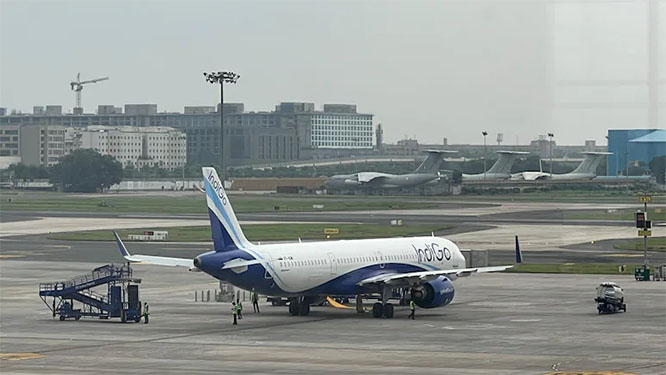
IndiGo, India’s largest airline, is battling one of its worst operational disruptions in recent years, with hundreds of delays and cancellations throwing domestic travel into chaos.

Government data on Tuesday showed its on-time performance plunging to 35%, an unusual dip for a carrier long associated with punctuality.

By Wednesday afternoon, airports in Delhi, Mumbai, Bengaluru and Hyderabad had collectively reported close to 200 cancellations, stranding travellers across the country.

Crew Shortage After New Duty Norms

A major trigger behind the meltdown is a severe crew shortage, especially among pilots, following the rollout of revised Flight Duty Time Limitation (FDTL) norms last month.

The rules mandate longer rest hours and more humane rosters — a shift IndiGo has struggled to incorporate across its vast network.

Sources said several flights were grounded due to lack of cabin crew, while some delays stretched upwards of eight hours.

With IndiGo controlling over 60% of India’s domestic aviation market, the ripple effect has impacted airports nationwide.

IndiGo Issues Apology, Lists “Compounding Factors”

In a statement, IndiGo acknowledged the large-scale disruption:

“We sincerely apologise to customers. A series of unforeseen operational challenges — technology glitches, winter schedule changes, adverse weather, system congestion and updated FDTL norms — created a compounding impact that could not have been anticipated.”

To stabilise operations, the airline has begun calibrated schedule adjustments for the next 48 hours, aiming to restore punctuality. Affected passengers are being offered refunds or alternate travel arrangements, IndiGo said.

What the FDTL Rules Require

The FDTL norms, designed to reduce pilot fatigue, cap duty and flying hours as follows:
•    Maximum 8 hours of flying per day
•    35 hours per week
•    125 hours per month
•    1,000 hours per year

Crew must also receive rest equalling twice the flight duration, with a minimum 10-hour rest period in any 24-hour window.

The DGCA introduced these limits to enhance flight safety.

Hyderabad: 33 Flights Cancelled, Long Queues Reported

Hyderabad’s Rajiv Gandhi International Airport saw heavy early-morning crowds as 33 IndiGo flights (arrivals and departures) were cancelled.

The airport clarified on X that operations were normal, advising passengers to contact IndiGo directly for latest flight status.

Cancellations included flights to and from Visakhapatnam, Goa, Ahmedabad, Delhi, Bengaluru, Chennai, Madurai, Hubli, Bhopal and Bhubaneswar.

Bengaluru: 42 Flights Disrupted

Bengaluru’s Kempegowda International Airport recorded 42 cancellations — 22 arrivals and 20 departures — affecting routes to Delhi, Mumbai, Chennai, Hyderabad, Goa, Kolkata and Lucknow.

Passengers Vent on Social Media

Irate travellers took to X to share their experiences. One passenger stranded in Hyderabad wrote: “I have been here since 3 a.m. and missed an important meeting.”

Another said: “My flight was pushed from 1:55 PM to 2:55 PM and now 4:35 PM. I was informed only three minutes before entering the airport.”

Delhi Airport Hit by Tech Glitch

At Delhi Airport, the disruption deepened due to a slowdown in the Amadeus system — used for reservations, check-ins and departure control.

The technical issue led to longer queues and sluggish processing, adding to delays already worsened by staff shortages.

Comments

Add new comment

  • Coastaldigest.com reserves the right to delete or block any comments.
  • Coastaldigset.com is not responsible for its readers’ comments.
  • Comments that are abusive, incendiary or irrelevant are strictly prohibited.
  • Please use a genuine email ID and provide your name to avoid reject.