



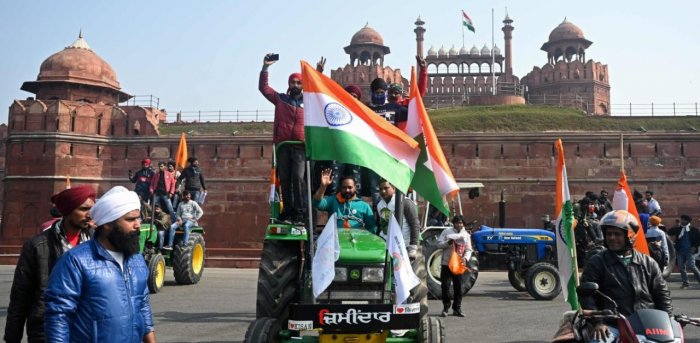
Protesting agitating farmers reach Red Fort on tractors, hoist flag

Agencies
January 26, 2021

11651445.jpg

New Delhi, Jan 26: Protesting farmers clashed with police at several places in the national capital and entered the iconic Red Fort and ITO in the heart of national capital, with hundreds of them deviating from pre-decided routes, prompting security personnel to resort to lathicharge and tear gas. A man climbed a flagstaff and hoisted a flag.

Chaotic scenes were witnessed at ITO, where hundreds of protesters could be seen chasing police personnel with sticks and ramming their tractors into the buses parked by police.

At the ITO, a bus was vandalised by angry farmers.

Police on Tuesday fired tear gas shells and lathicharged farmers when they clashed with the force in parts of city

Police used tear gas on groups of farmers and resorted to baton charge as protestors broke past barricades with tractors at different border points and did not take the pre-decided routes for their march in the national capital.

The Delhi Police had given permission to farmers protesting the three farm laws to hold their tractor parade on selected routes only after the official Republic Day parade on the Rajpath concludes.

However chaos ensued as the farmers were were adamant on heading towards central Delhi.

In the morning, groups of protesting farmers camping at Singhu and Tikri border points of the national capital broke police barricades to force their way into the city.

The ITO resembled a war zone as restive crowds of farmers and uniformed security personnel could be seen in the area. Police fired tear gas shells at hundreds of farmers who wielded sticks and clubs and entered ITO, a few kilometres away from Parliament, in an effort to move towards Rajpath.

Police baton charged farmers at Chintamani Chowk in Shahdara when they broke barricades and smashed window panes of cars. A group of 'Nihangs' (traditional Sikh warriors) clashed with security personnel near Akshardham Temple.

At Nangloi Chowk in west Delhi and at Mukarba Chowk farmers broke cemented barricades and police used tear gas to disperse them.

An official said police personnel used tear gas to disperse groups of farmers coming from the Singhu border point as they tried to hold a march on the Outer Ring Road much ahead of the allotted time.

Meanwhile, senior farmer Balbir Singh Rajewal said farmers were following the pre-decided route. No one from the Sankyukt Kisan Morcha went to the Outer Ring Road.

"We condemn violence against farmers, appeal to all to maintain peace," Rajewal told PTI.

The Delhi Police appealed to the protesting farmers to not take law in their hands and maintain peace as clashes between the force and protesting farmers broke out at a number of places in the national capital.

The police also asked the farmers to head back to their pre-decided routes for the tractor parade.

"We request to the protesting farmers to not take law in their hands and maintain peace," Additional PRO Anil Mittal said.

A member of the Sankyukt Kisan Morcha, an umbrella body of 41 unions, leading the protest against the three central farm laws at several border points of Delhi, said those who broke the barricades at Tikri border points belonged to the Kisan Mazdoor Sangharsh Committee.

He said the Sankyukt Kisan Morcha's tractor parade will start as scheduled after police give farmers way. The Kisan Mazdoor Sangharsh Committee on Monday announced that they would hold their march on Delhi's busy Outer Ring Road on Republic Day.

The entry and exit gates of more than 10 metro stations in central and north Delhi were temporarily closed on Tuesday following clashes between police and protesting farmers in part of the national capital.

The Delhi Metro Rail Corporation took to Twitter to inform the public about the temporary closure of metro station gates.

"Entry/exit gates of Indraprastha metro station are closed. Entry/exit gates of Samaypur Badli, Rohini Sector 18/19, Haiderpur Badli Mor, Jahangir Puri, Adarsh Nagar, Azadpur, Model Town, GTB Nagar, Vishwavidyalaya, Vidhan Sabha and Civil Lines are closed," the DMRC tweeted.

Earlier in the day, chanting 'rang de basanti' and 'jai jawan jai kisan' numerous farmers rode tractors, motorbikes, horses and even cranes to cross the national capital's borders into the city for their proposed parade against the three contentious farm laws.

Locals stood on both sides of the roads at various locations showering flower petals on the farmers amid drum beats.

Standing atop vehicles decked up with flags, the protesters danced to the tune of patriotic songs such as 'Aisa desh hai mera' and 'Sare jahan se achcha'.

Thousands of farmers, mostly from Punjab, Haryana and western Uttar Pradesh, have been camping at several Delhi border points since November 28, demanding a complete repeal of three farm laws and a legal guarantee on minimum support price for their crops.


Comments

Add new comment

  • Coastaldigest.com reserves the right to delete or block any comments.
  • Coastaldigset.com is not responsible for its readers’ comments.
  • Comments that are abusive, incendiary or irrelevant are strictly prohibited.
  • Please use a genuine email ID and provide your name to avoid reject.
News Network
December 6,2025

pilot.jpg

New Delhi: IndiGo, India’s largest airline, faced major operational turbulence this week after failing to prepare for new pilot-fatigue regulations issued by the Directorate General of Civil Aviation (DGCA). The stricter rules—designed to improve flight safety—took effect in phases through 2024, with the latest implementation on November 1. IndiGo has acknowledged that inadequate roster planning led to widespread cancellations and delays.

Below are the key DGCA rules that affected IndiGo’s operations:

1. Longer Mandatory Weekly Rest

Weekly rest for pilots has been increased from 36 hours to 48 hours.

The government says the extended break is essential to curb cumulative fatigue. This rule remains in force despite the current crisis.

2. Cap on Night Landings

Pilots can now perform only two night landings per week—a steep reduction from the earlier limit of six.

Night hours, defined as midnight to early morning, are considered the least alert period for pilots.

Given the disruptions, this rule has been temporarily relaxed for IndiGo until February 10.

3. Reduced Maximum Night Flight Duty

Flight duty that stretches into the night is now capped at 10 hours.

This measure has also been kept on hold for IndiGo until February 10 to stabilize operations.

4. Weekly Rest Cannot Be Replaced With Personal Leave

Airlines can no longer count a pilot’s personal leave as part of the mandatory 48-hour rest.

Pilots say this closes a loophole that previously reduced actual rest time.

Currently, all airlines are exempt from this rule to normalise travel.

5. Mandatory Fatigue Monitoring

Airlines must submit quarterly fatigue reports along with corrective actions to DGCA.

This system aims to create a transparent fatigue-tracking framework across the industry.

The DGCA has stressed that these rules were crafted to strengthen flight safety and align India with global fatigue-management standards. The temporary relaxations are expected to remain until February 2025, giving IndiGo time to stabilise its schedules and restore normal air travel.

Comments

Add new comment

  • Coastaldigest.com reserves the right to delete or block any comments.
  • Coastaldigset.com is not responsible for its readers’ comments.
  • Comments that are abusive, incendiary or irrelevant are strictly prohibited.
  • Please use a genuine email ID and provide your name to avoid reject.
News Network
December 4,2025

Mangaluru: Chaos erupted at Mangaluru International Airport (MIA) after IndiGo flight 6E 5150, bound for Mumbai, was repeatedly delayed and ultimately cancelled, leaving around 100 passengers stranded overnight. The incident highlights the ongoing country-wide operational disruptions affecting the airline, largely due to the implementation of new Flight Duty Time Limitations (FDTL) norms for crew.

The flight was initially scheduled for 9:25 PM on Tuesday but was first postponed to 11:40 PM, then midnight, before being cancelled around 3:00 AM. Passengers expressed frustration over last-minute communication and the lack of clarity, with elderly and ailing travellers particularly affected. “Though the airline arranged food, there was no proper communication, leaving us confused,” said one family member.

An IndiGo executive at MIA cited the FDTL rules, designed to prevent pilot fatigue by limiting crew working hours, as the cause of the cancellation. While alternative arrangements, including hotel stays, were offered, about 100 passengers chose to remain at the airport, creating tension. A replacement flight was arranged but also faced delays due to the same constraints, finally departing for Mumbai around 1:45 PM on Wednesday. Passengers either flew, requested refunds, or postponed their travel.

The Mangaluru delay is part of a broader crisis for IndiGo. The airline has been forced to make “calibrated schedule adjustments”—a euphemism for widespread cancellations and delays—after stricter FDTL norms came into effect on November 1.

While an IndiGo spokesperson acknowledged unavoidable flight disruptions due to technology issues, operational requirements, and the updated crew rostering rules, the DGCA has intervened, summoning senior airline officials to explain the chaos and outline corrective measures.

The ripple effect has been felt across the country, with major hubs like Bengaluru and Mumbai reporting numerous cancellations. The Mangaluru incident underscores the systemic operational strain currently confronting India’s largest carrier, leaving passengers nationwide grappling with uncertainty and delays.

Comments

Add new comment

  • Coastaldigest.com reserves the right to delete or block any comments.
  • Coastaldigset.com is not responsible for its readers’ comments.
  • Comments that are abusive, incendiary or irrelevant are strictly prohibited.
  • Please use a genuine email ID and provide your name to avoid reject.
News Network
December 6,2025

pilot.jpg

New Delhi: IndiGo, India’s largest airline, faced major operational turbulence this week after failing to prepare for new pilot-fatigue regulations issued by the Directorate General of Civil Aviation (DGCA). The stricter rules—designed to improve flight safety—took effect in phases through 2024, with the latest implementation on November 1. IndiGo has acknowledged that inadequate roster planning led to widespread cancellations and delays.

Below are the key DGCA rules that affected IndiGo’s operations:

1. Longer Mandatory Weekly Rest

Weekly rest for pilots has been increased from 36 hours to 48 hours.

The government says the extended break is essential to curb cumulative fatigue. This rule remains in force despite the current crisis.

2. Cap on Night Landings

Pilots can now perform only two night landings per week—a steep reduction from the earlier limit of six.

Night hours, defined as midnight to early morning, are considered the least alert period for pilots.

Given the disruptions, this rule has been temporarily relaxed for IndiGo until February 10.

3. Reduced Maximum Night Flight Duty

Flight duty that stretches into the night is now capped at 10 hours.

This measure has also been kept on hold for IndiGo until February 10 to stabilize operations.

4. Weekly Rest Cannot Be Replaced With Personal Leave

Airlines can no longer count a pilot’s personal leave as part of the mandatory 48-hour rest.

Pilots say this closes a loophole that previously reduced actual rest time.

Currently, all airlines are exempt from this rule to normalise travel.

5. Mandatory Fatigue Monitoring

Airlines must submit quarterly fatigue reports along with corrective actions to DGCA.

This system aims to create a transparent fatigue-tracking framework across the industry.

The DGCA has stressed that these rules were crafted to strengthen flight safety and align India with global fatigue-management standards. The temporary relaxations are expected to remain until February 2025, giving IndiGo time to stabilise its schedules and restore normal air travel.

Comments

Add new comment

  • Coastaldigest.com reserves the right to delete or block any comments.
  • Coastaldigset.com is not responsible for its readers’ comments.
  • Comments that are abusive, incendiary or irrelevant are strictly prohibited.
  • Please use a genuine email ID and provide your name to avoid reject.