



Is second Covid wave over? Positivity rate below 5% for two weeks but experts say end still far

News Network
June 21, 2021

New Delhi, June 21: India on Monday crossed the important milestone of a Covid positivity rate of less than 5 per cent for 14 consecutive days, conforming to the WHO’s recommended requirement for a region to reopen, but experts were wary of declaring the devastating second wave over.

With 53,256 new coronavirus infections, the lowest in 88 days, and a positivity rate of 3.83 per cent, it would seem the present phase of the Covid-19 crisis is over and it is a good time to lift instructions.

This optimistic picture, however, must be edged with abundant caution, said several scientists, citing the emergence of new variants, the still high absolute number of cases, the many districts where positivity rate remains over 5 per cent and concerns over the reliability of data.  

“With the current positivity rate at less than 5 per cent, India’s Covid-19 second wave is on the wane as quickly as it rushed to its peak, but the end of it may yet be far away as more transmissible new variants such as Delta plus variant are emerging,” said Naga Suresh Veerapu, associate professor at the School of Natural Sciences (SoNS), Shiv Nadar University, Delhi NCR. 

The Delta plus variant has been formed due to a mutation in the Delta or B.1.617.2 variant, first identified in India and considered one of the drivers of the second wave in the country and also in several others including the UK.  

The test positivity rate or TPR -- the percentage of all coronavirus tests performed that turn out to be positive -- is an important metric through which the public health system keeps tabs on the level of Covid transmission.  

The WHO recommends that test positivity should remain at 5 per cent or lower for 14 days before countries or regions reopen.

In February this year, the country was celebrating the end of the first wave and conveniently ignored an imminent second wave, Veerapu said.  

“The Delta variant that emerged in March spread across the different parts of India, then cases surged to the peak yielding a second wave. The second wave conjoined with the first when the latter was at 1 per cent positivity rate,” he told PTI.    

Public policy expert Chandrakant Lahariya added that while the cases are on the decline, the absolute number of cases are still very high.  

 “While the national level test positivity rate has come down, there are still many districts where TPR is above 5 per cent,” the Delhi-based physician-epidemiologist and health systems expert told PTI.

“Therefore, before saying that the second wave is over, I would like to wait for the TPR to come down below 5 per cent everywhere and sustain for two weeks or longer,” he said.

Scientist Gautam Menon agreed with Lahariya, noting that some states such as Kerala are still seeing positivity rates over 5 per cent. He added that it is unclear whether this reflects just better testing than other states or if the situation is still to improve there.  

Positivity rate was 10.84 per cent in Kerala on Sunday.   

According to Health Ministry data on Monday, India’s total tally of Covid-19 cases is 2,99,35,221 (2.99 crore/29.9 million) while active cases have reduced to 7,02,887.  

The second wave of the pandemic overwhelmed the healthcare system of the country, leaving hospitals struggling to cope with the surge in cases and critical drugs and oxygen in short supply. Infections have now slowed down and restrictions have been relaxed in most states. 

Agreeing that the drop in India’s cases has been quite dramatic, Menon noted, “From all we know, this is a genuine decline, both in urban and rural India.”  

“There is no strict definition of a ‘wave’, let alone of how and when it might be ending, but this is a good time as any to consider opening up, although with caution,” Menon, professor, Departments of Physics and Biology, Ashoka University in Haryana, told PTI.  

The experts also believe test positivity rates provide valuable information only if testing is broadly accessible across all regions.  

“Test positivity, when these tests are carried out on a random sample of the population and in sufficient quantity, is likely the best metric to dictate opening up, although we must be careful about local pockets where the level of infections have been lower than average and where the disease could still take off,” said Menon.  

“What we need to remember is that for a country the size of India, we need to have enough attention on the local level,” Lahariya added.  

He explained that Covid-19 is not just any other respiratory illness and decision-making parameters cannot be simple.  

“We know that there are new variants which are more transmissible. We know that human behaviour determines the spread of this virus. Therefore, it is not very relevant if we declare whether the second wave is over or not,” the public policy expert explained.  

“Key is, are we prepared to respond to the rise in cases? That's where the attention has to be,” Lahariya said.  

Widespread concerns about the accuracy of data, relating to both deaths and cases, also need to be factored in, said Menon. 

Though anecdotally, decline in cases appears to be true, media and other reports “suggest that deaths have been severely undercounted, sometimes by a factor of 10”.

“I hope these reports will spur states to be transparent with their numbers,” he said.  

Lahariya said India has sub-optimally performing mechanisms for medical certification of causes of deaths (MCCD). Even before the pandemic, the causes of deaths used to be certified in only one-fourth of registered deaths.  

“Therefore, it is not unthinkable that even in some cases of Covid-19 deaths; deaths have not been certified correctly,” the scientist added.   

Veerapu said asymptomatic people and some with mild symptoms may not even turn up for testing, therefore leading to the underestimation of cases.  

However, he said the waning second wave provides enough opportunities to minimise the spread of the disease.

“We should ramp up the vaccination drive, consolidate the health infrastructure to minimise the impact of the much anticipated third wave, and hone the public health strategies to prevent, control and respond to the third wave,” he added.

Comments

Add new comment

  • Coastaldigest.com reserves the right to delete or block any comments.
  • Coastaldigset.com is not responsible for its readers’ comments.
  • Comments that are abusive, incendiary or irrelevant are strictly prohibited.
  • Please use a genuine email ID and provide your name to avoid reject.
News Network
December 4,2025

Udupi: A 40-year-old NRI from Udupi has reportedly lost more than Rs 12.25 lakh in an online investment scam operated through Telegram.

According to a complaint filed at the CEN police station, Leo Jerome Mendonsa, who has been working in Dubai for the past 15 years in computer accessories sales, maintains NRI accounts in Karkala and Nitte.

On November 12, 2025, Mendonsa was added to a Telegram group called Instaflow Earnings by unknown individuals. Users identified as Priya and Dipannita persuaded him to invest in “Revenue Tasks.” Initially, Mendonsa transferred Rs 1,100 multiple times and received the promised returns, encouraging him to continue.

On November 14, another user, Nishmitha Shetty, directed him to register on a website, digitvisionuoce.cc, and invest Rs 4 lakh in various shares. Over the next few days, he made multiple transfers totaling Rs 12,25,000, including Rs 50,000 via Google Pay, believing the scheme was legitimate.

After receiving the money, the alleged handlers stopped responding, and neither the invested amount nor the promised profits were returned.

The CEN police have registered a case under Sections 66(C) and 66(D) of the IT Act and Section 318(4) of the Bharatiya Nyaya Sanhita (BNS), and investigations are ongoing.

Comments

Add new comment

  • Coastaldigest.com reserves the right to delete or block any comments.
  • Coastaldigset.com is not responsible for its readers’ comments.
  • Comments that are abusive, incendiary or irrelevant are strictly prohibited.
  • Please use a genuine email ID and provide your name to avoid reject.
News Network
December 3,2025

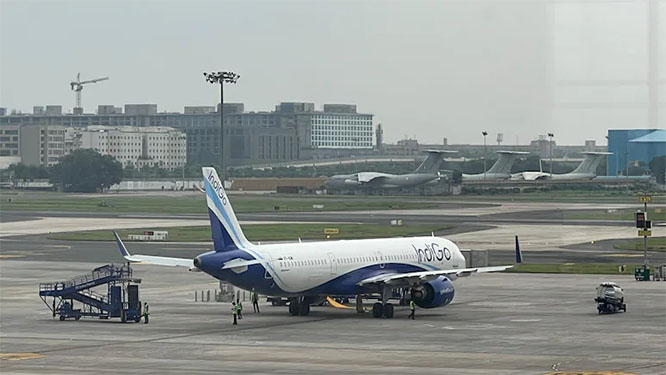
indigo.jpg

IndiGo, India’s largest airline, is battling one of its worst operational disruptions in recent years, with hundreds of delays and cancellations throwing domestic travel into chaos.

Government data on Tuesday showed its on-time performance plunging to 35%, an unusual dip for a carrier long associated with punctuality.

By Wednesday afternoon, airports in Delhi, Mumbai, Bengaluru and Hyderabad had collectively reported close to 200 cancellations, stranding travellers across the country.

Crew Shortage After New Duty Norms

A major trigger behind the meltdown is a severe crew shortage, especially among pilots, following the rollout of revised Flight Duty Time Limitation (FDTL) norms last month.

The rules mandate longer rest hours and more humane rosters — a shift IndiGo has struggled to incorporate across its vast network.

Sources said several flights were grounded due to lack of cabin crew, while some delays stretched upwards of eight hours.

With IndiGo controlling over 60% of India’s domestic aviation market, the ripple effect has impacted airports nationwide.

IndiGo Issues Apology, Lists “Compounding Factors”

In a statement, IndiGo acknowledged the large-scale disruption:

“We sincerely apologise to customers. A series of unforeseen operational challenges — technology glitches, winter schedule changes, adverse weather, system congestion and updated FDTL norms — created a compounding impact that could not have been anticipated.”

To stabilise operations, the airline has begun calibrated schedule adjustments for the next 48 hours, aiming to restore punctuality. Affected passengers are being offered refunds or alternate travel arrangements, IndiGo said.

What the FDTL Rules Require

The FDTL norms, designed to reduce pilot fatigue, cap duty and flying hours as follows:
•    Maximum 8 hours of flying per day
•    35 hours per week
•    125 hours per month
•    1,000 hours per year

Crew must also receive rest equalling twice the flight duration, with a minimum 10-hour rest period in any 24-hour window.

The DGCA introduced these limits to enhance flight safety.

Hyderabad: 33 Flights Cancelled, Long Queues Reported

Hyderabad’s Rajiv Gandhi International Airport saw heavy early-morning crowds as 33 IndiGo flights (arrivals and departures) were cancelled.

The airport clarified on X that operations were normal, advising passengers to contact IndiGo directly for latest flight status.

Cancellations included flights to and from Visakhapatnam, Goa, Ahmedabad, Delhi, Bengaluru, Chennai, Madurai, Hubli, Bhopal and Bhubaneswar.

Bengaluru: 42 Flights Disrupted

Bengaluru’s Kempegowda International Airport recorded 42 cancellations — 22 arrivals and 20 departures — affecting routes to Delhi, Mumbai, Chennai, Hyderabad, Goa, Kolkata and Lucknow.

Passengers Vent on Social Media

Irate travellers took to X to share their experiences. One passenger stranded in Hyderabad wrote: “I have been here since 3 a.m. and missed an important meeting.”

Another said: “My flight was pushed from 1:55 PM to 2:55 PM and now 4:35 PM. I was informed only three minutes before entering the airport.”

Delhi Airport Hit by Tech Glitch

At Delhi Airport, the disruption deepened due to a slowdown in the Amadeus system — used for reservations, check-ins and departure control.

The technical issue led to longer queues and sluggish processing, adding to delays already worsened by staff shortages.

Comments

Add new comment

  • Coastaldigest.com reserves the right to delete or block any comments.
  • Coastaldigset.com is not responsible for its readers’ comments.
  • Comments that are abusive, incendiary or irrelevant are strictly prohibited.
  • Please use a genuine email ID and provide your name to avoid reject.
News Network
December 4,2025

Mangaluru: Chaos erupted at Mangaluru International Airport (MIA) after IndiGo flight 6E 5150, bound for Mumbai, was repeatedly delayed and ultimately cancelled, leaving around 100 passengers stranded overnight. The incident highlights the ongoing country-wide operational disruptions affecting the airline, largely due to the implementation of new Flight Duty Time Limitations (FDTL) norms for crew.

The flight was initially scheduled for 9:25 PM on Tuesday but was first postponed to 11:40 PM, then midnight, before being cancelled around 3:00 AM. Passengers expressed frustration over last-minute communication and the lack of clarity, with elderly and ailing travellers particularly affected. “Though the airline arranged food, there was no proper communication, leaving us confused,” said one family member.

An IndiGo executive at MIA cited the FDTL rules, designed to prevent pilot fatigue by limiting crew working hours, as the cause of the cancellation. While alternative arrangements, including hotel stays, were offered, about 100 passengers chose to remain at the airport, creating tension. A replacement flight was arranged but also faced delays due to the same constraints, finally departing for Mumbai around 1:45 PM on Wednesday. Passengers either flew, requested refunds, or postponed their travel.

The Mangaluru delay is part of a broader crisis for IndiGo. The airline has been forced to make “calibrated schedule adjustments”—a euphemism for widespread cancellations and delays—after stricter FDTL norms came into effect on November 1.

While an IndiGo spokesperson acknowledged unavoidable flight disruptions due to technology issues, operational requirements, and the updated crew rostering rules, the DGCA has intervened, summoning senior airline officials to explain the chaos and outline corrective measures.

The ripple effect has been felt across the country, with major hubs like Bengaluru and Mumbai reporting numerous cancellations. The Mangaluru incident underscores the systemic operational strain currently confronting India’s largest carrier, leaving passengers nationwide grappling with uncertainty and delays.

Comments

Add new comment

  • Coastaldigest.com reserves the right to delete or block any comments.
  • Coastaldigset.com is not responsible for its readers’ comments.
  • Comments that are abusive, incendiary or irrelevant are strictly prohibited.
  • Please use a genuine email ID and provide your name to avoid reject.