



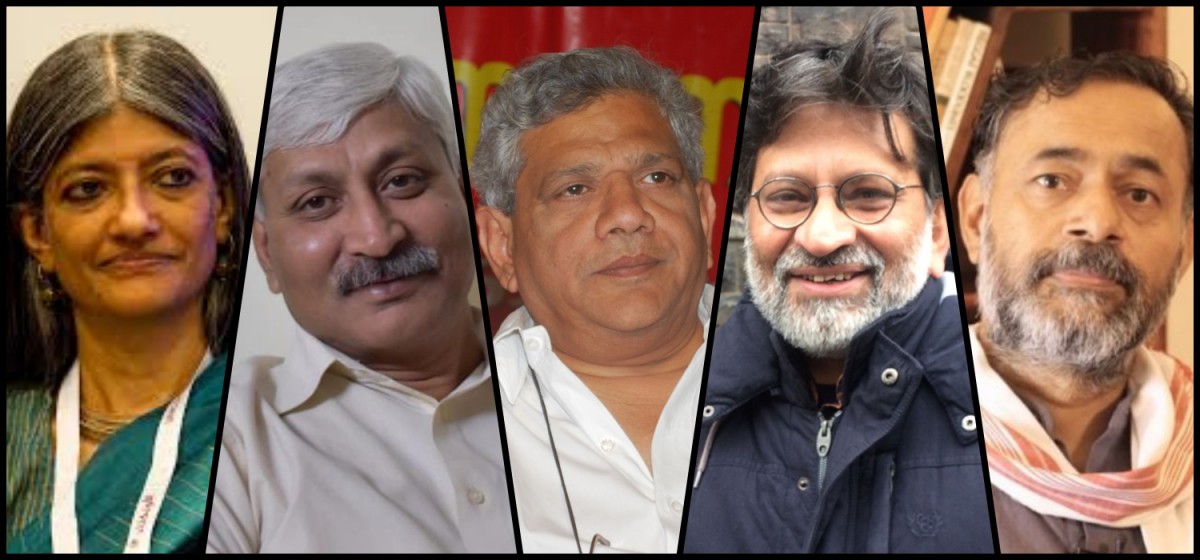
Shocking: Police name Yechury, Yogendra Yadav, Jayati Ghosh, Apoorvanand as co-conspirators in Delhi violence

Agencies
September 12, 2020

Delhi-riots-police-conspiracy.jpg

New Delhi, Sept 12: In a shocking development, the Delhi Police has named CPI (M) general secretary Sitaram Yechury, Swaraj Abhiyan leader Yogendra Yadav, economist Jayati Ghosh, Delhi University professor and activist Apoorvanand, and documentary filmmaker Rahul Roy as co-conspirators in the February Delhi riots.

They have been accused of asking anti-CAA protesters to go to ¨any extreme¨, spreading discontent in the community by calling CAA/NRC anti-Muslim, and organise demonstrations to “malign the image of the Government of India”.

The names appeared in a supplementary charge sheet, a copy of which is with the PTI, filed by the police on the riots in North East District between February 23 and 26, which claimed 53 lives and left 581 injured, 97 of them having gunshot wounds.

These eminent personalities have been made accused based on the confessions of three students -- women’s collective Pinjra Tod members and JNU students Devangana Kalita and Natasha Narwal, and Gulfisha Fathima of Jamia Milia Islamia -- in the Jafrabad violence, from where the riots spread to other parts of north-east Delhi.

All three are facing charges under various sections of the Unlawful Activities (Prevention) Act.

In the charge sheet, which was made public just two days before the commencement of the Monsoon Session of Parliament, the Delhi Police has claimed that Kalita and Narwal admitted to not just their complicity in the riots but also named Ghosh, Apoorvanand and Roy as their mentors, who allegedly asked them to carry out the protests against the Citizenship Amendment Act and go to ¨any extreme¨.

Their similarly-worded disclosure statements – mentioned in the charge sheet -- claim the two JNU students said they organised the Daryaganj protest in December and the Jafrafad chakka jam (road block) against the CAA on February 22, 2020 at the behest of Ghosh, Apoorvanand and Roy.

The student-activists also told the police the three coordinated with the Islamist group Popular Front of India (PFI) and the Jamia Coordination Committee to mentor the Pinjra Tod members to carry forward their campaign against the CAA, according to the charge sheet.

The police have used Jamia student Fathima’s statement to corroborate the ensuing events.

The charge sheet claims that apart from Yechury and Yogendra Yadav, Fathima’s statement mentions Bhim Army chief Chandrasekhar, United Against Hate activist Umar Khalid and some leaders from the Muslim community such as ex-MLA Mateen Ahmed, and MLA Amannatullah Khan.

The document claims they aided the conspirators of the violence.

In her statement, Fathima said that she was told to organise the protest to “malign the image of the Government of India”, the police claimed.

In her statement, included in the charge sheet, she says that ¨big leaders and lawyers started coming in to provoke and mobilize this crowd, including Omar Khalid, Chandrashekhar Ravan, Yogendar Yadav, Sitaram Yechury, and lawyer Mahmood Pracha, etc”.

“Pracha said that the sitting in demonstration is your democratic right and the rest of the leaders filled the feeling of discontent in the community by calling CAA/NRC anti-Muslim¨ she said, according to the charge sheet.

According to the charge sheet, Kalita added, “Umar Khalid had also given some tips for doing protest against CAA/NRC. On the directions of these persons, Umar Khalid''s United Against Hate Group and JCC (Jamia Coordination Committee) & members of our Pinjda Tod (we) together started protest in difierent parts of Delhi.”

Comments

kushal kumar
 - 
Tuesday, 15 Sep 2020

Delhi February 2020 Riots Case Supplementary Charge Sheet Filed On 12 September 2020 was a talking point in news media.
According to report in the news media , a supplementary chargesheet in Delhi February 2020 riots case has been filed by Delhi Police on 12 September , 2020 . The names of CPM general secretary Sitaram Yechury , Swaraj Abhiyan leader Yogendra Yadav , economist Jayati Ghosh , Delhi University Professor Apoorvanand and documentary film-maker Rahul Roy are reported to have figured in the narration of statement of one or two accused persons . It becomes clear that the names of said five eminent personalities in Indian politics/social-life/film-life do not figure as accused but their names find a mention in the disclosure statements claimed to have been made by accused person or persons before the police. This circumstance was a talking point in the news media on 13 September. The matter is sub-judice. In the context of such like case or cases , it may be apt to refer readers to this Vedic astrology writer’s one of predictions in article - “ India in the year 2021 - planetary impacts interpreted” - published on 7 September , 2020 at theindiapost.com. It may be mentioned here that a period of four months from September –December 2020 was also covered in addition to 2021 in the said article of 7 September. The related text in the article reads as follows :-
“ The planetary movements towards last four months , particularly November-December in the present year 2020 suggest that questions of commitments or liabilities or discharge , economic or otherwise , look to be arising. Such commitments or liabilities or discharge may have something to do with distant or recent past or even present covering such aspect as……………. telecommunication system and the like. Such subtle activities , passage medium of which happens to be space , may have one or other concern………………………The period between 10 October to 13 November in 2020 is also the one when some powerful or rich organizations or personalities associated therewith in one or more fields such as social , spiritual , political in the country can be in news or focus”.

Add new comment

  • Coastaldigest.com reserves the right to delete or block any comments.
  • Coastaldigset.com is not responsible for its readers’ comments.
  • Comments that are abusive, incendiary or irrelevant are strictly prohibited.
  • Please use a genuine email ID and provide your name to avoid reject.
News Network
November 30,2025

airportmetro.jpg

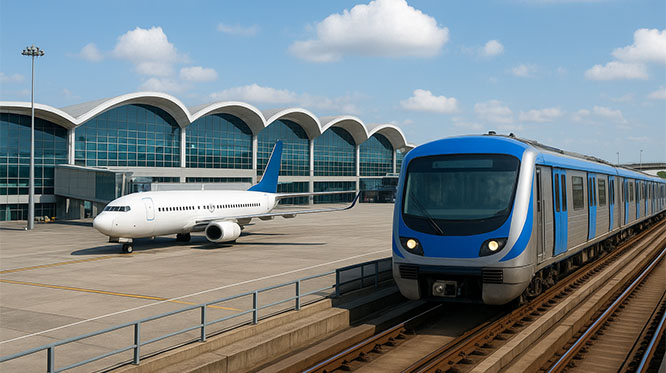
Udupi: The pontiffs of Sri Paryaya Puttige Mutt, the sacred seat of Jagadguru Shrimad Madhvacharya Moola Samsthanam, have submitted a proposal to the Prime Minister seeking comprehensive development for Udupi district. 

Proposal for International Airport

A key request is the establishment of an international airport. Highlighting that around 1,000 acres of land are available and suitable, the pontiffs noted that the existing Mangalore Airport provides limited international connectivity. They suggested the airport be developed under a Public-Private Partnership (PPP) or as a Greenfield Airport to boost trade, education, healthcare, and spiritual tourism.

Metro and Rapid Transit Connectivity

The proposal also calls for Metro Rail or Rapid Transit between Mangaluru and Udupi. The 55 km coastal stretch experiences heavy daily commuter traffic, causing congestion. The district administration is ready to prepare an initial project report for a Mass Rapid Transit corridor and requested inclusion under national urban mobility programmes to ensure safe, green, and time-efficient regional transport.

Port and Coastal Development

The pontiffs urged the development of an international-standard port with a cruise terminal along Udupi’s coast. They also requested fast-tracking of pending coastal tourism projects and revising Coastal Regulation Zone (CRZ) norms to encourage sustainable infrastructure and hospitality investment.

IT, AI and Technological Infrastructure

Support was sought for an IT and AI Innovation Park with incubation facilities under Digital India and Startup India initiatives. The proposal also emphasized the need for strengthened data security and cloud computing infrastructure to boost India’s technological independence.

Sports and Education Initiatives

The pontiffs requested national sports status for Kambala, along with financial and infrastructure support. They also sought the establishment of an AIIMS in Udupi, a new IIT campus, and approval for an IIM to promote higher education in the district.

Representation to the Prime Minister

Sri Sugunendra Tirtha Pontiff and Sri Sushrendra Tirtha Swamiji represented the pontiffs in submitting the comprehensive development proposal to the Prime Minister during his recent visit.

Comments

Add new comment

  • Coastaldigest.com reserves the right to delete or block any comments.
  • Coastaldigset.com is not responsible for its readers’ comments.
  • Comments that are abusive, incendiary or irrelevant are strictly prohibited.
  • Please use a genuine email ID and provide your name to avoid reject.
News Network
December 6,2025

pilot.jpg

New Delhi: IndiGo, India’s largest airline, faced major operational turbulence this week after failing to prepare for new pilot-fatigue regulations issued by the Directorate General of Civil Aviation (DGCA). The stricter rules—designed to improve flight safety—took effect in phases through 2024, with the latest implementation on November 1. IndiGo has acknowledged that inadequate roster planning led to widespread cancellations and delays.

Below are the key DGCA rules that affected IndiGo’s operations:

1. Longer Mandatory Weekly Rest

Weekly rest for pilots has been increased from 36 hours to 48 hours.

The government says the extended break is essential to curb cumulative fatigue. This rule remains in force despite the current crisis.

2. Cap on Night Landings

Pilots can now perform only two night landings per week—a steep reduction from the earlier limit of six.

Night hours, defined as midnight to early morning, are considered the least alert period for pilots.

Given the disruptions, this rule has been temporarily relaxed for IndiGo until February 10.

3. Reduced Maximum Night Flight Duty

Flight duty that stretches into the night is now capped at 10 hours.

This measure has also been kept on hold for IndiGo until February 10 to stabilize operations.

4. Weekly Rest Cannot Be Replaced With Personal Leave

Airlines can no longer count a pilot’s personal leave as part of the mandatory 48-hour rest.

Pilots say this closes a loophole that previously reduced actual rest time.

Currently, all airlines are exempt from this rule to normalise travel.

5. Mandatory Fatigue Monitoring

Airlines must submit quarterly fatigue reports along with corrective actions to DGCA.

This system aims to create a transparent fatigue-tracking framework across the industry.

The DGCA has stressed that these rules were crafted to strengthen flight safety and align India with global fatigue-management standards. The temporary relaxations are expected to remain until February 2025, giving IndiGo time to stabilise its schedules and restore normal air travel.

Comments

Add new comment

  • Coastaldigest.com reserves the right to delete or block any comments.
  • Coastaldigset.com is not responsible for its readers’ comments.
  • Comments that are abusive, incendiary or irrelevant are strictly prohibited.
  • Please use a genuine email ID and provide your name to avoid reject.
News Network
December 4,2025

Mangaluru: Chaos erupted at Mangaluru International Airport (MIA) after IndiGo flight 6E 5150, bound for Mumbai, was repeatedly delayed and ultimately cancelled, leaving around 100 passengers stranded overnight. The incident highlights the ongoing country-wide operational disruptions affecting the airline, largely due to the implementation of new Flight Duty Time Limitations (FDTL) norms for crew.

The flight was initially scheduled for 9:25 PM on Tuesday but was first postponed to 11:40 PM, then midnight, before being cancelled around 3:00 AM. Passengers expressed frustration over last-minute communication and the lack of clarity, with elderly and ailing travellers particularly affected. “Though the airline arranged food, there was no proper communication, leaving us confused,” said one family member.

An IndiGo executive at MIA cited the FDTL rules, designed to prevent pilot fatigue by limiting crew working hours, as the cause of the cancellation. While alternative arrangements, including hotel stays, were offered, about 100 passengers chose to remain at the airport, creating tension. A replacement flight was arranged but also faced delays due to the same constraints, finally departing for Mumbai around 1:45 PM on Wednesday. Passengers either flew, requested refunds, or postponed their travel.

The Mangaluru delay is part of a broader crisis for IndiGo. The airline has been forced to make “calibrated schedule adjustments”—a euphemism for widespread cancellations and delays—after stricter FDTL norms came into effect on November 1.

While an IndiGo spokesperson acknowledged unavoidable flight disruptions due to technology issues, operational requirements, and the updated crew rostering rules, the DGCA has intervened, summoning senior airline officials to explain the chaos and outline corrective measures.

The ripple effect has been felt across the country, with major hubs like Bengaluru and Mumbai reporting numerous cancellations. The Mangaluru incident underscores the systemic operational strain currently confronting India’s largest carrier, leaving passengers nationwide grappling with uncertainty and delays.

Comments

Add new comment

  • Coastaldigest.com reserves the right to delete or block any comments.
  • Coastaldigset.com is not responsible for its readers’ comments.
  • Comments that are abusive, incendiary or irrelevant are strictly prohibited.
  • Please use a genuine email ID and provide your name to avoid reject.
