



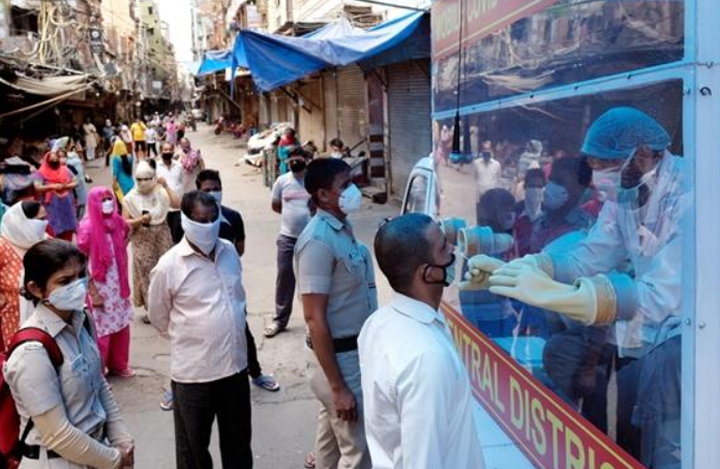
The novel coronavirus seemed like a distant problem in Boisar, a small factory town about two hours from Mumbai, until Daniel Tribhuvan died.
The 35-year-old tutor started feeling feverish in April, while bringing his father home from a chemotherapy appointment in the Indian financial capital. When a test confirmed Tribhuvan was infected, the local health system’s reaction was shambolic. After he checked into a public hospital, the first thing they did was try to pawn him off to a private facility in Mumbai. The ambulance turned around halfway when they discovered he couldn’t pay. Back at the public hospital, a doctor didn’t see him for three days, and when an elderly man occupying a bed nearby died, his body wasn’t collected for 12 hours. After a week, Tribhuvan’s blood-oxygen levels were dangerously low. He died on May 17, becoming Boisar’s first confirmed fatality from Covid-19.
“I think he would have survived if the system was good,” Samuel Tribhuvan, Daniel’s older brother, said in a recent interview at Boisar’s local administrative office, inside a rundown building that also houses a liquor store and a portrait studio. “This is the worst place where we could get the coronavirus.”
Six months after the start of the pandemic—as the developed world tries to restore some semblance of normalcy—the virus is arriving with a vengeance in India’s vast hinterland, where 70% of its more than 1.3 billion citizens live. The country is now adding more than 80,000 confirmed infections per day, with about 71,000 deaths so far, numbers experts say are likely being under-counted. On Monday it galloped past Brazil to become the world’s second-biggest outbreak, a sobering preview of what could happen once the coronavirus spreads in earnest across other poor, densely populated places from Nigeria to Myanmar. With such a vast reservoir of potential hosts and minimal ability to contain infections, it seems inevitable that India will at some point overtake the U.S. to have the most cases globally.
The result is likely to be a human and economic catastrophe, risking untold numbers of deaths and the reversal of years of rising incomes and living standards—developments that helped lift millions of people from grinding poverty into something like the middle class. The broader effects won’t be confined to the subcontinent.
With a gross domestic product last year of almost $3 trillion, India is the world’s fifth-largest economy and a crucial node in global supply chains. Despite the troubled state of its own medical system, it is by far the largest producer of both vaccines and the generic drugs that healthcare systems around the world rely upon. And with Asia’s economic giant, China, turning increasingly inwards, companies from Wal-Mart Stores Inc. to Facebook Inc. had been investing heavily in India, betting on its rising consumer market. India’s trouble containing the virus, therefore, could weigh on any global recovery from the coronavirus—either epidemiological or economic.
With infections gathering pace, Prime Minister Narendra Modi is facing criticism for not doing more to help the state and local-level officials on the front lines of fighting the virus, who face an excruciating choice. Failing to stop its spread could mean the collapse of already-fragile healthcare systems, potentially leaving thousands to die untreated. But the distancing measures that most experts see as essential to doing so will worsen an economic contraction that’s already among the world’s most severe, making it even more difficult for India to resume its progress toward broader prosperity and hampering the global recovery. That could ultimately cause just as many deaths, whether from malnutrition, other infectious diseases, or even suicide.
As the virus spreads throughout India, “the most immediate thing that will happen is people will die,” said Vivekanand Jha, executive director of the Indian branch of the Sydney-based George Institute for Global Health. “The second is that the people who have not died will lose their livelihoods.
When Modi announced, on March 24, that his government would institute the broadest coronavirus lockdown in the world, many experts were impressed. Officially, there were only about 500 cases in India at the time, mainly in large cities and traceable to travelers from abroad. Stamping out the virus—or at least keeping it from spreading into the vast and vulnerable countryside—by decisively interrupting daily life for the entire nation seemed like a laudable goal.
But the dense slums that house large numbers of the urban poor proved particularly hospitable to the spread of the highly contagious pathogen. Meaningful social distancing was often impossible, while infections could spread widely before coming to the attention of healthcare workers. Government efforts largely failed to match the scale of the problem, with testing and contact tracing typically one step behind the virus. While officials procured ventilators, constructed field hospitals, and even converted train carriages into makeshift isolation units, hospitals in Mumbai and New Delhi were still overwhelmed. Patients were turned away for lack of beds and bodies were left unattended in corridors, conditions that developed-world cities like Milan managed to avoid at even the worst points in their outbreaks.
Meanwhile the economic toll of the lockdown, which Modi extended repeatedly as new case numbers remained stubbornly high, was mounting. GDP contracted by almost 24% between April and June, throwing more than 120 million people out of work. Unlike in the U.S. and Europe, there was little financial support available. The Reserve Bank of India’s index of consumer confidence collapsed in May, and then plunged to an all-time low in July, the most recent survey. For some, the situation was desperate. Five weeks into the lockdown, which was enforced by police and barred most people from leaving their homes except for groceries and medical care, a survey of rural households by Oxfam found that half had cut back on the number of meals they ate, and a quarter had been forced to ask others for food.
The biggest impact was on the millions of people from rural areas who staff factories, sell snacks, shine shoes, and do odd jobs of all kinds in India’s major cities. Dependent on daily wages to survive, many found themselves with no place to sleep and nothing to eat after their jobs disappeared, leaving them little choice but to return to their home towns. With trains and buses halted by the lockdown, some had to simply walk, forming columns on highways that were reminiscent of Partition, the bloody separation of India and Pakistan in 1947—and almost certainly spreading the virus across the countryside.
Faced with such desperation, Modi had little choice but to end the lockdown in early June, even as infections continued to rise. The “unlock,” as it came to be known, saw even more of these migrant workers return to their villages, seeding the new outbreaks now being seen in ever more remote parts of the country.
India has a large and innovative healthcare industry, but private operators are focused on big cities and the wealthier patients who live in them. In rural areas, medical care falls to the creaking public health system, which is often absurdly under-resourced.
Built on the side of a dirt highway in the Khair sub-district of Uttar Pradesh, one of India’s poorest states, a two-story community health center serves as the main source of care for a population of about 225,000. The modest facility has no intensive care unit, and when Bloomberg News visited early this month, its six oxygen cylinders had all been designated for use in ambulances. About 60 Covid-19 patients were in home isolation in Khair at the time; if one of them took a turn for the worse, the best the clinic could offer would be a ride to the nearest city, an hour’s drive away. “The district administration is trying to create new centers,” said Shailendra Kumar, the clinic’s manager. But for now, the increasing number of infected people in Khair can only hope the virus doesn’t hit them hard.
Uttar Pradesh has more than 200 million inhabitants, making it India’s most populous state. But its rural health system is the most understaffed in the country, with just 2.7 doctors for every 100,000 people. (The rate in the U.S. is a little under 10 times higher.) The numbers elsewhere aren’t much better. Only 40 percent of India’s physicians work in the countryside, even though it’s home to more than two-thirds of the population.
In the district that contains Boisar, the town where Tribhuvan died, “we do not have enough manpower to cater to this population,” Abhijit Khandare, a state health officer, said in an interview at a local community center. “We pulled manpower from other villages” to deal with spikes in Covid-19 cases, he said, “but now the other villages are affected too.”
In an attempt to fill the gap, local officials are even pressing teachers into service as healthcare aides. Schools remain closed due to the pandemic, but they provide a ready source of educated workers who are known in the community, an important factor in gaining trust. Last week, about 50 of them gathered in a brightly painted Boisar meeting room for a day of training. They were told their primary job would be to execute a strategy pioneered in Dharavi, a Mumbai slum where the virus was successfully brought under control in June.
The teachers would be going door-to-door through the district, asking whether anyone in a home had symptoms and referring those who did for testing. In addition to breaking chains of transmission, the goal is to get infected people treated early, avoiding the common problem of severely ill patients arriving too late for doctors to be able to help. The group had spent the day seated on plastic chairs in front of a panel of public health workers, being instructed on how to read an oximeter and social-distancing strategies for people who live in tight quarters.
While masks have become commonplace across India, physical distancing largely hasn’t, despite regular government campaigns and official reminders. In the countryside, markets where farmers and merchants gather to do business are still packed with people, and day laborers pile together into the back of small trucks to travel to job sites. Tea stalls and corner stores are doing little to prevent crowds forming.
In part, this may be a function of complacency about the dangers of Covid-19. With case numbers exploding, Modi’s government has been emphasizing India’s fatality rate—which at about 1.75% is among the lowest in the world—as evidence that it’s managing the disease successfully. Experts are skeptical, however, that deaths are being counted comprehensively, and even if they are, the relative youth of India’s population compared with virus hotspots like Italy or Florida is a likelier explanation. Relatively lax attitudes to distancing could also owe something to the fact that, even in a worst-case scenario, the coronavirus is just one on a long list of diseases that can kill a person in rural parts of the subcontinent. Some 79,000 Indians died last year from tuberculosis, an infection that’s now relatively rare in the developed world. A mother dies in childbirth roughly every 20 minutes. Even leprosy is still an active problem.
Meanwhile, fear of impoverishment is starting to outstrip fear of Covid-19, a trend exacerbated as migrant workers return to the cities. The lockdown and economic slump means many poor families have suffered a double blow: the loss of remittances, plus more mouths to feed at home.
Until the lockdown, 22-year-old Manoj Kumar earned about 14,000 rupees ($191) a month making car seats at a factory outside Delhi, sending almost everything he earned back to his family. But Kumar’s job disappeared in March and now he’s back in his village, about 150 kilometers (93 miles) from the capital, in a one-room house with nine other family members. The only person with a job is his mother, who earns about 6,000 rupees monthly as a part-time health worker. To survive, the family has had to borrow money at rates as high as 30%.
“Everyone is scared of corona,” Kumar said, sitting cross-legged on the floor of his home, where the family had used rows of low red bricks to demarcate the kitchen and a tiny sitting area. “We live in fear, but how long can we go on like this?”
The impact of this kind of financial strain is beginning to ripple across society. Delhi is recording higher rates of petty crime, while one mental health expert estimated suicides may have soared by as much as 70% nationwide. Unwanted pregnancies have spiked, child labor is on the rise, and activists warn that the scarcity of opportunity is intensifying caste and religious prejudices. That all of these trends derive, at least in part, from the response to the coronavirus, rather than the pathogen itself, highlights the precariousness of India’s situation. It’s one likely to play out elsewhere as the pandemic’s epicenter shifts to poorer nations, where the challenges of containing the virus will dwarf those of countries like the U.S.—and likely drag on the developed world’s ultimate recovery as well.
“Our concern here is the large population with limited resources to combat it—but that’s also a concern for the rest of the world,” said K. Srinath Reddy, president of the Public Health Foundation of India in New Delhi. “No country is safe until every country is safe. The virus can surge anywhere and then spring up anywhere else because the world is connected.”

Comments
Add new comment