



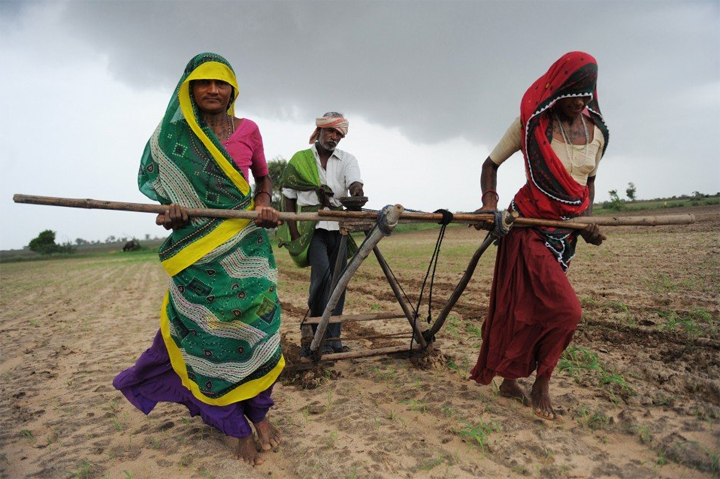
From small businesses to farmers, middle India is driving demand

News Network
November 29, 2020

farmers.jpg

New Delhi/Mumbai, Nov 29: Manish Mehra, owner of Washex Hospitality, an industrial laundry service, recently flew from Delhi to Jodhpur, a city in north-western India, to win a contract to service a large, government-run hospital - a move essential to kickstarting his business.

"For a new relationship it is essential to know each other before you can establish the trust and confidence to work online and that need is higher in case of government departments," said Mehra, who had to stay for a week in a Jodhpur hotel.

Increased demand for air travel and hotel stays by small business owners like Mehra, accompanied by a rise in rural incomes and spending after two good monsoons, is helping the pandemic-hit Indian economy slowly recover.

Government data released on Friday showed the economy shrank 7.5% in the July-September quarter, performing better than analysts' expectation of an 8.8% contraction as lockdowns were eased and some pent-up demand was met. In the April-June period, the economy shrank 23.9%.

Annual growth of 3.4% in farm sector and 0.6% in manufacturing during the September quarter has raised hopes of an early recovery and some service sectors such as trade, hotels and transport contracted at a much slower pace compared with the April-June period.

Farmers, benefiting from a bumper crop, are lapping up tractors while demand for personal vehicles, due to a lack of public transport and the need for safer travel options, has boosted sales of cars and motorcycles.

There has also been an uptick in goods and services, tax collections and higher energy consumption.

A recovery is taking shape and it has been led by the manufacturing sector which has moved from near annihilation in the July quarter to rebound mode, said Yuvika Singhal, an economist at QuantEco Research.

"Until there is a stronger recovery in high contact service sectors, which make up 60% of the GDP, agriculture and manufacturing are expected to carry the growth," said Singhal, adding that India is still growing on a lower GDP base and it will take more than a year to recover lost output.

Slow start for hotels and airlines

A string of Marriot hotels in industrial towns like Sriperumbudur, Visakhapatnam and Nasik are operating at 50% to 60% occupancy with the bulk of guests working with domestic manufacturing companies, said Ashish Jakhanwala, CEO of hospitality firm SAMHI which owns the properties.

Meanwhile SAMHI's hotel in the tech-city of Bengaluru, that mainly depends on large corporates, is filling only 20% to 30% of rooms.

"Demand from large corporates and international travel will take longer to recover. Hotels catering to public sector and infrastructure companies are doing better," said Jakhanwala.

Since the end of May, when the government lifted a ban on flights, monthly domestic passenger traffic has more than doubled from 2 million in June to over 5 million in October. But that is still down from about 12 million a year ago.

India's biggest carrier IndiGo and rival Vistara are seeing an uptick in business travel but to a much smaller extent than before.

"Much of it is from small and medium enterprises (SMEs) or small business owners who cannot afford to sit at home," said Vinod Kannan, chief commercial officer at Vistara, a joint venture between Singapore Airlines and Tata Group.

SMEs have contributed to a 35% to 40% recovery in hotel bookings compared with pre-Covid times and between 27% and 32% recovery in flights, according to online travel agency MakeMyTrip.

Rural revival robust

In the hinterlands, the impact of Covid-19 has not been as severe as in the big cities and farmers have benefited from good rainfall for two consecutive years leading to a bumper harvest and adequate conditions for winter-sown crops. This is driving up sales for tractor makers like Mahindra & Mahindra.

Lack of adequate and safe public transport in small towns and villages has also pushed up demand for cars and motorcycles.

Maruti Suzuki, India's biggest carmaker, had a 10% growth in rural sales between July and September versus a 4% rise overall, led by small, entry-level models, said Shashank Srivastava, executive director, marketing and sales.

"While Bharat (rural India) is leading India in terms of a recovery, it cannot carry India," he said, adding that steady, long-term demand will depend on improving economic factors, growing incomes and a rebound in urban markets.


Comments

Add new comment

  • Coastaldigest.com reserves the right to delete or block any comments.
  • Coastaldigset.com is not responsible for its readers’ comments.
  • Comments that are abusive, incendiary or irrelevant are strictly prohibited.
  • Please use a genuine email ID and provide your name to avoid reject.
News Network
December 7,2025

SHRIMP.jpg

Mangaluru, Dec 7: A rare bamboo shrimp has been rediscovered on mainland India more than 70 years after it was last reported, confirming for the first time the presence of Atyopsis spinipes in the country. The find was made by researchers from the Centre for Climate Change Studies at Sathyabama Institute of Science and Technology, Chennai, during surveys in Karnataka and Odisha.

The team — shrimp expert Dr S Prakash, PhD scholar K Kunjulakshmi, and Mangaluru-based researcher Maclean Antony Santos — combined field surveys, ecological assessments and DNA analysis to identify the elusive species. Their findings, published in Zootaxa, resolve decades of taxonomic confusion stemming from a 1951 report that misidentified the species as Atyopsis moluccensis without strong evidence.

The shrimp has now been confirmed at two locations: the Mulki–Pavanje estuary near Mangaluru and the Kuakhai River in Bhubaneswar. Historical specimens from the Andaman Islands, previously labelled as A. moluccensis, were also found to be misidentified and actually belong to A. spinipes.

The rediscovery began after an aquarium hobbyist in Odisha spotted a shrimp in 2022, prompting systematic surveys across Udupi, Karwar and Mangaluru. Four female specimens were collected in Mulki and one in Odisha, all genetically matching.

Researchers warn the species may exist in very small, vulnerable populations as freshwater habitats face increasing pressure from pollution, sand mining and infrastructure development. All verified specimens have been deposited with the Zoological Survey of India for future reference.

Comments

Add new comment

  • Coastaldigest.com reserves the right to delete or block any comments.
  • Coastaldigset.com is not responsible for its readers’ comments.
  • Comments that are abusive, incendiary or irrelevant are strictly prohibited.
  • Please use a genuine email ID and provide your name to avoid reject.
News Network
November 30,2025

The United Nations Committee against Torture (CAT) has condemned the Israeli regime for enforcing a policy of “organized torture” against Palestinians.

In a report published on Friday, CAT stated that the occupying regime enforces a deliberate policy of “organized and widespread torture and ill-treatment” against Palestinian abductees, particularly since October 7, 2023, when Israel launched its genocidal war on Gaza.

The committee expressed “deep concern over repeated severe beatings, dog attacks, electrocution, water-boarding, use of prolonged stress positions [and] sexual violence” inflicted on Palestinians.

Palestinian prisoners were degraded by “being made to act like animals or being urinated on,” systematically denied medical care, and subjected to excessive restraints, “in some cases resulting in amputation,” the report added.

CAT also condemned the routine application of “unlawful combatants law” to justify the prolonged detention without trial of thousands of Palestinian men, women, and children.

More than 10,000 Palestinians, including women and children, are currently held in Israeli prisons, according to Palestinian and international human rights groups, with 3,474 Palestinians in “administrative detention,” meaning they are imprisoned without trial for indefinite periods.

The report highlighted the “high proportion of children who are currently detained without charge or on remand,” noting that while Israel sets the age of criminal responsibility at 12, even younger children have been abducted.

Children designated as security prisoners face severe restrictions on family contact, may be subjected to solitary confinement, and are denied access to education, in clear violation of international law.

The committee further suggested that Israel’s policies across the Occupied Territories constitute collective torture against the Palestinian population.

“A range of policies adopted by Israel in the course of its continued unlawful presence in the Occupied Palestinian Territory amounts to cruel, inhuman or degrading living conditions for the Palestinian population,” the report said.

On Thursday, the Palestinian resistance movement Hamas condemned the systematic killing and torture of Palestinian abductees in Israeli prisons, urging international action to halt these abuses.

Citing human rights data, Hamas stated that 94 Palestinians have been killed in Israeli prisons since the start of Tel Aviv’s genocidal war on Gaza.

“This reflects an organized criminal approach that has turned these prisons into direct killing grounds to eliminate our people,” the resistance movement said.

Hamas called on the international community, the UN, and human rights organizations to immediately pressure Israel to end crimes against prisoners and uphold their rights as guaranteed by all international conventions and norms.

Comments

Add new comment

  • Coastaldigest.com reserves the right to delete or block any comments.
  • Coastaldigset.com is not responsible for its readers’ comments.
  • Comments that are abusive, incendiary or irrelevant are strictly prohibited.
  • Please use a genuine email ID and provide your name to avoid reject.
News Network
December 4,2025

indigoflight.jpg

Domestic carrier IndiGo has cancelled over 180 flights from three major airports — Mumbai, Delhi and Bengaluru — on Thursday, December 4, as the airline struggles to secure the required crew to operate its flights in the wake of new flight-duty and rest-period norms for pilots.

While the number of cancellations at Mumbai airport stands at 86 (41 arrivals and 45 departures) for the day, at Bengaluru, 73 flights have been cancelled, including 41 arrivals, according to a PTI report that quoted sources.

"IndiGo cancelled over 180 flights on Thursday at three airports-Mumbai, Delhi and Bengaluru," the source told the news agency.

Besides, it had cancelled as many as 33 flights at Delhi airport for Thursday, the source said, adding, "The number of cancellations is expected to be higher by the end of the day."

The Gurugram-based airline's On-Time Performance (OTP) nosedived to 19.7 per cent at six key airports — Delhi, Mumbai, Chennai, Kolkata, Bengaluru and Hyderabad — on December 3, as it struggled to get the required crew to operate its services, down from almost half of December 2, when it was 35 per cent.

"IndiGo has been facing acute crew shortage since the implementation of the second phase of the FDTL (Flight Duty Time Limitations) norms, leading to cancellations and huge delays in its operations across the airports," a source had told PTI on Wednesday.

Chaos continued at several major airports for the third day on Thursday because of the cancellations.

A spokesperson for the Kempegowda International Airport (KIA) in Bengaluru said that 73 IndiGo flights had been cancelled on Thursday.

At least 150 flights were cancelled and dozens of others delayed on Wednesday, airport sources said, leaving thousands of travellers stranded, according to news agency Reuters.

The Directorate General of Civil Aviation (DGCA) has said it is investigating IndiGo flight disruptions and has asked the airline to submit the reasons for the current situation, as well as its plans to reduce flight cancellations and delays.

It may be mentioned here that the pilots' body, Federation of Indian Pilots (FIP), has alleged that IndiGo, despite getting a two-year preparatory window before the full implementation of new flight duty and rest period norms for cockpit crew, "inexplicably" adopted a "hiring freeze".

The FIP said it has urged the safety regulator, the DGCA, not to approve airlines' seasonal flight schedules unless they have adequate staff to operate their services "safely and reliably" in accordance with the New Flight Duty Time Limitations (FDTL) norms.

In a letter to the DGCA late on Wednesday, the FIP urged the DGCA to consider re-evaluating and reallocating slots to other airlines, which have the capacity to operate them without disruption during the peak holiday and fog season if IndiGo continues to "fail in delivering on its commitments to passengers due to its own avoidable staffing shortages."

Comments

Add new comment

  • Coastaldigest.com reserves the right to delete or block any comments.
  • Coastaldigset.com is not responsible for its readers’ comments.
  • Comments that are abusive, incendiary or irrelevant are strictly prohibited.
  • Please use a genuine email ID and provide your name to avoid reject.