



Spillover effects of developed nations' policies hurting our countries: Indian FM

Agencies
October 16, 2022

During the just concluded annual meetings of the International Monetary Fund and the World Bank, several countries including India expressed concern over the spillover effects of political and economic decisions of developed nations, Union Finance Minister Nirmala Sitharaman said.

The Minister said she raised the issue prominently during her meetings here.

Earlier this week, Ms. Sitharaman had said that in the near-term, advanced nations must take responsibility for the global spillover of their political and economic decisions and put in place safety nets rather than impose sanctions on nations who are merely fulfilling their moral and democratic obligations for their people.

Her remarks came in the wake of the push by the U.S.-led western countries to reduce their oil purchase from Russia and warning to other nations that they would face sanctions if they continued to do so.

In an interaction with a group of Indian reporters here on Saturday, she said she raised the issue during her bilateral and multilateral meetings as well.

"I repeated it in some of the meetings inside as well," she said in response to a question.

"I didn't particularly notice any one minister and their reaction but I did say this. And incidentally, at a different meeting, Sri Mulyani (Indrawati, Finance Minister of Indonesia) also voiced it. Maybe one or two of the countries also voiced it. If I'm not mistaken, maybe the finance minister from Nigeria also voiced it," she said.

"There are several others who said it as well... that the unintended consequences of certain action taken, or the spillover (effects) of policies is definitely hurting our countries," she added.

Ms. Sitharaman is on a six-day visit to the U.S., which began on October 11. Besides attending the annual meetings of the IMF and the World Bank, she held bilateral meetings with her counterparts from several countries during the visit.

Comments

Add new comment

  • Coastaldigest.com reserves the right to delete or block any comments.
  • Coastaldigset.com is not responsible for its readers’ comments.
  • Comments that are abusive, incendiary or irrelevant are strictly prohibited.
  • Please use a genuine email ID and provide your name to avoid reject.
News Network
November 22,2025

gaza.jpg

The Israeli regime’s forces have killed two Palestinian children in the Gaza Strip every day since the ceasefire began in early October, UNICEF has warned.

The UN children’s agency said on Friday that Israeli forces continue to attack Palestinians in Gaza even though the agreement was meant to stop the killing.

“Since 11 October, while the ceasefire has been in effect, at least 67 children have been killed in conflict-related incidents in the Gaza Strip. Dozens more have been injured. That is an average of almost two children killed every day since the ceasefire took effect,” UNICEF spokesperson Ricardo Pires said in Geneva, reminding that each number in the statistics represents a child whose life had ended violently.

“These are not statistics,” he said. “Each child had a story, a family, and a future that was stolen from them.”

Data from Palestinian factions, human rights groups, and government bodies recorded since the US-brokered ceasefire deal went into effect on October 10 show that Israeli forces have carried out numerous attacks, each constituting a separate ceasefire violation.

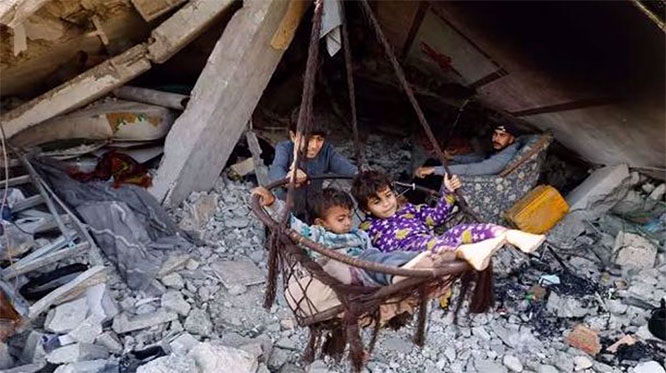
UNICEF teams say they repeatedly continue to witness heart-wrenching scenes of fearful Palestinian children sleeping outdoors with amputated limbs, while others live as orphans in flooded, makeshift shelters.

“I saw this myself in August. There is no safe place for them. The world cannot normalize their suffering,” Pires said, lamenting that the UN could “do a lot more if the aid that is really needed was entering faster.”

The UNICEF spokesperson warned that with the advent of winter, the risks for hundreds of thousands of displaced children will increase.

He warned, “The stakes are incredibly high” for children as winter acts as a threat multiplier, where children have no heating, no insulation, and few blankets. He said respiratory infections rise.

“Too many children have already paid the highest price,” Pires said. “Too many are still paying it, even under a ceasefire. The world promised them it would stop and that we would protect them.”

“Now we must act like it,” the UNICEF spokesperson added.

Since the Israeli regime launched its genocidal war against Palestinians in Gaza in October 2023, it has killed nearly 70,000 people in the territory, most of them women and children, and injured over 170,000 more, while reducing most of the structures in the enclave to rubble.

Comments

Add new comment

  • Coastaldigest.com reserves the right to delete or block any comments.
  • Coastaldigset.com is not responsible for its readers’ comments.
  • Comments that are abusive, incendiary or irrelevant are strictly prohibited.
  • Please use a genuine email ID and provide your name to avoid reject.