'Sticky bombs' in heavily-militarized Kashmir sets off alarm bells

Agencies
February 28, 2021

Arrival of 'Sticky Bombs' in Indian Kashmir Sets off Alarm Bells | World  News | US News

Srinagar, Feb 28: Security forces battling a decades-long insurgency in Indian-controlled Kashmir are alarmed by the recent arrival in the disputed region of small, magnetic bombs that have wreaked havoc in Afghanistan.

"Sticky bombs", which can be attached to vehicles and detonated remotely, have been seized during raids in recent months in the federally administered region of Jammu and Kashmir, three senior security officials told Reuters.

"These are small IEDs and quite powerful," said Kashmir Valley police chief Vijay Kumar, referring to improvised explosive devices. "It will certainly impact the present security scenario as volume and frequency of vehicular movements of police and security forces are high in Kashmir Valley."

The Indian government flooded Kashmir, already one of the world's most militarised regions, with more troops in August 2019, when it split the country's only Muslim-majority state into two federally administered territories.

The arrival of the sticky bombs in India-controlled Kashmir - including 15 seized in a February raid - raises concerns that an unnerving tactic attributed to the Taliban insurgents in nearby Afghanistan could be spreading to the India-Pakistan conflict.

Afghanistan in recent months has seen a series of sticky-bomb attacks targeting security forces, judges, government officials, civil society activists and journalists. The attacks - some as victims sat in traffic - have sown fear, while avoiding substantial civilian casualties.

None of the devices seized in Kashmir was produced there, a senior security official said, suggesting they were being smuggled from Pakistan. "All of them have come via drone drops and tunnels," he said, asking not to be named.

Kashmir has long been a flashpoint between nuclear-armed neighbours India and Pakistan, which each claim all of the Himalayan region but rule only parts of it.

India accuses Pakistan of backing the insurgency in Kashmir, which has claimed tens of thousands of lives since the 1990s. Pakistan denies the charge, saying it gives only moral and diplomatic support to Kashmiri people fighting for self-determination.

New Delhi has attempted to maintain a tight grip over the Kashmir Valley, where high-speed mobile internet was suspended for 18 months until earlier in February, but the insurgency has simmered on.

Officials said the bombs are particularly worrying because they can be easily attached to vehicles using magnets, potentially allowing militants to carry out assassinations or target military convoys that regularly criss-cross the valley.

In February 2019, a suicide bomber drove a car laden with explosives into a convoy in Kashmir's Pulwama, killing 40 soldiers - the deadliest attack on Indian forces in the region - bringing India and Pakistan to the brink of another war.

Police chief Kumar said that security forces were changing protocols to deal with the new threat. The measures included increasing the distance between private and military traffic, installing more cameras on vehicles and using drones to monitor convoys.

A difference between militants in Kashmir and Afghanistan is that the Taliban have tremendous ability to move around in urban and rural areas, which, along with the easier availability of explosives, make the bombs a potent threat.

The Taliban, which initially said it was behind some of the attacks, has since denied any involvement in the attacks.

"The Taliban has targets, can reach them, and kill them with impunity. The whole structure of the attack - and its endless repetition - is what makes the bomb effective," said Avinash Paliwal, a senior lecturer in international relations at SOAS University of London.

"In Kashmir, the space for such ability to manoeuvre with ease is limited."

Comments

Add new comment

  • Coastaldigest.com reserves the right to delete or block any comments.
  • Coastaldigset.com is not responsible for its readers’ comments.
  • Comments that are abusive, incendiary or irrelevant are strictly prohibited.
  • Please use a genuine email ID and provide your name to avoid reject.
News Network
November 22,2025

gaza.jpg

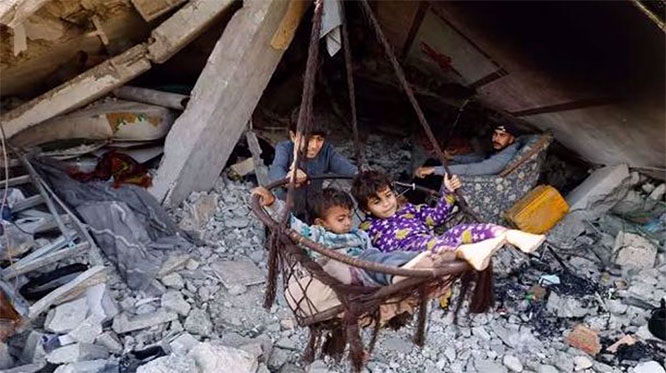
The Israeli regime’s forces have killed two Palestinian children in the Gaza Strip every day since the ceasefire began in early October, UNICEF has warned.

The UN children’s agency said on Friday that Israeli forces continue to attack Palestinians in Gaza even though the agreement was meant to stop the killing.

“Since 11 October, while the ceasefire has been in effect, at least 67 children have been killed in conflict-related incidents in the Gaza Strip. Dozens more have been injured. That is an average of almost two children killed every day since the ceasefire took effect,” UNICEF spokesperson Ricardo Pires said in Geneva, reminding that each number in the statistics represents a child whose life had ended violently.

“These are not statistics,” he said. “Each child had a story, a family, and a future that was stolen from them.”

Data from Palestinian factions, human rights groups, and government bodies recorded since the US-brokered ceasefire deal went into effect on October 10 show that Israeli forces have carried out numerous attacks, each constituting a separate ceasefire violation.

UNICEF teams say they repeatedly continue to witness heart-wrenching scenes of fearful Palestinian children sleeping outdoors with amputated limbs, while others live as orphans in flooded, makeshift shelters.

“I saw this myself in August. There is no safe place for them. The world cannot normalize their suffering,” Pires said, lamenting that the UN could “do a lot more if the aid that is really needed was entering faster.”

The UNICEF spokesperson warned that with the advent of winter, the risks for hundreds of thousands of displaced children will increase.

He warned, “The stakes are incredibly high” for children as winter acts as a threat multiplier, where children have no heating, no insulation, and few blankets. He said respiratory infections rise.

“Too many children have already paid the highest price,” Pires said. “Too many are still paying it, even under a ceasefire. The world promised them it would stop and that we would protect them.”

“Now we must act like it,” the UNICEF spokesperson added.

Since the Israeli regime launched its genocidal war against Palestinians in Gaza in October 2023, it has killed nearly 70,000 people in the territory, most of them women and children, and injured over 170,000 more, while reducing most of the structures in the enclave to rubble.

Comments

Add new comment

  • Coastaldigest.com reserves the right to delete or block any comments.
  • Coastaldigset.com is not responsible for its readers’ comments.
  • Comments that are abusive, incendiary or irrelevant are strictly prohibited.
  • Please use a genuine email ID and provide your name to avoid reject.
News Network
December 6,2025

pilot.jpg

New Delhi: IndiGo, India’s largest airline, faced major operational turbulence this week after failing to prepare for new pilot-fatigue regulations issued by the Directorate General of Civil Aviation (DGCA). The stricter rules—designed to improve flight safety—took effect in phases through 2024, with the latest implementation on November 1. IndiGo has acknowledged that inadequate roster planning led to widespread cancellations and delays.

Below are the key DGCA rules that affected IndiGo’s operations:

1. Longer Mandatory Weekly Rest

Weekly rest for pilots has been increased from 36 hours to 48 hours.

The government says the extended break is essential to curb cumulative fatigue. This rule remains in force despite the current crisis.

2. Cap on Night Landings

Pilots can now perform only two night landings per week—a steep reduction from the earlier limit of six.

Night hours, defined as midnight to early morning, are considered the least alert period for pilots.

Given the disruptions, this rule has been temporarily relaxed for IndiGo until February 10.

3. Reduced Maximum Night Flight Duty

Flight duty that stretches into the night is now capped at 10 hours.

This measure has also been kept on hold for IndiGo until February 10 to stabilize operations.

4. Weekly Rest Cannot Be Replaced With Personal Leave

Airlines can no longer count a pilot’s personal leave as part of the mandatory 48-hour rest.

Pilots say this closes a loophole that previously reduced actual rest time.

Currently, all airlines are exempt from this rule to normalise travel.

5. Mandatory Fatigue Monitoring

Airlines must submit quarterly fatigue reports along with corrective actions to DGCA.

This system aims to create a transparent fatigue-tracking framework across the industry.

The DGCA has stressed that these rules were crafted to strengthen flight safety and align India with global fatigue-management standards. The temporary relaxations are expected to remain until February 2025, giving IndiGo time to stabilise its schedules and restore normal air travel.

Comments

Add new comment

  • Coastaldigest.com reserves the right to delete or block any comments.
  • Coastaldigset.com is not responsible for its readers’ comments.
  • Comments that are abusive, incendiary or irrelevant are strictly prohibited.
  • Please use a genuine email ID and provide your name to avoid reject.
News Network
December 4,2025

Mangaluru: Chaos erupted at Mangaluru International Airport (MIA) after IndiGo flight 6E 5150, bound for Mumbai, was repeatedly delayed and ultimately cancelled, leaving around 100 passengers stranded overnight. The incident highlights the ongoing country-wide operational disruptions affecting the airline, largely due to the implementation of new Flight Duty Time Limitations (FDTL) norms for crew.

The flight was initially scheduled for 9:25 PM on Tuesday but was first postponed to 11:40 PM, then midnight, before being cancelled around 3:00 AM. Passengers expressed frustration over last-minute communication and the lack of clarity, with elderly and ailing travellers particularly affected. “Though the airline arranged food, there was no proper communication, leaving us confused,” said one family member.

An IndiGo executive at MIA cited the FDTL rules, designed to prevent pilot fatigue by limiting crew working hours, as the cause of the cancellation. While alternative arrangements, including hotel stays, were offered, about 100 passengers chose to remain at the airport, creating tension. A replacement flight was arranged but also faced delays due to the same constraints, finally departing for Mumbai around 1:45 PM on Wednesday. Passengers either flew, requested refunds, or postponed their travel.

The Mangaluru delay is part of a broader crisis for IndiGo. The airline has been forced to make “calibrated schedule adjustments”—a euphemism for widespread cancellations and delays—after stricter FDTL norms came into effect on November 1.

While an IndiGo spokesperson acknowledged unavoidable flight disruptions due to technology issues, operational requirements, and the updated crew rostering rules, the DGCA has intervened, summoning senior airline officials to explain the chaos and outline corrective measures.

The ripple effect has been felt across the country, with major hubs like Bengaluru and Mumbai reporting numerous cancellations. The Mangaluru incident underscores the systemic operational strain currently confronting India’s largest carrier, leaving passengers nationwide grappling with uncertainty and delays.

Comments

Add new comment

  • Coastaldigest.com reserves the right to delete or block any comments.
  • Coastaldigset.com is not responsible for its readers’ comments.
  • Comments that are abusive, incendiary or irrelevant are strictly prohibited.
  • Please use a genuine email ID and provide your name to avoid reject.