



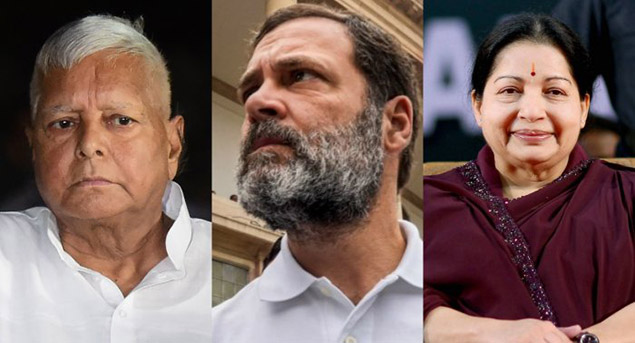
These MPs and MLAs were disqualified after conviction

News Network
March 24, 2023

MPMLA.jpg

Congress leader Rahul Gandhi who was suspended from Lok Sabha following his conviction in a criminal defamation case joins an ignominious list of members of Parliament and assemblies who faced similar action in the past.

According to the Representation of the People Act, a person sentenced to imprisonment of two years or more shall be disqualified "from the date of such conviction" and remain disqualified for another six years after serving time.

Here are some of the lawmakers suspended upon conviction and sentencing in criminal cases:

Lalu Prasad:

The RJD supremo was disqualified from the Lok Sabha after his conviction in the fodder scam case in September 2013. He was an MP from Saran in Bihar.

J Jayalalithaa:

AIADMK supremo J Jayalalithaa was disqualified from the Tamil Nadu Assembly in September 2014 after she was sentenced to four years in jail in a disproportionate assets case. She was the chief minister of Tamil Nadu at the time of her disqualification and had to resign from the post.

P P Mohammed Faizal:

Lakshadweep MP P P Mohammed Faisal of the Nationalist Congress Party stood automatically disqualified after he was sentenced to 10 years in jail in January 2023 in connection with an attempt to murder case. However, the Kerala High Court later suspended his conviction and sentence. According to the MP, the Lok Sabha Secretariat is yet to issue a notification revoking his disqualification.

Azam Khan:

Samajwadi Party leader Azam Khan was disqualified from the Uttar Pradesh Assembly in October 2022 after a court sentenced him to three years in jail in a 2019 hate speech case. He represented Rampur Sadar in the Assembly.

Anil Kumar Sahni:

RJD MLA Anil Kumar Sahni was disqualified from the Bihar Assembly in October 2022 after he was sentenced to three years in jail in a case of fraud. He represented the Kurhani assembly seat.

He was held guilty of attempting to avail travel allowance in 2012 using forged Air India e-tickets without having undertaken the journeys. Sahni, who was a JD(U) Rajya Sabha MP at the time of the attempted fraud, had submitted claims of Rs 23.71 lakh.

Vikram Singh Saini:

BJP MLA Vikram Singh Saini was disqualified from the Uttar Pradesh Legislative Assembly with effect from October 2022 after he was sentenced to two years of imprisonment in a 2013 Muzaffarnagar riots case. Saini was an MLA from Khatauli in Muzaffarnagar.

Pradeep Chaudhary:

Congress MLA Pradeep Chaudhary was disqualified from the Haryana Assembly in January 2021 after he was sentenced to a three-year jail term in an assault case. He was an MLA from Kalka.

Kuldeep Singh Sengar:

Kuldeep Singh Sengar was disqualified from the Uttar Pradesh Assembly in February 2020 following his conviction in a rape case. Sengar, who was elected from the Bangarmau constituency in Unnao, was earlier expelled by the BJP.

Abdullah Azam Khan:

Samajwadi Party MLA Abdullah Azam Khan was disqualified from the Uttar Pradesh Assembly in February 2023, days after a court sentenced him to two-year imprisonment in a 15-year-old case. He represented Suar in Rampur district in the Assembly.

The case against Abdullah Azam Khan, the son of Azam Khan, pertained to a dharna on a highway after his cavalcade was stopped by police for checking following an attack on a CRPF camp in Rampur on December 31, 2007.

Anant Singh:

RJD MLA Anant Singh was disqualified from the Bihar Assembly in July 2022 after being convicted in a case related to the recovery of arms and ammunition from his residence. Singh was an MLA from Mokama in Patna district.


Comments

Add new comment

  • Coastaldigest.com reserves the right to delete or block any comments.
  • Coastaldigset.com is not responsible for its readers’ comments.
  • Comments that are abusive, incendiary or irrelevant are strictly prohibited.
  • Please use a genuine email ID and provide your name to avoid reject.
News Network
February 3,2026

Bengaluru: Following reports of fresh Nipah virus (NiV) cases in West Bengal and heightened vigilance across parts of Southeast Asia, the Karnataka Health Department has placed the state on high alert and activated emergency preparedness protocols.

Health officials said enhanced surveillance measures have been initiated after two healthcare workers in Barasat, West Bengal, tested positive for the virus earlier this month. While no cases have been reported in Karnataka so far, authorities said the state’s past exposure to Nipah outbreaks and high inter-state mobility warranted preventive action.

Officials have directed district health teams to intensify monitoring, particularly at hospitals and points of entry, and to ensure early detection and isolation of suspected cases.

High Mortality Virus with Multiple Transmission Routes

Nipah virus is a zoonotic disease that can spread from animals to humans and has a reported fatality rate ranging between 60 and 75 per cent. Fruit bats, also known as flying foxes, are the natural reservoirs of the virus and can transmit it by contaminating food sources with saliva or urine.

Known modes of transmission include:

•    Contaminated food: Consumption of fruits partially eaten by bats or raw date-palm sap
•    Animal contact: Exposure to infected pigs or other animals
•    Human-to-human transmission: Close contact with body fluids of infected persons, particularly in healthcare settings

Symptoms and Disease Progression

The incubation period typically ranges from 4 to 14 days, though delayed onset has also been reported. Early symptoms often resemble common viral infections, making prompt clinical suspicion critical.

•    Initial symptoms: Fever, headache, body aches, fatigue, sore throat
•    Progressive symptoms: Drowsiness, disorientation, altered mental state
•    Severe stage: Seizures, neck stiffness and acute encephalitis, which can rapidly progress to coma

Public Health Advisory

The Health Department has issued precautionary guidelines urging the public to adopt risk-avoidance practices to prevent any local spillover.

Do’s
•    Wash fruits thoroughly before consumption
•    Drink boiled and cooled water
•    Use protective equipment while handling livestock
•    Maintain strict hand hygiene

Don’ts
•    Avoid fruits found on the ground or showing bite marks
•    Do not consume beverages made from raw tree sap, including toddy
•    Avoid areas with dense bat populations
•    Do not handle sick or dead animals

Preparedness Measures

Officials confirmed that isolation wards are being readied in major government hospitals and that medical staff are being sensitised to identify early warning signs.

“There is no cause for panic, but there is a need for heightened vigilance,” a senior health official said, adding that there is currently no approved vaccine or specific antiviral treatment for Nipah, and care remains largely supportive.

Comments

Add new comment

  • Coastaldigest.com reserves the right to delete or block any comments.
  • Coastaldigset.com is not responsible for its readers’ comments.
  • Comments that are abusive, incendiary or irrelevant are strictly prohibited.
  • Please use a genuine email ID and provide your name to avoid reject.
News Network
February 1,2026

Bengaluru: The Karnataka High Court has refused to quash an investigation against a WhatsApp group administrator accused of allowing the circulation of obscene and offensive images depicting Hindutva politicians and idols in 2021.

Justice M Nagaprasanna observed that, prima facie, the ingredients of the offence under Section 295A of the Indian Penal Code were made out. “The offence under Section 295A of the IPC is met to every word of its ingredient, albeit prima facie,” the judge said.

The petitioner, Sirajuddin, a resident of Belthangady taluk in Dakshina Kannada district, had challenged the FIR registered against him at the CEN (Cyber, Economics and Narcotics) police station, Mangaluru, for offences under Section 295A of the IPC and Section 67 of the Information Technology Act. Section 295A relates to punishment for deliberate and malicious acts intended to outrage the religious feelings of any class of citizens.

According to the complaint filed by K Jayaraj Salian, also a resident of Belthangady taluk, he received a WhatsApp group link from an unknown source and was added to the group after accessing it. The group reportedly had six administrators and around 250 participants, where obscene and offensive images depicting Hindu deities and certain political figures were allegedly circulated repeatedly.

Sirajuddin was arrested in connection with the case and later released on bail on February 16, 2021. He argued before the court that he was being selectively targeted, while other administrators—including the creator of the group—were neither arrested nor investigated. He also contended that the Magistrate could not have taken cognisance of the offence under Section 295A without prior sanction under Section 196(1) of the CrPC.

Rejecting the argument, Justice Nagaprasanna held that prior sanction is required only at the stage of taking cognisance, and not at the stage of registration of the crime or during investigation.

The judge noted that the State had produced the entire investigation material before the court. “A perusal of the material reveals depictions of Hindu deities in an extraordinarily obscene, demeaning and profane manner. The content is such that its reproduction in a judicial order would itself be inappropriate,” the court said, adding that the material, on its face, had the tendency to outrage religious feelings and disturb communal harmony.

Observing that the case was still at the investigation stage, the court said it could not interdict the probe at this juncture. However, it expressed concern that the investigating officer appeared to have not proceeded uniformly against all administrators. The court clarified that if the investigation revealed the active involvement of any member in permitting the circulation of such content, they must also be proceeded against.

“At this investigative stage, any further observation by this Court would be unnecessary,” the order concluded.

Comments

Add new comment

  • Coastaldigest.com reserves the right to delete or block any comments.
  • Coastaldigset.com is not responsible for its readers’ comments.
  • Comments that are abusive, incendiary or irrelevant are strictly prohibited.
  • Please use a genuine email ID and provide your name to avoid reject.
News Network
January 23,2026

modIKERALA.jpg

Prime Minister Narendra Modi, during his visit to Thiruvananthapuram on Friday, January 23, indicated that the Bharatiya Janata Party (BJP) is aiming to expand its political footprint in Kerala ahead of the Assembly elections scheduled in the coming months.

Speaking at a BJP-organised public meeting, Modi drew parallels between the party’s early electoral gains in Gujarat and its recent victory in the Thiruvananthapuram Municipal Corporation. The civic body win, which ended decades of Left control, was cited by the Prime Minister as a possible starting point for the party’s broader ambitions in the state.

Recalling BJP’s political trajectory in Gujarat, Modi said the party was largely insignificant before 1987 and received little media attention. He pointed out that the BJP’s first major breakthrough came with its victory in the Ahmedabad Municipal Corporation that year.

“Just as our journey in Gujarat began with one city, Kerala’s journey has also started with a single city,” Modi said, suggesting that the party’s municipal-level success could translate into wider electoral acceptance.

The Prime Minister alleged that successive governments led by the Left Democratic Front (LDF) and the United Democratic Front (UDF) had failed to adequately develop Thiruvananthapuram. He accused both fronts of corruption and neglect, claiming that basic infrastructure and facilities were denied to the capital city for decades.

According to Modi, the BJP’s control of the civic body represents a shift driven by public dissatisfaction with the existing political alternatives. He asserted that the BJP administration in Thiruvananthapuram had begun working towards development, though no specific details or timelines were outlined.

Addressing the gathering at Putharikandam Maidan, Modi said the BJP intended to project Thiruvananthapuram as a “model city,” reiterating his party’s commitment to governance-led change.

The Prime Minister’s visit to Kerala also included the inauguration of several development projects and the flagging off of new train services, as the BJP intensifies its political outreach in the poll-bound state.

Comments

Add new comment

  • Coastaldigest.com reserves the right to delete or block any comments.
  • Coastaldigset.com is not responsible for its readers’ comments.
  • Comments that are abusive, incendiary or irrelevant are strictly prohibited.
  • Please use a genuine email ID and provide your name to avoid reject.